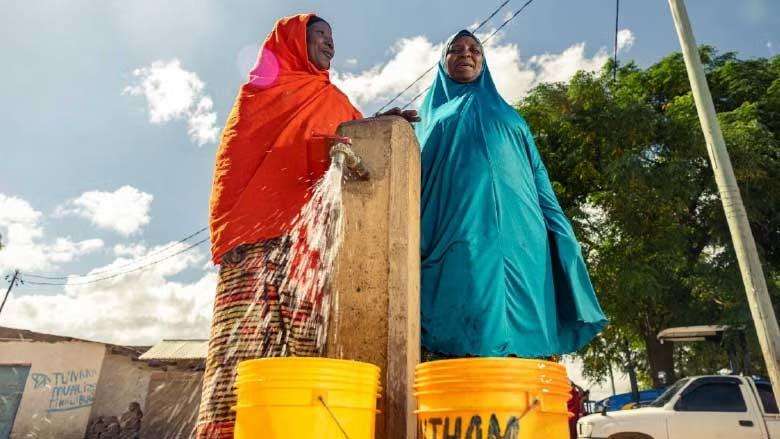
Kiperesa is among 11,628 villages in Tanzania that have recently gained access to clean water through the World Bank-financed Sustainable Rural Water Supply and Sanitation Program (SRWSSP).
The first phase of SRWSSP was implemented by the Government of Tanzania from 2019 to 2025 as part of its third Water Sector Development Program (WSDP-3), which combined infrastructure development and institutional reforms to improve water supply and sanitation services. The program aimed to expand rural water and sanitation services across the country while building local capacity to sustain them, ultimately supporting resilience and growth.
In rural areas, water schemes are managed by Community-Based Water Supply Organizations (CBWSOs), which are legally registered through the Rural Water Supply and Sanitation Agency to maintain the infrastructure and ensure clean water supply for households. Under the SRWSSP, these local organizations receive comprehensive training designed to equip them with the financial, technical, and governance skills needed to manage systems effectively and extend service connections to more homes.
One such organization is Kimwiche CBWSO, which serves the villages of Kiperesa, Mwitikira, and Chekanao. When Kimwiche took over the local water scheme in 2021, it managed just five water points. Expanding access quickly became its top priority. Using revenue from service payments, Kimwiche added 75 new water points across the three villages and reached a 70% rate of household connections in Chekanao alone.
“We launched the ‘Connect Water and Get One Unit Free’ campaign to encourage more people to bring water into their homes,” explains Upendo, Kimwiche CBWSO’s manager.
Having previously worked with two CBWSOs in Kondoa, Upendo was familiar with the challenges—but also with the solutions. With training and technical support from the Rural Water Supply and Sanitation Agency, she and her team were confident they could strengthen operations and sustain results.
Resourceful local management is a key measure of success for SRWSSP’s capacity-building efforts. Through focused training and mentorship, CBWSO members have gained the technical, financial, and managerial skills needed to operate water systems sustainably. Beyond managing the schemes, CBWSO leaders play an important role in raising community awareness about the benefits of clean and safe water, while encouraging residents to take ownership as active partners in maintaining their newly connected water systems.
These capacity building efforts have achieved visible impact across the area. Eight kilometers away from the Kiteto District Council, in Matui Ward, in rural Tanzania, a new water scheme managed by Bwamacha CBWSO now serves over 30,000 residents across three villages: Bwawani, Matui, and Chapakazi. When the scheme began operations in 2021, it only had 50 households and institutional connections. Following training under SRWSSP, that number has grown to more than 350.
Hamza Miraji, an accountant for the Bwamacha CBWSO in Matui, admits his understanding of operations was limited before the program. “In some situations, a customer would seek help, and with little knowledge, we failed to provide immediate assistance. This discouraged many,” said Hamza. “But I’m glad that with the capacity building, I can now solve issues promptly, sometimes even via phone calls since the line is always reachable.”
For residents like Sauda Nkusa, the impact has been life changing. “Before the arrival of these water points, we had to walk over one kilometer to get water from ponds, and sometimes we would fetch water two or three times a day,” she recalls. “With such long trips, it was difficult for many women like me to find time for other economic activities, but now, with water within reach, daily life has become easier and more productive. I can spend more time tending to my farm to be able to earn a little extra income, which was challenging before.”
Inspired by the results of SRWSSP and similar projects, the World Bank has recently launched the Water Forward Initiative, a diverse coalition of countries, financing institutions, technical agencies, philanthropies, and private-sector leaders committed to transforming water security at scale. Its ambitious objective is to improve water security for 400 million people by 2030, thus fostering food and energy supplies, supporting public health, and encouraging private investment, job creation, and long-term prosperity.
Reddit-runner on July 18th, 2026 at 05:30 UTC »
Good news?
Let's just hope this is done sustainable. And not done by drilling into an ever shrinking water table.
Puzzled-Hedgehog4984 on July 18th, 2026 at 03:50 UTC »
The water access number is huge, but the time returned might be even more important. When hours stop going into collecting water, they can start going into school, paid work, and basic rest.
ArgentineBeauty on July 17th, 2026 at 19:34 UTC »
"Women and girls who previously spent hours searching for water now have more time for education, farming, entrepreneurship and family responsibilities. Children arrive at school with greater confidence and improved attendance, while households benefit from better hygiene practices."
It amazing how something a lot of people take for granted can competely change someone elses life.
Hope they and other countries in same situation get to 100% soon.