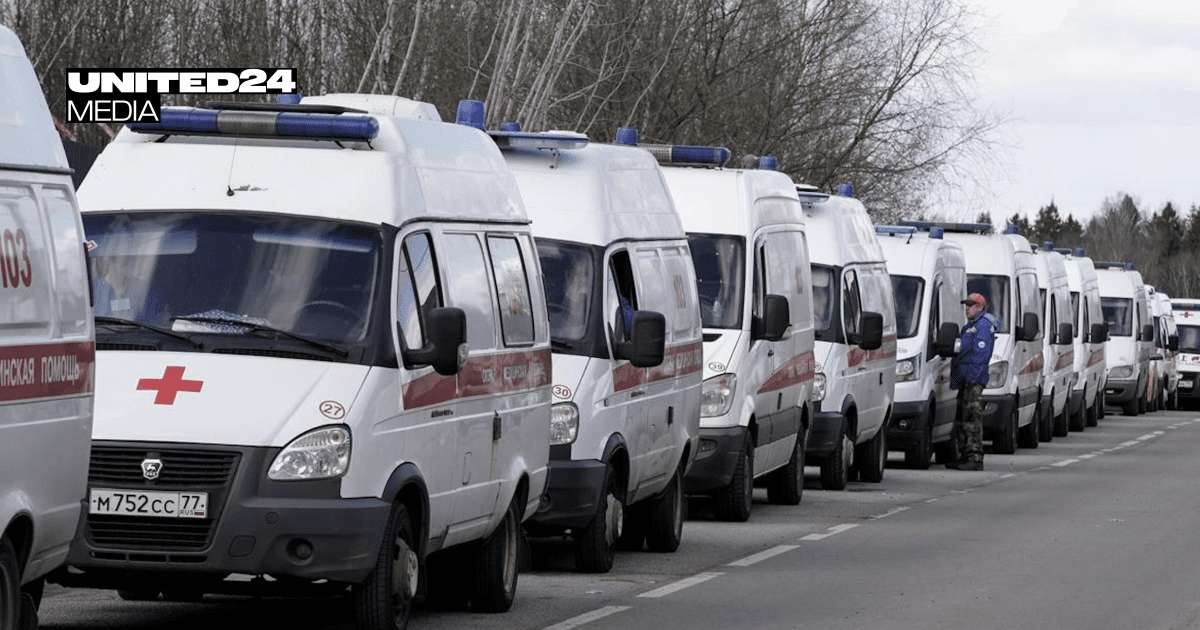
Russia's deepening fuel shortage has begun to cut hospitals, fire brigades, and municipal services off from the gasoline market, with state fuel tenders collapsing across the country.
This was reported by RBC-Ukraine on July 14, citing Russian media.
We bring you stories from the ground. Your support keeps our team in the field. DONATE NOW
In May and June, the number of canceled, unfulfilled, or re-announced fuel tenders for medical institutions, utilities, and emergency services tripled compared with the same period last year, the outlet noted.
The mechanism is straightforward. Suppliers no longer find it profitable to work under fixed-price state contracts, RBC-Ukraine explained.
While a tender is still being processed, fuel prices climb, so companies prefer to sell gasoline through retail networks or to commercial clients rather than bid for government business.
The outlet documented a series of failed purchases:
the Dynastia regional medical center in the Samara region found no bidder at all for 8,500 liters of AI-92 gasoline;
a purchase of 28,000 liters of AI-95 for the Daryna rehabilitation center in the Leningrad region collapsed for the same reason;
tenders held by the utility company Gorelektroset in the Vladimir region were declared void;
the fire and emergency rescue service in the Stavropol region re-announced its fuel tender several times before contracting a single supplier;
the Tuapse social services center in Krasnodar Krai secured fuel the same way.
This supply tightness stems directly from Ukraine's long-range drone strikes on Russian oil refineries, which have reduced national refining capacity and constrained domestic fuel supplies.
Fixed-price public contracts, drafted for a stable market, cannot accommodate price movements faster than the tender calendar. Hospitals, rescue services, and municipal fleets are now competing for gasoline against retail buyers.
RBC-Ukraine indicated that re-tendering continues, with public institutions increasingly being forced to sign with a single supplier, with no competition at all.
The collapse of public fuel tenders follows months of sustained pressure on Russia's refining sector.
More than 50 Ukrainian drone strikes have hit Russian energy infrastructure since March, idling roughly a third of the country's refining capacity.
Crude processing fell 25% year-on-year in June to 3.91 million barrels per day, the lowest level in more than two decades, while gasoline output dropped 17%.
Sales restrictions have spread to over 40 regions, and on July 9 Mordovia, the Nizhny Novgorod region, and Astrakhan began rationing gasoline by license plate number.
To cover the gap, Moscow bought 453,000 tons of Belarusian gasoline in the first half of 2026—twenty times the volume of a year earlier.
ZaphodG on July 14th, 2026 at 12:06 UTC »
Ukraine is just getting started with scaling up to attack Russian infrastructure. January/February will likely be quite dire in Moscow. No electricity. No heat. Food shortages. Crimea will be an indefensible island by then.
aicis on July 14th, 2026 at 11:06 UTC »
If only there was a way to prevent that.
ContentsMayVary on July 14th, 2026 at 10:38 UTC »
Russia will need to introduce some legislation to force the oil companies to supply the hospitals.
Or they could just, you know, get the fuck out of Ukraine.