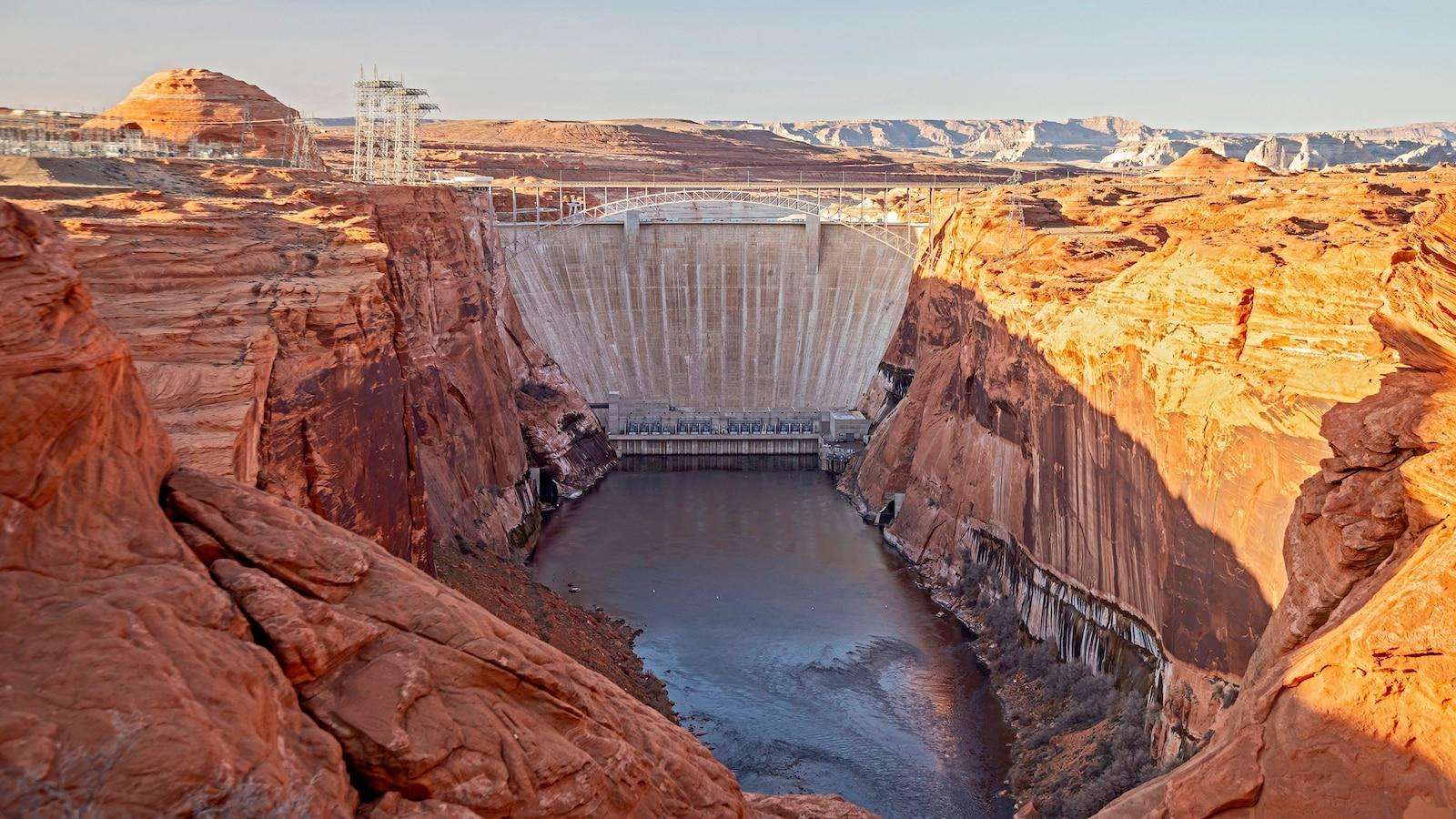
The reservoir is nearing the lowest point at which hydropower can be produced.
The downstream side of the Glen Canyon Dam. Lake Powell, the dam's reservoir, is only 27 percent full.
Lake Powell, the second-largest reservoir in the U.S., is nearing critically low water elevation levels, the latest data shows.
As of Monday, water levels at Lake Powell measured at 3,524.3 feet above sea level, according to the U.S. Bureau of Reclamation tracker.
Minimum, or "dead," power pool -- in which the water is too low to spin the hydroelectric turbines and can no longer produce hydropower -- starts at 3,490 feet of elevation, Peter Soeth, public affairs lead at the Bureau of Reclamation, told ABC News. Elevation at Lake Powell is currently about 34 feet above the minimum power pool.
The downstream side of the Glen Canyon Dam. Lake Powell, the dam's reservoir, is only 27 percent full. Jim West/UCG/Universal Images Group via Getty Images
Since the early 1960s, when Lake Powell initially was created by the completion of Glen Canyon Dam, the reservoir has never been lower than 5.26 million acre feet in live storage -- or the water that can flow by gravity from the reservoir through the various tubes and tunnels that can be used for reservoir release, Jack Schmidt, director of the Center for Colorado River Studies at Utah State University, told ABC News.
Lake Powell currently has about 5.52 million acre-feet of large storage and has lost about 4,800 acre-feet of water per day since June 1, Schmidt said.
Reservoir operations can get "very complicated" once elevation drops below 3,500 feet and live storage drops below 4.3 million acre-feet, Schmidt said. At that point, the Bureau of Reclamation would "be seriously concerned," he added.
The reservoir could reach a "dead pool" when its elevation drops to 3,370 feet, at which point water can no longer flow past Glen Canyon Dam by gravity.
In a dead pool, about 240 feet of water would be trapped at the bottom of the canyon, unable to flow to millions of people who rely on it in Arizona, California and Nevada, the Lake Powell Chronicle reported.
Full pool elevation is at 3,700 feet, according to the Lake Powell Water Database.
Water levels remain low at Lake Powell in Glen Canyon National Recreation Area on April 30, 2026, near Big Water, Utah. RJ Sangosti/MediaNews Group/The Denver Post via Getty Images
The Colorado River Basin is experiencing the impacts from the lowest snowpack on record, Soeth said.
Earlier this year, hydrology experts began warning that water levels in the Colorado River Basin would approach critically low levels due to the lack of snowpack over the winter months.
More than two-thirds of the West remains in drought, with much of the Colorado River Basin experiencing severe to extreme conditions, according to the U.S. Drought Monitor.
There could be some short-term relief in the near future. Above-average precipitation is favored across much of the West, according to the National Oceanic and Atmospheric Administration's Climate Prediction Center. Monsoon season and an intensifying El Niño are also underway and could bring more chances for rain to the region.
However, any additional precipitation will not offset the long-term factors driving water shortages like prolonged drought conditions and historically low seasonal snowpack, according to experts.
Water levels in Lake Powell are several hundred feet below full capacity at the Glen Canyon Dam on June 7, 2026 in Page, Arizona. George Frey/Getty Images
Water supplies in Lake Powell are currently dwindling dangerously close -- about 4 feet -- to the previous record set in April 2023 at 3,520 feet, driven by a decades-long megadrought. The rate of decline has leveled off in recent weeks, running around 2 feet higher than previous projections, which suggests that mitigation efforts could be helping somewhat.
In May, the Colorado River Basin Forecast Center projected that Lake Powell could drop to a new record-low level by July, based on expected inflow rates between April and July.
Experts predict that a new record-low could be reached at Lake Powell in August.
"If you do the simple math, it would suggest that Lake Powell will set a record for its lowest point in about a month and a half," Schmidt said.
Lake Mead, the largest reservoir in the country, is currently measuring at 1,042.8 feet above sea level -- just over 2 feet above its record-low level. It continues to steadily decline, with the water level dropping around 5 feet in June, Bureau of Reclamation data shows. Lake Mead could approach the record of 1,041 feet above sea level set in July 2022 by the end of the month.
The poor outlook for water supplies along the Colorado River system underscores the need for new operating guidelines, Soeth said.
The basin is severely over-allocated, experts say. The water rights were established during a period of the 20th century when water levels were "unusually high," Erica Fleishman, director of the Oregon Climate Change Research Institute, told ABC News in May.
Since the mid-21st century, runoff in the Colorado River Basin has been about 13 to 15% less than in the mid to late 20th century, Schmidt said. Year over year, the basin has experienced reduced supply, often combined with a string of very dry years, and the river system has never been able to adequately rebuild its supply.
"During those very dry years, we deplete reservoir storage because society is not able to reduce its use at the same rate that nature reduces its supply," Schmidt said.
The lower basin states have submitted an allocation plan for consideration, but there is not yet a consensus plan among all of the states, including the upper basin states, Dave White, director of the Global Institute of Sustainability and Innovation at Arizona State University, told ABC News.
If the states can't reach a negotiated agreement, the Bureau of Reclamation will need to intervene to make a final decision, Schmidt said.
"The Department and Reclamation remain committed to reducing the collective risk of both Lake Powell and Lake Mead falling below critical elevations to protect critical infrastructure so that it can continue to function as authorized to meet the water and hydropower needs of the basin," Soeth said.
The Bureau of Reclamation is set to release another update to the projections this week.
ABC News' Dan Peck contributed to this report.
Bad-job-dad on July 14th, 2026 at 01:43 UTC »
Who could have predicted this?
See: The Revelle and Waggoner Study (1983)
Responsible-Grand-57 on July 14th, 2026 at 01:40 UTC »
Sure seems to me like it’s time to revisit those “water rights” contracts? Every user of this waterway is screwed if entities keep using their “rights” to the fullest extent possible.
YodaForceGhost on July 14th, 2026 at 01:36 UTC »
Went to Lake Powell about a decade ago and there was concern from some tourism workers that the lake may not exist by 2030 or beyond. Looks like we’re at that point a few years early