Add AP News as your preferred source to see more of our stories on Google.
Add AP News on Google Add AP News as your preferred source to see more of our stories on Google. Share
MANILA, Philippines (AP) — The United States, the United Kingdom and a dozen other Western and Asian countries reasserted on Sunday that China’s expansive claims in the South China Sea are illegal based on a 2016 arbitration ruling.
A joint statement issued by the 14 nations said they rejected “destabilizing” actions in the disputed waters that threaten regional stability. The 27-nation European Union released a separate statement, reaffirming the ruling as a “landmark decision in the peaceful settlement of disputes.”
The statements commemorated a July 12, 2016, arbitration ruling by a tribunal established in The Hague under the United Nations Convention on the Law of the Sea, saying the landmark decision is “is final and legally binding.”
China reiterated Sunday that the ruling was “null and void and has no binding force” and Beijing “neither accepts nor recognizes it.”
China refused to join the arbitration initiated by the Philippines in 2013 after a tense standoff in the contested waters a year earlier that ended with Beijing effectively seizing a disputed shoal.
Beijing rejected the 2016 ruling and continues to defend its claims to virtually the entire sea passage, a key global trade route that has long been feared as one of Asia’s most active flashpoints. The areas has been the scene of repeated territorial standoffs involving China and the Philippines, Vietnam, Malaysia, Brunei and Taiwan.
“We reaffirm the Arbitral Tribunal’s decision that there is no legal basis for China’s expansive maritime claims in the South China Sea, including those based on `historic rights,’” the U.S.-led statement said.
The arbitration tribunal largely decided in favor of the Philippines, ruling then that under the U.N. Convention on the Law of the Sea, “there was no legal basis for China to claim historic rights to resources” in the South China Sea outside of its regular territorial areas recognized under the convention.
The convention, largely regarded as the treaty governing the world’s oceans and seas, took effect in 1994 and has been ratified by more than 170 countries and parties, including China and the Philippines.
In addition to the U.S. and Britain, the other countries listed in Sunday’s statement were the Philippines, Japan, Australia, New Zealand, Canada, Germany, Italy, Estonia, Latvia, Lithuania, Romania and Slovenia.
Sign up for Morning Wire: Our flagship newsletter breaks down the biggest headlines of the day. Email address Sign up By checking this box, you agree to AP's Terms of Use and acknowledge that AP may collect and use your data pursuant to our Privacy Policy
“We reiterate our strong opposition to any destabilizing or unilateral actions including by force or coercion that threaten peace and stability in the region,” they said.
The nations stressed “our strong opposition to the use of coast guard, military and maritime militia forces to harass, obstruct, intimidate lawful operations by other states at sea or in the air and in so doing endanger the safety of personnel and fishermen and seriously degrade regional peace and security.”
“Freedom of navigation and overflight as well as other internationally lawful uses of the sea as reflected in UNCLOS” must be upheld, the countries said, adding that the territorial disputes should be resolved peacefully based on the 1982 U.N. convention.
In Beijing, China’s Ministry of Foreign Affairs said the arbitration tribunal and its ruling “seriously contravene the general practice of international arbitration” and “gravely infringe upon China’s legitimate rights as a sovereign state and state party to UNCLOS and are unjust and unlawful.”
“China opposes and will never accept any claim or action based on those awards,” the Chinese foreign ministry said, adding that Beijing “does not accept any means of third-party dispute settlement or any solution imposed on China.”
Territorial confrontations in the disputed waters have become more prevalent in recent years, particularly between Chinese and Philippine and Vietnamese forces and fishing fleets.
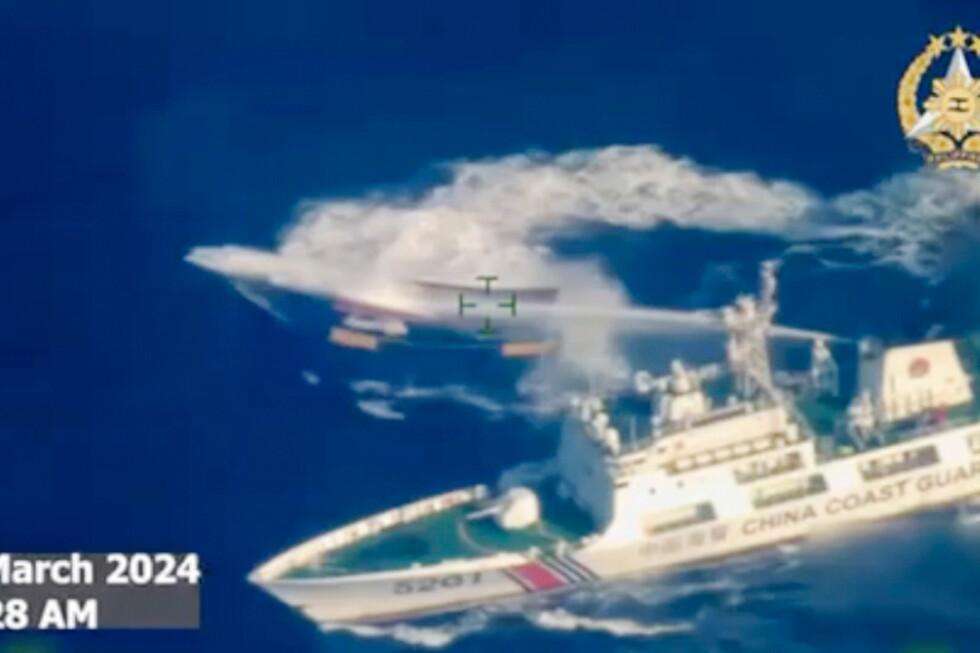
Chinese coast guard ships and support vessels have used powerful water cannons, military-grade lasers and dangerous blocking maneuvers against Philippine forces and fishermen from rival claimant countries that have led to collisions in the high seas and high-risk encounters in the air.
The United States has repeatedly called on China to comply with the arbitration ruling.
The former Biden and current Trump administrations both warned that Washington is obligated to defend the Philippines, its oldest treaty ally in Asia, if Filipino forces, vessels or aircraft come under armed attack in the disputed waters.
diffidentblockhead on July 12nd, 2026 at 10:10 UTC »
China has not tried to define what “historic rights” imply either.
China de-emphasized the dashed line after the 2016 ruling. The Foreign Ministry described it as merely an indication of which four “island groups” are claimed. The definitions of those groups are still problematic, but not as large as the dashed line area.
Many or most of the ship confrontations are not about issues covered in the arbitration, for example the Paracel baseline perimeter and internal waters claim, or the 12 mile territorial waters that the tribunal recognized around the disputed islands and rocks. Of the PRC Spratly bases only Mischief Reef was deemed not generating territorial waters.
The great irony is that the arbitrators carefully considered China’s interests and gave a ruling almost as favorable as possible to China, but the response from most nonexpert opinion in China has been generalized, unfocused whining that everyone is treating poor little China unfairly and China doesn’t have to listen to anyone.
Proper_Garbage9570 on July 12nd, 2026 at 08:25 UTC »
That targeting reticle aimed right at the China Coast Guard vessel pretty much says everything about why the ruling keeps getting cited.
Wooden-Evidence4792 on July 12nd, 2026 at 06:16 UTC »
SS: The US, UK, and 12 other nations (including the Philippines, Japan, Australia, Canada, Germany, and several EU states) jointly reaffirmed the landmark 2016 Hague arbitration ruling on the anniversary of its issuance, declaring China’s expansive “historic rights” claims in the South China Sea illegal under UNCLOS and rejecting Beijing’s continued destabilizing actions, water cannon attacks, and militia harassment. This coordinated diplomatic push—framed as upholding freedom of navigation in one of the world’s busiest trade routes—comes amid persistent standoffs with the Philippines and Vietnam. China predictably dismissed the statement, insisting the ruling is “null and void.”