The audio version of this article is generated by AI-based technology. Mispronunciations can occur. We are working with our partners to continually review and improve the results.
German shipbuilder ThyssenKrupp Marine Systems (TKMS) is Canada's preferred choice to build the navy's new fleet of submarines — a multibillion-dollar defence program that is expected to be the largest in the country's history.
Prime Minister Mark Carney's announcement dockside in Halifax on Monday put an end to long-running speculation about the future of the highly contested program which will determine the navy's future for decades.
Carney said the federal government will now enter into negotiations with TKMS to sign a contract, a process that will take several months.
"This project is about much more than acquiring submarines. It builds Canadian industrial capacity," he said.
WATCH | Carney makes sub announcement: Canada to buy 'up to 12' submarines from German shipbuilder | Duration 1:14 Prime Minister Mark Carney says Canada is negotiating to procure 'up to 12' submarines from German shipbuilder Thyssenkrupp Marine Systems. Speaking to reporters in Halifax on Monday, Carney called the reported $24-billion procurement the 'largest in Canadian history.'
"This government campaigned on the promise we would fix Canada's chronic defence procurement problems. Today's announcement is another important step in that direction."
Secretary of State for Defence Procurement Stephen Fuhr was also slated to be in Esquimalt, B.C., to reveal the decision to the West Coast navy.
The joint German-Norwegian bid was chosen over South Korea's Hanwha Ocean and Carney suggested there was hard bargaining ahead.
Oliver Burkhard, CEO of TKMS, said it was an "important day" for Canada, Germany and Norway.
"We stand ready to work alongside the government of Canada, Canadian industry and our partners in Germany and Norway to deliver a world-class submarine capability that will strengthen security, create economic opportunity and generate lasting benefits for future generations," Burkhard said in a news release.
Ottawa aims for contract by next year
A senior federal official, speaking on background aboard the prime minister's plane en route to Halifax, said they hope to conclude a contract by next year.
"In the event that negotiations with TKMS are unsuccessful, Canada retains the right to designate Hanwha's KSS-III, currently the reserve supplier, as the preferred supplier and enter negotiations with them," Carney said in his speech.
"This was a difficult, close decision between two highly qualified suppliers. Both the TKMS and Hanwha platforms met the capabilities of the Royal Canadian Navy, and both put forward strong proposals to maximize benefits for Canadian workers and businesses."
Almost a year ago, Carney announced the field of submarine bidders had been narrowed to two choices — the German-designed Type 212CD and the South Korean KSS-III. Both bidders and their governments were given until the spring to submit detailed bids and promises of economic offsets — proposals that could mean billions of dollars in investment in the Canadian economy.
The navy is looking for 12 submarines to replace its aging Victoria-Class fleet.
WATCH | Carney on economic benefits of TKMS deal: Canada to receive 'tens of billions in investments' as part of sub deal, Carney says | Duration 1:31 Prime Minister Mark Carney says Canada is set to receive 'tens of billions in investment' as part of a deal with Thyssenkrupp Marine Systems, the German shipbuilding company that won Canada's bid for new submarines. Carney said the investments 'will impact every region of the country.'
No overall price tag was revealed on Monday, even though the prime minister touted it as the single biggest defence procurement in Canadian history. A senior federal official said the cost will be determined through the contract negotiations.
It is believed, however, that the purchase of the submarines could run up to $24 billion. With lifetime maintenance and sustainment costs added, the overall program will likely hit $100 billion or more.
In its original pitch, TKMS committed to delivering four submarines to Canada by 2036, but the federal official said Monday that timeline could be advanced to 2034.
Carney signalled that he's committed to buy all 12 boats and said he's set aside money in the federal government's long-term fiscal framework.
HMCS Corner Brook passes an iceberg in Frobisher Bay on Aug 19, 2009. It is among the Victoria-Class subs due to be retired in the 2030s. (Adrian Wyld/The Canadian Press)
The choice to negotiate with a German shipbuilding company has far-reaching geostrategic implications, notably pulling Canada closer into Europe's orbit when the United States is pulling away from NATO.
The decision is bound to disappoint the South Koreans who have long felt that Canada looks more toward Europe than to the Indo-Pacific. Some analysts have suggested that the choice of the German-Norwegian bid could be a blow for Canadian ambitions and investment in Asia.
"As dynamic, reliable, like-minded democracies, Germany, Norway and the Republic of Korea are each critical strategic partners to Canada in this new world," Carney said.
"In the end, this decision was about choosing the absolute best platform and partnership to meet Canada's combined strategic, security and economic interests."
The prime minister is headed next to Ankara, Turkey, for the NATO summit, where Secretary General Mark Rutte has told allies they are expected to show up not only with a plan to meet the defence spending benchmark, but military capabilities.
The submarine deal is expected to be one of the highlights of Canada's presentation, along with the prime minister's plan to create a defence investment bank that will allow NATO countries easier access to capital for the arm-making industry.
"A strategic opportunity for Canada in the Indo-Pacific has been squandered," said former diplomat and soldier Marius Grinius, who has done five postings in the region.
"NATO solidarity in the face of Putin's aggression and Trump's unreliability is important. I would argue, however, that Canada's long-term economic and security interests lie in the Indo-Pacific."
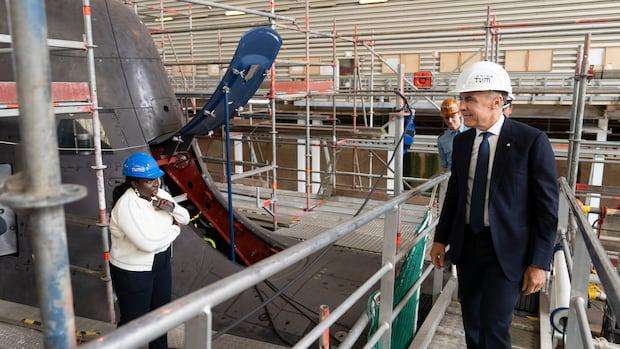
Carney looks over a 212A class submarine under maintenance as he tours a Thyssenkrupp Marine Systems (TKMS) facility last year. (Christinne Muschi/The Canadian Press)
But Carney said this decision doesn't mean Canada is stepping away from the region.
"We're very committed to the Indo-Pacific strategy," he said, noting that he had spoken to South Korean President Lee Jae Myung over the weekend.
"There are a series of other initiatives Canada and Korea are pursuing that build our economic resilience and security footprint."
Carney said that while he can see how the decision is "a disappointment" to the South Koreans, "we're moving forward with the relationship because there are so many things we can do together."
The plan has the potential to fundamentally reshape the Canadian navy. If all 12 boats are purchased, a full one-third to half of its fleet would be made up of subs.
While Canada had the world's third-largest navy after the Second World War, its complement of submarines was never that large.
Defence analyst Dave Perry said the decision will have an impact for decades.
"The selection today of TKMS as the preferred bidder is a huge step forward to acquire Canadian naval capability," said Perry, president of the Canadian Global Affairs Institute.
"It will give Canada a right sized fleet of modern submarines for the first time in generations."
During last year's election, the federal Liberals promised to move swiftly to rearm Canada in the face of increasing international conflict and tension.
While a contract still needs to be signed, Perry said the announcement "shows the government of Canada actually meant it when it said it was going to move much faster procuring military equipment for Canada.
"For a project of this size, the submarine buy has moved with astonishing speed."
gwelfguy on July 6th, 2026 at 21:33 UTC »
As a Canadian, I didn't have strong feelings about this one way or the other. The Germany-Norwegian offering represents better cross-Atlantic defence cooperation, both at the operational and industrial levels. The South Korean offering represented longer range submarines on a better delivery schedule.
Silicon_Knight on July 6th, 2026 at 21:24 UTC »
I’m glad a decision has been made so we can continue. I think as Carney said there are more negotiations to be had with Korea which is good too (as they are meeting in a few days).
I like seeing investments on our military and supporting NATO.
EDIT: and not endless faffing around. Make a decision. Otherwise we drag this shit on for decades.
postusa2 on July 6th, 2026 at 21:21 UTC »
Das aboot time.