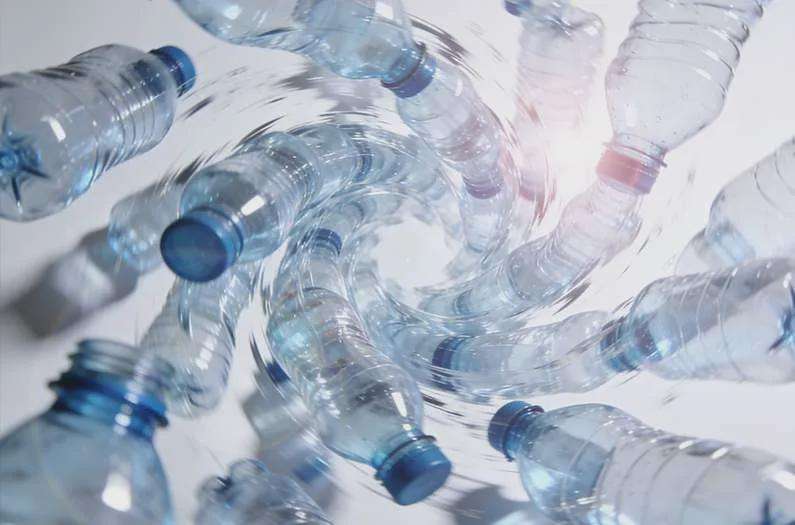
Hydrogen is a promising clean-burning fuel for trucks, ships, and airplanes. The global demand for hydrogen has nearly doubled over the past two decades. But most hydrogen today does not come from a green source, over 95% comes from natural gas or as a byproduct of petrochemical processes.
At the same time, the world faces the environmental crisis of plastic waste. Researchers at the University of Cambridge have now come up with a practical solution for both problems.
They have made a device that uses sunlight to break down plastic waste and turn it into hydrogen. And it’s not just a lab curiosity. The team made it using simple methods and materials, and have tested it outside in the sunlight. “Converting waste streams into valuable products using clean energy sources is…an attractive strategy to address both energy and environmental concerns,” they write in the journal Nature Chemical Engineering.
The idea isn’t brand new. Chemistry professor Erwin Reisner and his team has been working on a way to do it for several years. Three years ago, they developed a solar-powered reactor that turns carbon dioxide and plastic waste into fuels and useful chemicals.
That previous device relied on light-activated catalysts based on semiconductor materials. Making panels with such materials typically involves suspending the small particles in solution, depositing them onto a substrate and heating it. The process requires high temperatures and harsh chemicals, which limits scalability and increases cost and complexity. The older reactor was about 5 cm x 5 cm, and the researchers only tested it in the lab under simulated sunlight.
The new device is significantly larger—about one meter square—and the team has now tested it under natural sunlight outside Cambridge’s chemistry department. The researchers make the panels at room temperature using simple gear.
Using a common paint sprayer, they first spray the light-absorbing material onto a glass panel. Then they coat it with a second layer made of specially designed molecules containing cobalt and zirconium, which serve as the catalyst.
The reactor extracted hydrogen from cut-up plastic drink bottles, as well as from glucose and cellulose, which are found in plant biomass waste. Glucose produced the most hydrogen, while cellulose gave less.
The spray-coating method cuts the cost to produce the reactors significantly, which should make them easier to produce at scale. But the hydrogen right now is still too expensive. According to a press release, the researchers still need to improve the durability and efficiency of the reactors.
Source: Ariffin Bin Mohamad Annuar et al. Photoreforming of solid waste on 1 m2 scale using single-source precursor-derived co-catalyst films. Nature Chemical Engineering, 2026.
Imposter88 on July 6th, 2026 at 03:38 UTC »
Burps out hydrogen, but what else? I find it hard to believe hydrogen is the only byproduct
Orstio on July 6th, 2026 at 02:36 UTC »
There are a lot of heavy metals used in this process, and the upstream and downstream hazards of those, as well as the aluminum, are not addressed in the paper.
It sounds great to turn plastic into hydrogen, but if it poisons the earth and water in the process, it's worthless.
Chrono_Convoy on July 6th, 2026 at 02:27 UTC »
https://giphy.com/gifs/dyiOB0Zzwf4PY8fDii