This content can't be displayed right now. To view this embed, please accept targeting cookies. It's loaded from a third party and requires that permission to appear. Manage cookie preferences
Keith Krach was barely out of high school when the country celebrated its 200th birthday. He vividly remembers images of tall ships in New York Harbor, the Bicentennial Minutes that aired on CBS, and the fireworks by the Ambassador Bridge in Detroit. The war in Vietnam was over, Nixon was no longer in the White House, the energy crisis was nearing an end, and, for millions of Americans, the celebration was a welcome respite. “I saw a study that they did on 1976 where people who were young and had a really positive experience, they did some type of a mathematical correlation, and these people had more confidence and more pride in the United States,” Krach tells me from his home office in Washington, D.C., in a recent conversation.
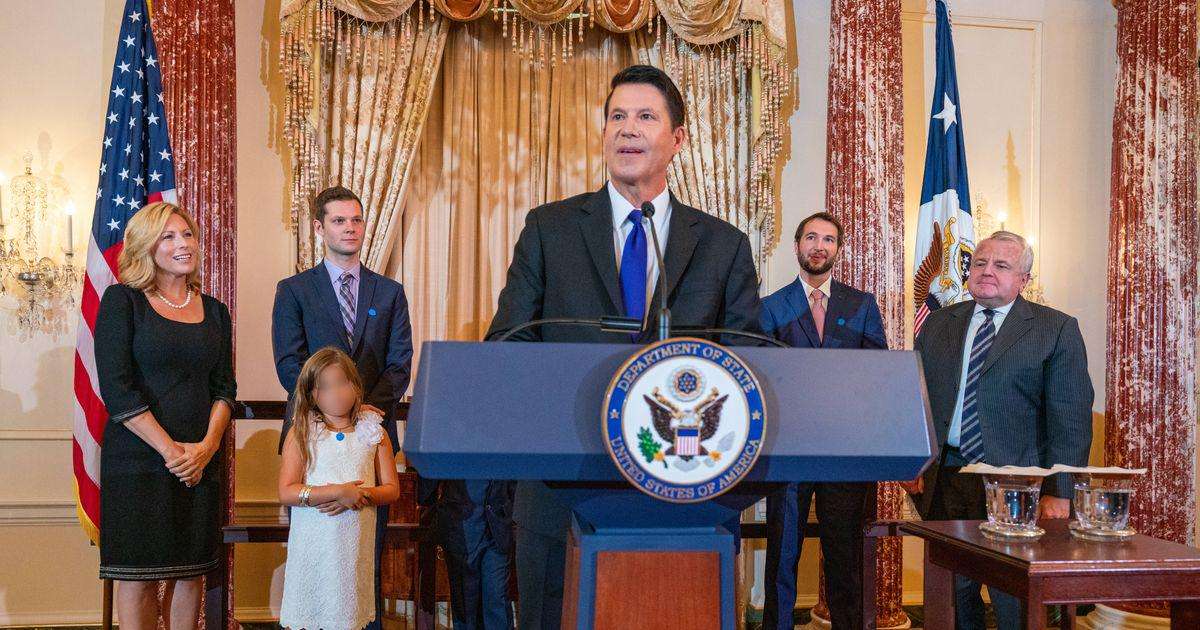
Krach (pronounced crock) is a youthful 69-year-old with a dark head of hair, an easy smile, and a net worth of hundreds of millions of dollars thanks in large part to the software companies Ariba and Docusign, which he led to lucrative IPOs. He’s the sort of unassuming tech executive who makes a point of attending his high-school reunion in Rocky River, Ohio, every five years — which is exactly where he was this past fall when he received a call from Vince Haley, President Donald Trump’s domestic-policy director. “He said, ‘Hey, would you be interested in running the American celebration?’” Krach says, his voice rising to an excited, high-pitched croak. “And I’m like, ‘Yeah, sure! I absolutely will.’ That sounded great! I didn’t know at that time all that it entailed.”
Technically, the country’s birthday celebration was already underway, but the president had decided that America250 — the nonpartisan, congressionally mandated commission formed in 2016 and charged with coordinating the semiquincentennial festivities — wasn’t cutting it. America250 had been given a decade to organize a program worthy of the occasion, and by 2025, it had little to show for it. Or at least the programming it had arranged — a Fourth of July celebration called America’s Block Party, a plan to bury a time capsule, and initiatives that encouraged volunteerism and charitable giving — was not the kind that Trump had in mind. So in December, Trump announced a new public-private partnership that would launch its own slate of “presidential level” events featuring more fireworks, more flyovers, and more Lee Greenwood. The new entity would be called Freedom 250, and, Trump promised, it would deliver “the most spectacular birthday party the world has ever seen.” Krach would be its CEO.
From the start, Freedom 250 was controversial. The new organization and its slighted sibling, American250, both claimed the right to spend money Congress had set aside for the celebration. The existence of two organizations was confusing, but more concerning was the opaque nature of Freedom 250’s private funding. In February, the New York Times published a slide deck that seemed to show the organization offering potential donors access to the president, raising questions about who exactly was giving money to the group and what they expected in return.
Then there was the programming itself. In May, Freedom 250 hosted Rededicate 250, a nine-hour rally on the National Mall with a lineup dominated by Evangelical Christian pastors and Trump officials who praised God and the president. At the same time, six tractor trailers, called “Freedom Trucks,” were dispatched across the country as mobile museums created by Hillsdale College and PragerU, a nonprofit media group that describes its mission as the promotion of Judeo-Christian values. The trucks’ displays include apocryphal moments that paint a Christian revisionist version of American history. One slide includes a dramatic anecdote about Peter Muhlenberg, an Anglican priest, ripping off his robes in front of his congregation in 1776 to reveal his colonel’s uniform before marching from his church to the sound of beating drums. Historians say the story is, at the very least, exaggerated. The trucks also displayed a tribute to prominent Americans that incorrectly claimed the late boxer Muhammad Ali had “disavowed” Islam. (A spokesperson for Freedom 250 told me this was an inadvertent error that has since been corrected.)
Krach was an unlikely choice to lead Freedom 250. He’s not a well-known figure in the MAGA-verse. He never contributed to Trump’s political campaigns, and there are no pictures of him with the president online. He is wealthy but not a member of the Palm Beach crowd. As a CEO, he says he proudly ran his companies “politically neutral,” a claim his friends back up. “He’s not politically active at all,” says Marc Carlson, Krach’s longtime friend and colleague. “Keith is sort of a born-joyful, servant-leader kind of guy. If you dropped him into any situation with 100 people, he’d be the leader of those hundred people.”
Nonetheless, Krach has suddenly been given a prominent platform and some measure of political capital. People close to Krach say that underneath his wholesome persona and rah-rah patriotism is a thoroughly ambitious person. “Keith Krach thinks he can be, and wants to be, president,” one former colleague tells me. He’s branded himself accordingly: His personal website is flooded with press from uncritical media chronicling his ascent in Silicon Valley and portraying him as a folksy, bootstrapping Midwesterner. The site features tabs like “Krachisms,” a page of motivational quotes, and “Mama Krach’s Korner,” a page dedicated to his late mother.
Behind the scenes, things look much different. As Krach tours America, speaking from country-fair stages, his soon-to-be ex-wife has accused him of abusing her and their young daughter. He denies these allegations. I ask him whether they might hinder his political ambitions. “Not one bit,” he says.
Krach tells his story the same way almost every time he’s asked. His childhood was humble and loving. When he wasn’t working at his father’s machine shop, he was tagging along with his mother, a physical-education teacher who coached wrestling at a nearby Catholic school. He left Rocky River for Purdue University, followed by Harvard, where he got his M.B.A. He took a job at GM in Detroit and became the vice-president of its robotics division at 26, the youngest VP in the company’s history. When he turned 30, he and his wife, Jennifer Secoy Krach, left for Silicon Valley, where Krach eventually co-founded Ariba. He held a large stake in the company when, in 1999, it went public. Shares tripled in value on the first day. Eventually, it sold for more than $4 billion.
In 2004, Krach and Jennifer divorced. About a year later, he met his second wife, Metta Grokenberger Krach, at a Sigma Chi event. Krach was serving as the brotherhood’s grand consul, the president of one of the largest fraternities in the country. Metta, a Georgetown Law graduate working at the Gap’s corporate headquarters, had been elected its International Sweetheart, the fraternity’s honorary female, in the late ’90s. Though Metta was 19 years younger than Krach, the two began dating and, in 2009, they married.
Later that year, Krach joined the board of Docusign, then a relatively small start-up. In 2011, Metta gave birth to twins, a boy and a girl. The timing was awkward — the company had just asked Krach to become CEO. Though the job wouldn’t leave much time for Krach to attend to their growing family, Metta encouraged him to take it. “She just goes, ‘All I know, Keith, is that every time you go to a Docusign board meeting, you’re so excited,’” he recounts in a video about the decision, which he posted to his YouTube account. “‘I’ve seen husband Keith, father Keith, Purdue Keith, Sigma Chi Keith. I’ve never seen CEO Keith. I’d love to see CEO Keith.’” Years later, he’d tell the same story in a Medium post titled “The First Lady of Docusign.” His wife was not only the reason he took the job, he writes — she was the reason he was able to do it so well. “She is the consummate first lady and has always been an unofficial sales team member,” he writes. “Metta spreads the DocuLove.” Metta was also the reason that he was able to have such a happy home life. “As she explains to our 5-year-old twins, ‘Daddy is working late because he is helping to give people jobs.’ For that, I get hugs and smiles of pride when I come home from working late nights, and that gives me the heart to put my foot on the gas.”
As CEO, Krach oversaw a rapid expansion, raising hundreds of millions of dollars. He was a hard-charging, ebullient CEO who mustered uncanny enthusiasm for a product that didn’t necessarily have the sex appeal of other start-ups. At conferences, Krach tried to fire up his employees, showing a Top Gun–style trailer of himself in a fighter jet or “docudancing” his way across the stage. His antics played well among employees, and he liked to show them a good time, surprising colleagues with “Krachtail hour.” But in 2015, Krach abruptly announced that he would be stepping down as CEO.
To his employees and the public, Krach’s exit appeared to be the result of a mutual decision. Privately, Metta alleges, he was reeling. According to a statement included in a 2024 application for a temporary restraining order in San Francisco County Superior Court — in which she accuses Krach of “coercive and violent control over me and our children” — the Docusign board was attempting to force him out as CEO. Metta describes this as “a profoundly devastating professional blow.” His negotiated exit allowed him to remain CEO until he hired a replacement, a process that took nearly two years, and to maintain his role as chairman of the board until 2019. But according to Metta, “Keith felt powerless, betrayed and often humiliated by his Board and was unable to manage this pain in a healthy manner.” He seemed to look for ways he could spin it publicly. “I think we’re at a place in life where it’s really time to give back and pay it forward,” he told Inside Philanthropy.
Throughout the transition, Metta says she watched as her husband changed. “He was irate, suffered from wild mood swings and frequent bouts of depression,” she alleged in her application. “He turned to unauthorized excessive use of prescription medication of multiple controlled substances and testosterone supplements. Due to his emotional trauma and misuse of medicine, he truly changed as a husband and friend before my very eyes and began to take out his anger and powerlessness on the one person closest to him and who knew the truth about all of it: me.” In her statement, Metta alleges that in January 2017, days before Krach officially ceded Docusign to a new CEO, he kicked her to the ground from behind. Metta considered leaving Krach but decided to draw a red line instead. She swore to call the police and divorce Krach if he was ever violent with her again. “Keith did not physically harm me again, but he berated me, screamed at me and emotionally tormented me on an increasingly regular basis through the remaining 7 years of our marriage,” she says in her statement. “I always believed that the only physical danger was to me, or else I never would have stayed in this abusive marriage and allowed my children to be in harm’s way.”
When asked about the allegation that he kicked his wife, Krach denies it. “I’m going through an obviously painful divorce,” he says. He also denies being verbally and emotionally abusive, misusing prescription drugs, and Metta’s description of his exit from Docusign. “All good,” he says, when I ask what he was feeling as he left the company. “We call it the Docufamily. But it was, you know — I had a tremendous opportunity to serve the country, and I wasn’t going to pass that over.”
After he left his job at Docusign, Krach took a trip to China that made him believe the U.S. was in trouble. “I saw a lot of things in China that really concerned me,” Krach says. “The guys with the best technology win the war.” About a week later, he went to Washington and met with Vice-President Mike Pence. According to Krach, Pence ended the meeting by asking whether he’d ever thought about serving his country. “That’s a dream I never knew I had,” Krach says he replied.
This was not entirely true. People close to Krach say that he occasionally wondered aloud whether he could be mayor, governor, or something higher. Even before he met with Pence, they say, he’d had his sights on a role in the Trump administration. Originally, he’d toyed with the idea of being ambassador to Australia. After Krach’s meeting with the vice-president, Trump nominated Krach to be Secretary of State Mike Pompeo’s under secretary for economic growth, energy, and the environment. Krach’s history of political neutrality was an asset — he could tell Democratic lawmakers with a straight face that he would not be a Trump lackey.
After the alleged kicking incident, Metta had been determined to make things work. “I was strong enough to stay and resolved that I could weather any storm if it meant I could stay with my children and protect and love them every day,” she writes in her application. She and the twins were seated behind Krach at his Senate confirmation hearing, where he recited his bootstrapping biography to great effect. The story resonated with Senator Tim Kaine, who had grown up working in his father’s welding shop. “Mr. Krach, I must tell you I have listened to many statements before our committee, and yours was one of the most impressive I have heard,” Democratic senator Ben Cardin said. The Senate unanimously confirmed him.
According to former State Department staffers, Krach brought in at least seven people from the private sector to mirror career staffers on his leadership team, a move that was at first viewed with skepticism. “We looked around the room and counted at least two billionaires and seven other folks who might as well have been,” says a career State Department staffer whom Krach quickly won over. “I was very leery about them early on, but they brought a completely different perspective that was helpful. I never saw in his office a political bent. Never. It was always what the substance was and how it could be improved.” Ultimately, State Department employees found Krach well suited for the job, which wasn’t so different from managing a large company.
Krach distinguished himself as an unabashed China hawk. He led a high-profile delegation that visited Taiwan, incensing the CCP, and he worked to convince foreign governments not to do business with Chinese telecommunications giant Huawei, which western intelligence widely considered a tool of China’s authoritarian surveillance state. Building on an idea that he had developed at Docusign, he began referring to the “trust principle,” the need for both private and public sectors to develop a “clean network” using “trusted technologies.” In 2020, he posted a video of himself standing next to a recently unveiled statue of Ronald Reagan at the U.S. Embassy in Berlin. “Mr. Xi,” he said. “Tear down China’s great firewall!”
At the State Department, Krach traveled often, pitching the clean network with a close-knit group of staffers. During COVID, they traveled together on a private jet that he paid for, and he occasionally invited his team to brainstorm around a fire pit on the balcony of the luxury apartment he rented on the Georgetown Waterfront. He had told Metta that he wouldn’t accept the job unless she and the kids moved with him, and, at first, that seemed to be the plan. They spent the summer in Georgetown, and the couple secured spots at an elite primary school. But in late summer Metta chose to bring the twins back to Pacific Heights. Their son had health issues, and she wanted to be near his doctors in San Francisco. “I had been sworn in, put my hand on the Constitution, the Bible, the flag, so, you know, there’s no way for me to back out,” Krach says. “The way I compensated for it, almost every night I would talk to the kids on FaceTime or play video games and all that.”
Metta alleges in her application that her decision to keep the kids in San Francisco enraged Krach. His political neutrality began to shift. When, in the run-up to the 2020 election, Krach’s daughter brought up the Electoral College, a subject she’d recently learned about in school, Metta alleges Krach called her “a fucking brainwashed Democrat.”
When Trump’s first term ended, Krach was once again out of a job. But this time he had a newfound passion — foreign policy. In 2022, a former State Department colleague reportedly nominated him for the Nobel Peace Prize, citing his “trust principle” framework. He posted the nomination across his website, on his LinkedIn profile, and in press releases. “He is a very effective marketer and brander,” Rob Noel, who served as Krach’s speechwriter at the State Department, told Politico. “So what may come off to others as self-promotional, that was really to him just part and parcel to the overall branding effort.” Indeed, Krach started branding the nascent field of tech diplomacy with his name. He pledged $25 million to Purdue University to open the Krach Institute for Tech Diplomacy, and in 2023, Antony Blinken presented the State Department’s inaugural Keith J. Krach Tech Diplomacy Award to an employee who facilitated a “trust network” with the Albanian government. Krach settled into the role of a credentialed diplomat hammering Chinese technology companies. He led the U.S.-Taiwan Business Council and wrote op-eds on the threat of Huawei. In 2023, he testified at a Montana House Judiciary Committee hearing about a potential TikTok ban. “TikTok is programmed to be weaponized,” he told the committee. “I won’t let my 11-year-old twins near it.”
By then, Krach was spending less time in Washington. In her application for a restraining order, Metta claims she had a lock installed on a guest bedroom so she could sleep peacefully, and eventually she started carrying pepper spray inside her own home. Her statement includes an email she allegedly sent to Krach on October 19, 2022, begging him to stop verbally abusing their daughter. “This is now maybe the 10th time that you have really lost it uncontrollably yelling at her to the point of feeling so bullying, berating, and scary. As I told you the last time on our way to Europe, the way that you scream at her and demean her is almost as bad as if you physically hurt her. It is abusive and doing irreparable damage to her,” Metta writes. “I can’t bear to have our little daughter made to feel so small and her spirit crushed. She literally hides from you because she doesn’t want to see you. It is so sad how bad you have made it.”
On December 23, 2023, according to the application, Metta was in the bathroom blow-drying her hair while Krach was in the bedroom with the twins. Through a closed door, Metta claims, she heard “blood-curdling screaming.” She “ran into my bedroom to see [my daughter] hysterically sobbing, begging her dad to stop kicking her, pleading with him through tears and barely able to catch her breath.” Metta claims that their son told her that Keith lost his temper after he’d playfully pushed his sister onto the bed where Keith was watching TV. “Get them the fuck out of the room,” Krach yelled, according to Metta’s filing. Metta eventually demanded Krach move out of the house. She claims Krach left only after Metta gave him an ultimatum: Leave or she would call the police.
“I did not assault my daughter,” Krach says to me when I ask him about the incident. A few months after he left the house, according to a responsive filing in the divorce case, Krach wrote a letter to his children’s pediatricians explaining his version of events. After the twins jumped on his bed, he writes, they inadvertently rolled onto his legs. Krach had edema, and he repeatedly yelled for them to get off him. “When the pain became unbearable, I reflexively kicked to get them off with my feet under the covers,” he writes. He claims that no one had been injured. “Moments later, Metta opened the closed bathroom door and without attempting to understand what occurred and why, instantly aligned with [my daughter] and started berating me.” In a declaration responding to Metta’s restraining-order application, Krach disputes his wife’s timeline of events, claiming the couple had an “amicable relationship” before and immediately following the incident. He also claims that she never threatened to call the police and that he left voluntarily. “The accusation that Mr. Krach harmed his ex-wife or children is false and reprehensible,” his lawyer, Robert M. Schwartz, writes in a statement. “His ex-wife made up the allegation hoping to gain an edge in ending their marriage.” Metta has declined to comment for this story.
A few months after Metta applied for the restraining order, Krach gave the keynote speech at Sigma Chi’s 2024 Krach Transformational Leader Workshop. The speech was titled “Navigating the Ultimate Breach of Trust.” “Just when you feel invincible, perched atop a zenith of success, life can brutally hurl unforeseen challenges your way, shattering your illusions and betrayals from those you hold dearest. I experienced such a betrayal, an unfathomable breach of trust by someone I trusted the most,” Krach told his fraternity brothers. “There were moments I found myself curled up under my desk in a fetal position, my mind struggling to fathom how someone could be so false-hearted. This was not just a personal betrayal, it was a profound injustice, an unrelenting storm that tested the core of my being and that left me grappling with a devastating sense of loss and bewilderment.”
After Trump won in 2024, Krach gave $51,652.89 to the Trump Vance Inaugural Committee. It was the first time he had contributed to any Trump entity, and, according to friends and associates, he was eager for a role in the new administration. “From the outset, he was talking to people there about various roles and we had a couple of conversations. Somebody raised with him ideas like the General Service Administration,” says former Indiana governor Mitch Daniels, who served as the director of the Office of Management and Budget under George W. Bush. “I don’t think he was particularly interested in it and was looking elsewhere.” Krach tells me that he was, in fact, asked to serve in some capacity but turned the opportunity down. “I believe that the office seeks the man, and the man doesn’t seek the office,” he says. Nevertheless, a few months after Trump’s inauguration, Krach paid $4.65 million for an apartment in the same Georgetown building in which he’d been renting. It would be another five months before the White House asked him to run Freedom 250.
During our interview, Krach was seated at his desk in his D.C. apartment, where he spends most of his time these days. His divorce proceedings are ongoing, but an October 2024 agreement between him and Metta vacated her request for a restraining order against Krach and granted Metta sole legal and physical custody of the twins, though they have agreed to appoint a parenting coordinator to allow the children to have a relationship with their father.
The fight over the couple’s assets remains contentious. In a separate lawsuit in Santa Clara County Superior Court, Metta alleges that Krach was working with a divorce attorney throughout their entire marriage, colluding with their financial adviser to keep much of their marital assets in Krach’s name. (He denies this.) Krach hasn’t seen his twins in person in over two years. Behind him was a display filled with scores of challenge coins, the custom medallions traded by government employees and members of the armed services. (While at the State Department, Krach gave out his own challenge coin, an unusual practice for an under secretary.) Hanging over the challenge-coin display was a large carved wooden seal. “That’s my seal,” he told me, smiling. “As under secretary of State, I was a four-star.”
As CEO of Freedom 250, Krach is overseeing a considerably smaller team than he did at the State Department. But the work he’s doing is getting more media coverage than anything he did as an under secretary. Freedom 250 had only just announced a lackluster lineup of musical acts set to perform at a kickoff event for the Great American State Fair, when several of the artists — including Martina McBride, Bret Michaels, and Milli Vanilli — backed out. Krach was sad when the artists withdrew for political reasons. “I think it was overblown,” he says. “But that’s the way the mop flops.”
To kick off the fair, Alexis Wilkins, Kash Patel’s girlfriend, sang the national anthem. Later, 83-year-old Lee Greenwood struggled to get through his patriotic super-ballad God Bless the U.S.A. The next morning, the Great American State Fair opened to mixed reviews. A Ferris wheel offered views of the Mall; cowboys performed at a miniature rodeo; Mississippi’s booth highlighted the state’s music history, Nebraska’s had a train-engineer simulator, and North Carolina’s displayed a Confederate flag that was eventually taken down. A number of booths sat mostly empty — states that had chosen not to send delegations, some explicitly citing the president’s use of Freedom 250 as a political tool. A power outage hit, and, by late afternoon, all of the ice cream had melted.
Still, Krach is making the most of the festivities. He emceed a sparsely attended pancake-eating contest that was part of MAHA Day at the fair; he promoted the Freedom Trucks at the Indianapolis 500; and, wearing a cowboy hat and blue blazer, he took the stage at the America First Freedom 250 Rodeo in Fort Worth and delivered his well-worn story about his journey from Detroit through Silicon Valley to Washington, D.C. In this context, it sounded less like an inspiring tale of entrepreneurial success and more like a campaign speech. He attended UFC Freedom 250 at the White House. “I mean, to see the fighters walking through the White House, you know? I mean, it’s a people’s house, right? And it was a people’s house that night,” he tells me. Recently, a new woman has accompanied him to a number of 250 events. He’s rumored to have introduced her as “the First Lady of Freedom 250.”
Before our conversation wraps up, Krach says one more thing. “What Freedom 250 is all about, what my No. 1 job is all about, it comes down to one word: trust. Which I really believe is the most important word in any language,” he says. It’s a line I’ve heard him repackage over and over, applying it to his time at Docusign, the State Department, his personal life, and now America’s 250th-birthday party. “Your most important strategic asset in life is your trusted relationships. At the end of the day, I think that’s what we’re trying to do with Freedom 250, too. Trust in our country. Trust in all Americans.”
RLewis8888 on July 4th, 2026 at 13:25 UTC »
Sad. There was a bipartisan committee two years ago to plan a celebration this weekend - which Trump disbanded and replaced with his own team. The only ones going to this dumpster file are over 1,000 evangelists coming to convert already brainwashed MAGA.
AcadiaLivid2582 on July 4th, 2026 at 13:18 UTC »
Being an abuser is a Trump administration job requirement
Tiny_Structure_7 on July 4th, 2026 at 13:18 UTC »
Nothing says republican role model like abuser/deviant/crook/fraud.