close Cancel email WhatsApp link share Share bookmark Save
A move by Russia to place heavy machine guns on board a civilian cargo ship which has been sanctioned by Britain is designed to deter increasingly bold attempts by Nato countries to disrupt Moscow’s lucrative fossil fuel trade, intelligence experts have warned.
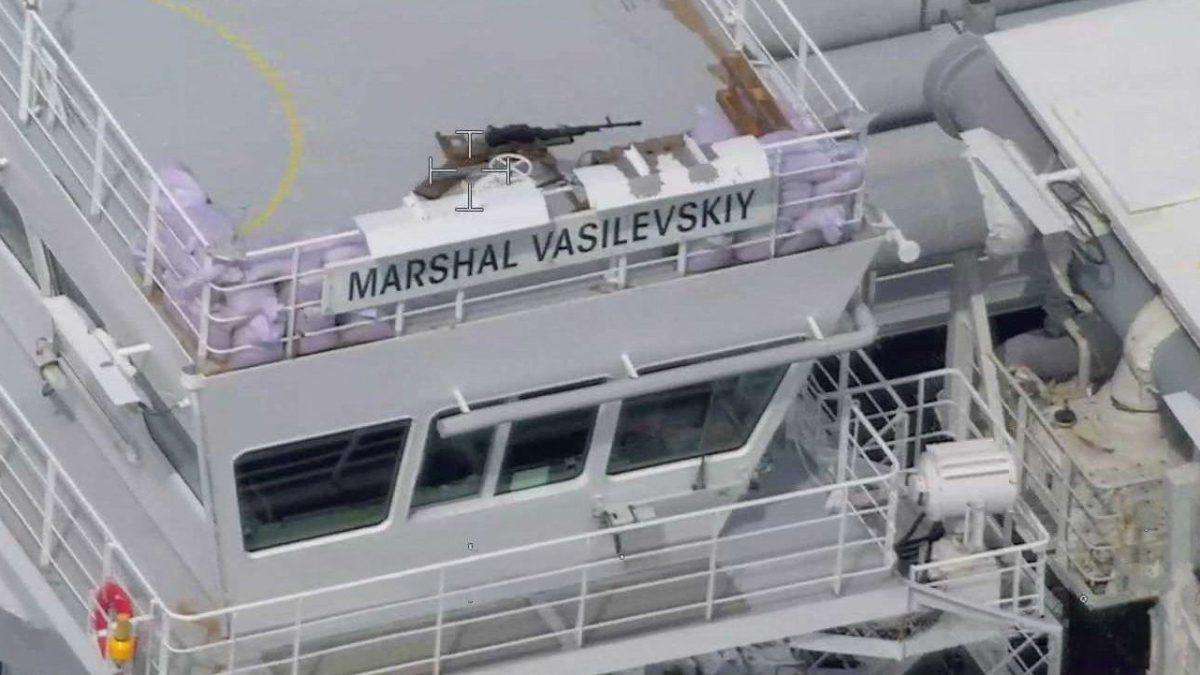
The Estonian authorities this week released pictures of two sandbag-protected machine gun emplacements aboard the Marshal Vasilevskiy, a liquified natural gas (LNG) tanker which sails between Russia’s Baltic coast and Moscow’s Kaliningrad exclave.
The decision to visibly arm a merchant vessel in the congested waters of the Baltic Sea has prompted concern in Western capitals that the Kremlin is willing to increase the risk of a confrontation with European countries while under pressure from Nato over its key trade route for oil and gas exports worth £75bn a year.
It comes after The i Paper this week revealed that Vladimir Putin has stepped up the use of Russia’s “shadow fleet” of oil tankers to conduct intelligence-gathering operations using drones to surveil sensitive sights.
The International Institute for Strategic Studies (IISS) said this activity had included using a sanctioned tanker located off Hull to launch drones to spy on Nato nuclear weapon capabilities by overflying RAF Lakenheath in Suffolk. The US airbase is widely thought to have taken delivery of a consignment of nuclear bombs last year after facilities were upgraded.
Since the beginning of this year, nine ships from Moscow’s so-called shadow fleet of sanctions-busting oil tankers have been seized by countries including France and the UK. French special forces last week detained a shadow fleet tanker in the Mediterranean, following a similar intervention by Royal Marine Commandos in the English Channel when another tanker, the Smyrtos, was seized two weeks ago.
The intensification of seizures has coincided with growing evidence that Putin is intensifying his hybrid warfare campaign against the UK and other key European Nato states. According to the IISS report, drones suspected of having been launched from shadow fleet vessel Hav Dolphin were also used to spy on a French nuclear submarine base and linked to a spate of incidents in Germany and Denmark during a 15-month intelligence-gathering operation.
The Vasilevskiy is not a shadow fleet vessel but is instead owned by Russian fossil fuel giant Gazprom and travels between Russia’s gas export hubs on the Baltic and Kaliningrad, which is sandwiched between Poland and Lithuania.
The fact it sails under a Russian flag means it is highly unlikely to be the subject of an attempted seizure by Western countries. It was sanctioned by the UK government in 2024 for its role in servicing Russia’s war economy.
A ceremony to welcome back a naval force of the Russian Baltic fleet in Baltiysk, Kaliningrad, in 2021. Nine ships from Moscow’s shadow fleet of oil tankers have been seized by countries including UK this year (Photo: Vitaly Nevar/Getty)
But intelligence sources told The i Paper that conspicuously arming a vessel like the Vasilevskiy was likely to be an attempt by the Kremlin to signal that it was willing to extend similar measures to its shadow fleet tankers and in so doing deter further seizures.
A Western official said: “The Russians are trying more and more to muddy the waters between [military] naval capabilities and their civilian fleet. This is another step along that road because they desperately want to change the calculus for Nato.
“If they can put machine guns on one ship coming out of [the Baltic ports] then they can put them on any other. For a Western power looking to enforce sanctions, that would change matters considerably. The chances of ordering a special forces unit to rappel by rope on to a vessel where there is an assessed risk of there being a machine gun nest on board are pretty much zero.”
Moscow has been ramping up its rhetoric with regard to the protection of its vital oil and gas exports through the Baltic, which provide some £225m a day in revenues to the Russian economy.
Speaking earlier this month, Nikolai Patrushev, Putin’s maritime affairs adviser, said: “We cannot allow the blockade of our key maritime routes. It is crucial to ensure the timely dispersal and combat readiness of the [Russian] fleet, its ability to counter the full spectrum of threats.”
The Vasilevskiy is used for LNG shipments between Russia and Kaliningrad and has been cited by Putin as an important means of assuring the exclave’s energy security (Photo: Estonian police and borderguard)
There is already some indication that Moscow’s militarisation of its cargo fleet is having the desired effect on the willingness of Nato countries to directly confront its merchant fleet. In April, the commander of Estonia’s navy said it had halted attempts to detain Russia-linked vessels that do not pose an immediate risk to the country because “the risk of military escalation is too high”.
Experts said the machine guns placed on board the Vasilevskiy would have an effective range of up to 2,000 metres and could be used against both aerial and seaborne targets.
One possible explanation for their presence is an attempt to protect against an attack by Ukrainian sea drones, which are believed to have been used to destroy another Russian LNG tanker, the Arctic Metagaz, in the Mediterranean off Libya in March. Kyiv has claimed the vessel was carrying a senior Kremlin intelligence officer responsible for Russian sabotage campaigns across Europe.
But sources said it was unlikely Ukraine would undertake a similar attack in the Baltic region for fear that it would be used by Moscow as a pretext for sparking a wider confrontation with Kyiv’s Nato allies.
Instead, experts argue Russia is taking increasingly reckless measures as it faces stalemate in Ukraine.
Yoruk Isik, head of maritime security monitor Bosphorus Observer, said: “There is no justification for a self-defence posture like a machine gun in the Baltic… This clearly shows that the high seas are becoming increasingly lawless.”
slartbangle on July 2nd, 2026 at 16:50 UTC »
Wouldn't 'arming' be a more accurate term than 'weaponizing' here? It's not as though they made them into huge, slow attack drones.
B5_V3 on July 2nd, 2026 at 16:00 UTC »
Merchant ships have been targets of war since naval warfare exists. over 5000 merchant vessels were sank by the allied forces during WW2. this is quite literally one of the main roles of an attack submarine. it is pretty standard practice to arm merchant ships. Especially if you're at war or planning for it. whether it be Armed security for anti piracy or Containerized Weapon systems have also been developed by China, The US, and Russia. hell Britain even disguised warships as merchant vessels called Q-Ships to bait submarines into attacking them. it is clear the Author of the article has never once picked up a history book.
Currently Russian merchant vessels are being boarded and seized by NATO members, or outright blown up. It's a no-brainer that Russia would start putting defenses on these ships. they don't have the warship capacity to guard every ship, nor can they sustain the economic losses being incurred by the loss of these ships. This is a standard practice and it's being portrayed as some alarming new development. if anything Russia doing this signals they're finally starting to feel the squeeze.
SpeedoPaedo on July 2nd, 2026 at 12:09 UTC »
Can't view the article without paying.