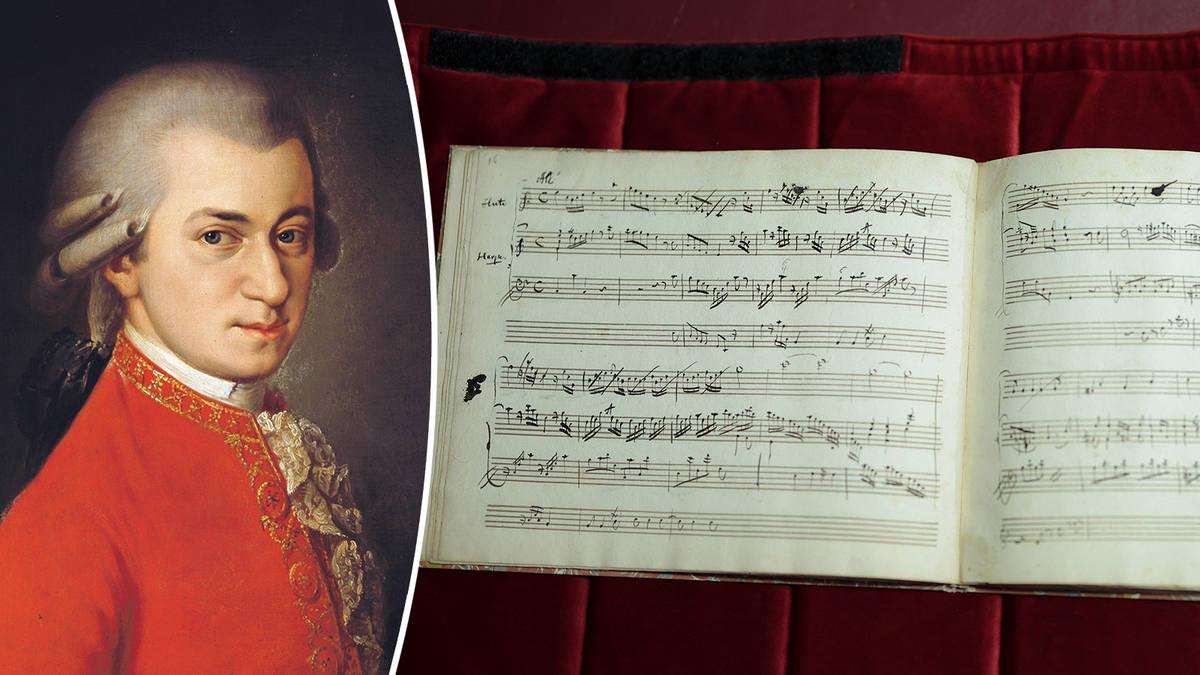
22-year-old Mozart’s handwritten notebook unearthed in ‘major discovery’
A handwritten manuscript book, belonging to a 22-year-old Mozart, has been discovered in Paris. Picture: Getty
The notebook was confiscated during the French Revolution, and has now been found in Paris.
Listen to this article Loading audio...
A 248-year-old notebook in France’s National Library (BnF) has been officially identified as belonging to a 22-year-old Mozart, in what library experts have called a “major discovery”.
Consisting of 44 pages, the notebook was kept by the young composer between May and July 1778, while he was staying in Paris, employed as a music tutor for Marie-Louise-Philippine de Bonnieres de Guines.
Her father was the Duke of Guines, a highly-regarded flute player in 18th century Paris, who commissioned Mozart’s now-popular Concerto for Flute and Harp.
The notebook contains daily exercises that Mozart prescribed his harp-playing tutee, in addition to seven pieces for both flute and harp, which may have been intended for the father-daughter duo to play together.
Read more: ‘Mozart dropped a new single’ – classical fans queue to hear newly discovered work in Leipzig
A manuscript belonging to Mozart in 1778 has been found in Paris. Picture: Getty
The discovery was made by curator Francois-Pierre Goy, who works in the library’s music department. Goy had set himself the task of sorting through a pile of documents before his retirement, when he chanced upon the notebook.
“I never imagined what I was about to find,” he said. By coincidence, Goy had been looking at other documents Mozart had written for teaching just weeks earlier, and began noticing similarities in the handwriting on close examination.
“The treble clefs are quite rounded and tilted slightly forward,” he described, noting that the bass clefs in Mozart’s hand were the opposite of the style usually used by French composers.
Goy compared the document side-by-side with other handwritten works by Mozart, including a copy of Mozart’s Concerto for Flute and Harp, commissioned by the Duke of Guines, which used identical stamps to the notebook.
All together, the evidence looked more and more convincing, and the document was authenticated in April 2026 by Armin Brinzing, director of the Mozarteum Foundation in Austria.
Read more: Did you know Mozart’s middle name isn’t really Amadeus?
Mozart's 'Deh vieni, non tardar' from The Marriage of Figaro
The BnF said that the manuscript was “part of two bundles of music that were confiscated from the home of the Duke of Guines in 1794.”
The Duke was a close confidant of Marie-Antoinette, and fled to England at the outbreak of the French Revolution. His relationship with Mozart was fraught. The composer was impressed by the Duke’s musical talents but became frustrated that his daughter didn’t seem to share them.
The relationship soured further when the Duke failed to pay Mozart for his work. Instead, he was offered a measly half of what he was owed by the Duke’s head butler–a sum he reportedly refused.
Som12H8 on June 20th, 2026 at 14:51 UTC »
Astounding! It was actually, it was beyond belief. These were first and only drafts of music, but they showed no corrections of any kind. Not one. He had simply written down music already finished in his head! Page after page of it as if he were just taking dictation. And music, finished as no music is ever finished. Displace one note and there would be diminishment. Displace one phrase and the structure would fall. It was clear to me that sound I had heard in the Archbishop's palace had been no accident. Here again was the very Voice of God! I was staring through the cage of those meticulous ink-strokes at an absolute beauty.
toan55 on June 20th, 2026 at 14:23 UTC »
The notebook contains daily exercises that Mozart prescribed his harp-playing tutee, in addition to seven pieces for both flute and harp, which may have been intended for the father-daughter duo to play together.
Lonely_Noyaaa on June 20th, 2026 at 14:20 UTC »
People forget Mozart was writing at a breakneck pace at that age, already deep into his career but still experimenting. A notebook like this is basically a snapshot of his brain mid thought and makes me wonder what else is out there on other collections