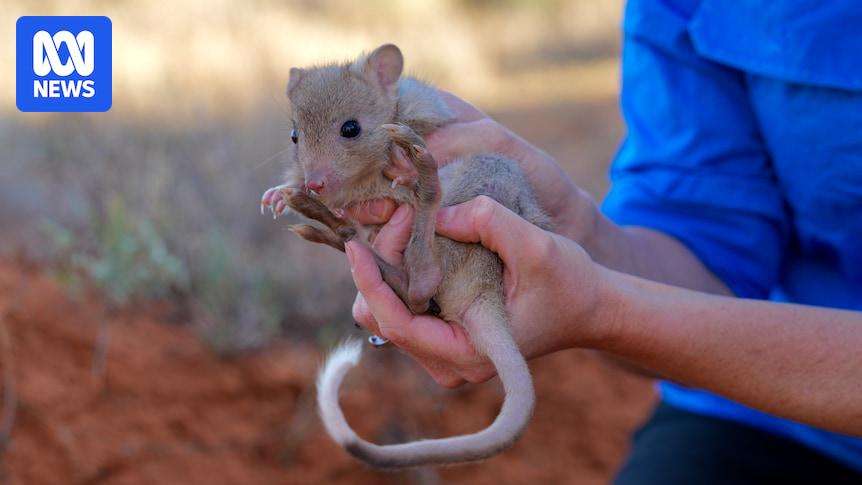
A football-sized relative of kangaroos, the burrowing bettong once thrived across much of Australia's arid and semi-arid interior.
Then, within a century of European settlement, the marsupials vanished from most of the mainland.
Like many native animals, the population was decimated by feral cats and foxes.
A baby burrowing bettong trapped in one of the project's two feral-free safe havens. (ABC Broken Hill: Bill Ormonde)
But now, after two years of breeding behind pest-free exclosures in the far north-west corner of New South Wales, a team of ecologists has released a handful of bettongs beyond the fences.
Bettongs have a pouch, hop like roos, dig warrens like rabbits and per animal, shift about 3 tonnes of soil a year.
Combine this with the clicking and fart noises they use to communicate, the marsupials are considered one of the country's most unique native species.
Sturt National Park in far north-west NSW is located near Cameron Corner, where the borders of Qld, SA and NSW intersect. (ABC News)
Wild Deserts principal ecologist Rebecca West said it was exciting to see these "ecosystem engineers" released decades after extinction in Sturt National Park near Cameron Corner.
"They are very important in terms of turning over the soil and nutrients and seed cycling, but also providing refuges for other animals," Dr West said.
"They dig their homes and they dig their warrens and they're constantly picking their new places and moving on, but they're digging every night for their food."
Rebecca West is hoping to release about 20 burrowing bettongs into the wild. (ABC Broken Hill: Bill Ormonde)
Australia has the world's highest mammal extinction rate, something this project is trying to counteract.
Over the past few weeks, bettongs were released into a 100 square kilometre "wild training zone" inside Sturt National Park, about 100 kilometres west of the outback town of Tibooburra.
Feral cat kills 'grossly underestimated' Research tracking released bilbies and bettongs in remote SA has found feral cats are their biggest killer.
Inside the exclosure, the number of feral predators such as cats can be monitored, controlled, and kept at a low density through shooting and trapping.
Each of the bettongs has been equipped with a radio collar, so the team can intensively monitor them.
"We know that animals can live in a fence where there's no predators and nothing to worry them," Wild Deserts conservation field officer David Damschke said.
David Damschke (pictured) and the team will track the bettongs over the coming months. (ABC Broken Hill: Bill Ormonde)
"But, getting them beyond the fence and back into the landscape where they can continue on their natural function and the ecological role, that would be the key part."
Feral cats kill more than 1.5 billion native animals every year in Australia, according to the Department of Climate Change, Energy, the Environment and Water.
By living alongside a low density of feral predators, ecologists in South Australia have observed behavioural changes in the bettongs.
Rebecca West and Richard Kingsford handle a captured golden bandicoot. (ABC Broken Hill: Bill Ormonde)
Dr West is hopeful they will see similar shifts with these recently released species.
"They're going to be learning to listen when they're feeding, to look around them to make sure that they've got really good safety and that they're not moving too far from their warrens," she said.
"So all of these skills that sound like things that they should innately know how to do, but they didn't evolve with cats.
The team checks an animal trap. (ABC Broken Hill: Bill Ormonde)
"Cats have different hunting strategies [to native predators], they smell different, they actually travel differently within the landscape."
The bettongs are the fifth native species to be successfully bred up and reintroduced by the Wild Deserts team.
These newly released bettongs join bilbies, golden bandicoots and western quolls, as well as crest-tailed mulgaras beyond the fences.
A small, carnivorous crest-tailed mulgara. (ABC Broken Hill: Bill Ormonde)
Over the past 18 months, 400 bilbies have also been released into the wild training zone.
"We're seeing dispersal across the whole area that we've released them into," Dr West said.
"We're seeing really good signs of breeding and so that's fantastic news for us."
The bilby population is booming inside the two pest-free exclosures. (ABC Broken Hill: Bill Ormonde)
It is not just bilbies breeding, according to Dr West, they have found evidence other species are also reproducing despite the threat of predators.
The Wild Deserts team is hopeful the bettongs can successfully navigate their new environment.
Wild Deserts is a collaboration led by UNSW with Ecological Horizons, NSW National Parks and Wildlife Service and Taronga Conservation Society Australia. (ABC Broken Hill: Bill Ormonde)
"Surviving is one part of this story, but we need animals to survive and then actually breed the next generation that are predator smart," Dr West said.
Wild Deserts project leader Richard Kingsford said it was important staff monitored the bettongs as they navigated their new home.
"They don't really know their way around, so we need to go out there every day and track them, where they're located," Professor Kingsford said.
Richard Kingsford is eager to see how the animals adapt. (ABC Broken Hill: Bill Ormonde)
"If we find one that's been killed, we've got an opportunity to work out what happened to it.
"We can take genetic swabs and get them analysed to see if it was a cat, so all of those things are important and allow us to learn."
Wightly on June 16th, 2026 at 09:26 UTC »
TIL that the bettong exist and they communicate with fart noises!
maguirenumber6 on June 16th, 2026 at 06:02 UTC »
Burrowing Bettongs! The alliteration is very satisfying
Excellent-Signature6 on June 16th, 2026 at 03:51 UTC »
https://giphy.com/gifs/FMqLuGY5nn5I0BbTJ8 “Did someone say something about a delicious endangered animal?!?!”