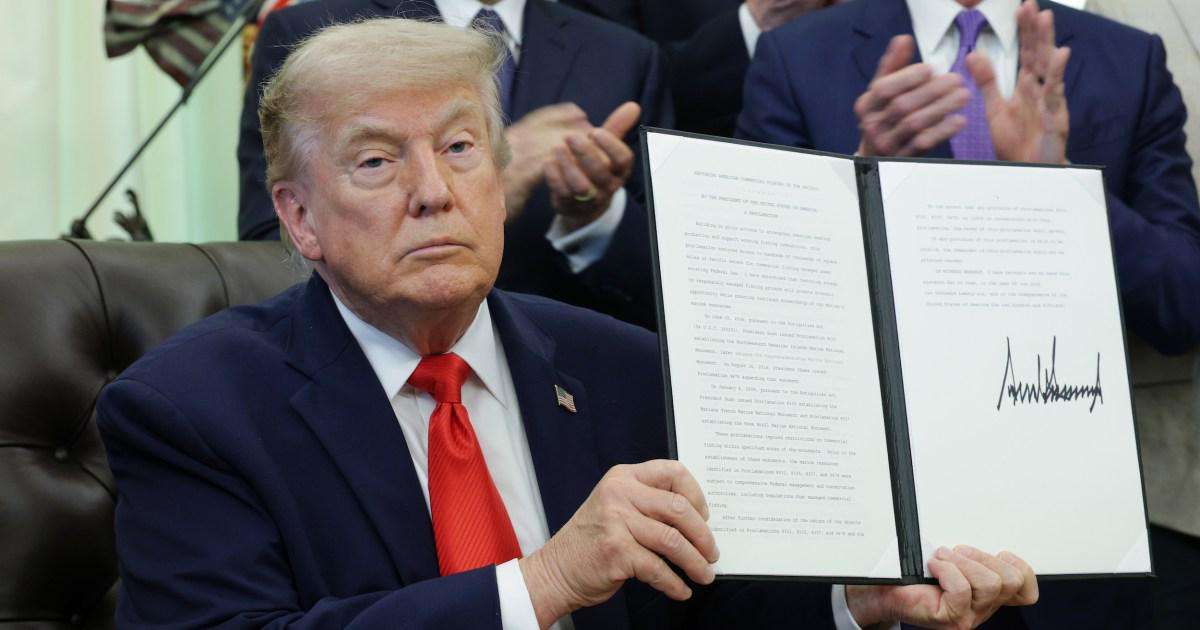
The emerging agreement with Iran that President Donald Trump is touting does not appear to achieve several of the key goals he stated at the outset of the military conflict over three months ago.
For one, it’s unclear whether the president’s core objective of permanently preventing Iran from obtaining a nuclear bomb will be achieved. Experts say that based on the limited information provided by the administration so far, Iran offered Trump’s envoys a better nuclear deal before the war than the one Tehran is apparently offering now.
The killing of the country’s top leaders by the U.S. and Israel appears to have strengthened and emboldened the powerful Islamic Revolutionary Guards Corps, and Iran’s new supreme leader, Mojtaba Khamenei, is more radical than his late father, Ayatollah Ali Khamenei. Having demonstrated their ability to close the Strait of Hormuz and absorb U.S. and Israeli air attacks, Iran’s new hardline leaders, experts say, are likely determined to maintain its nuclear program in some form and wield greater influence in the Middle East.
“A war meant to prevent Iran from acquiring nuclear weapons will be the war that pushed them over the Rubicon,” Danny Citrinowicz, a retired Israeli military intelligence officer, told The New York Times.
There appear to be several key holes in the draft memorandum of understanding as it was outlined by a senior Trump administration official to reporters on Friday.
It is unclear whether both sides have agreed to the final wording of the memorandum.
Trump said on Saturday that he expected the “deal,” as he called it, to be signed on Sunday. But a spokesman for Iran’s foreign ministry reportedly said any signing of a memorandum of understanding “will not be tomorrow.”
The senior administration official did not describe to reporters that any specific limits on Iran’s missile stockpile had been agreed to as part of the memorandum. When Trump announced the war on Feb. 28, he said one of the administration’s core goals was to “destroy their missiles.” Recent U.S. intelligence assessments found that 70% of Iran’s missile stockpile remains intact.
There are also apparently no clear references to another goal Trump described at the outset of the war, to “ensure that the regime’s terrorist proxies can no longer destabilize the region.” The senior administration official only said the agreement would end fighting across the region and, as a result, Iran would apparently no longer fund its proxies.
“We feel confident that the Israelis, that the Gulf Coast partners, that the Americans and the Iranians are all going to get behind this thing,” the official said. “And we can make it enforceable, and we can make it stick.”
BlueEmma25 on June 14th, 2026 at 08:56 UTC »
This is not exactly surprising, since Trump painted himself into a corner by first announcing expansive war aims - Iran permanently gives up its nuclear ambitions, including the capacity to enrich uranium domestically, end support for proxies, stop ballistic missile development, and ideally undergo regime change - with no clear idea how to achieve these aims, apart from launching a decapitation strike and blowing up a lot of stuff. Meanwhile Iran closed the Strait of Hormuz, potentially laying the groundwork for a severe global economic shock. The decapitation strike and bombing campaign didn't achieve the desired results, but the pressure from the strait closure is mounting, and Trump has clearly been eager for an offramp for some time. He is bored with the war now, and acutely aware that the longer it drags out the more political capital it will cost him, at a time when his presidency is already approaching its lame duck phase.
It follows that if there is going to be a deal, it would entail a very significant downsizing of Trump's original ambitions, something like Iran agreeing to reopen the strait and downblend its HEU, in exchange for the US ending its blockade, the provision of some monetary compensation, likely through back channels, and possibly some sanctions relief.
The issue of a "toll" on traffic through the strait might be a sticking point. Iran will be very reluctant to completely surrender its claim, but Trump doesn't want to be known as the president who killed freedom of navigation, a principle with which the US has historically been closely identified. A face saving compromise like the implementation of an "environmental levy" on shipping, with revenue being shared by Gulf states but Iran getting an outsize slice, might offer a way forward, but might be too pragmatic for someone of Trump's temperament to accept.
NekoCatSidhe on June 14th, 2026 at 07:47 UTC »
I am still waiting for the US and Iran to even agree about what is in their deal before I judge it.
But the journalist here is all acting “shocked, shocked !” that Iran is not being asked by the deal to limit their missiles, defund their proxies, and renounce peaceful uses of their nuclear program, as if all those were not Iranian political red lines they have repeatedly said they would never agree with.
The only way to change that would have been to overthrow the Iranian government and replace it with an American puppet, which may have been the stated overall goal of the US at the beginning of the war, but clearly did not happen and now has not even the beginning of a chance of happening, thanks to the rally around the flag effect that that war caused in Iran and the fact that the US are clearly politically unwilling to commit the military resources necessary to mount a successful large-scale invasion of the country (and do not even have them in the Middle East right now).
Downblending their uranium in exchange for removal of economic sanctions is clearly the only deal that Iran was ever ready to accept, and no wonder since it basically was the JCPOA that Iran agreed with a long time ago but that the US unilaterally pulled out of.
Trump is still going to tout as a victory the fact that “Iran renounced having nuclear weapons” as if Iran had not repeatedly stated they did not want nuclear weapons (officially).
myname_1s_mud on June 14th, 2026 at 07:07 UTC »
This is going to be one of those broken peace deals that only lasts a few years, in which all sides prepare for war, so when it ends, the ensuing conflict is far worse. And when that happens, everyone is going to act shocked.