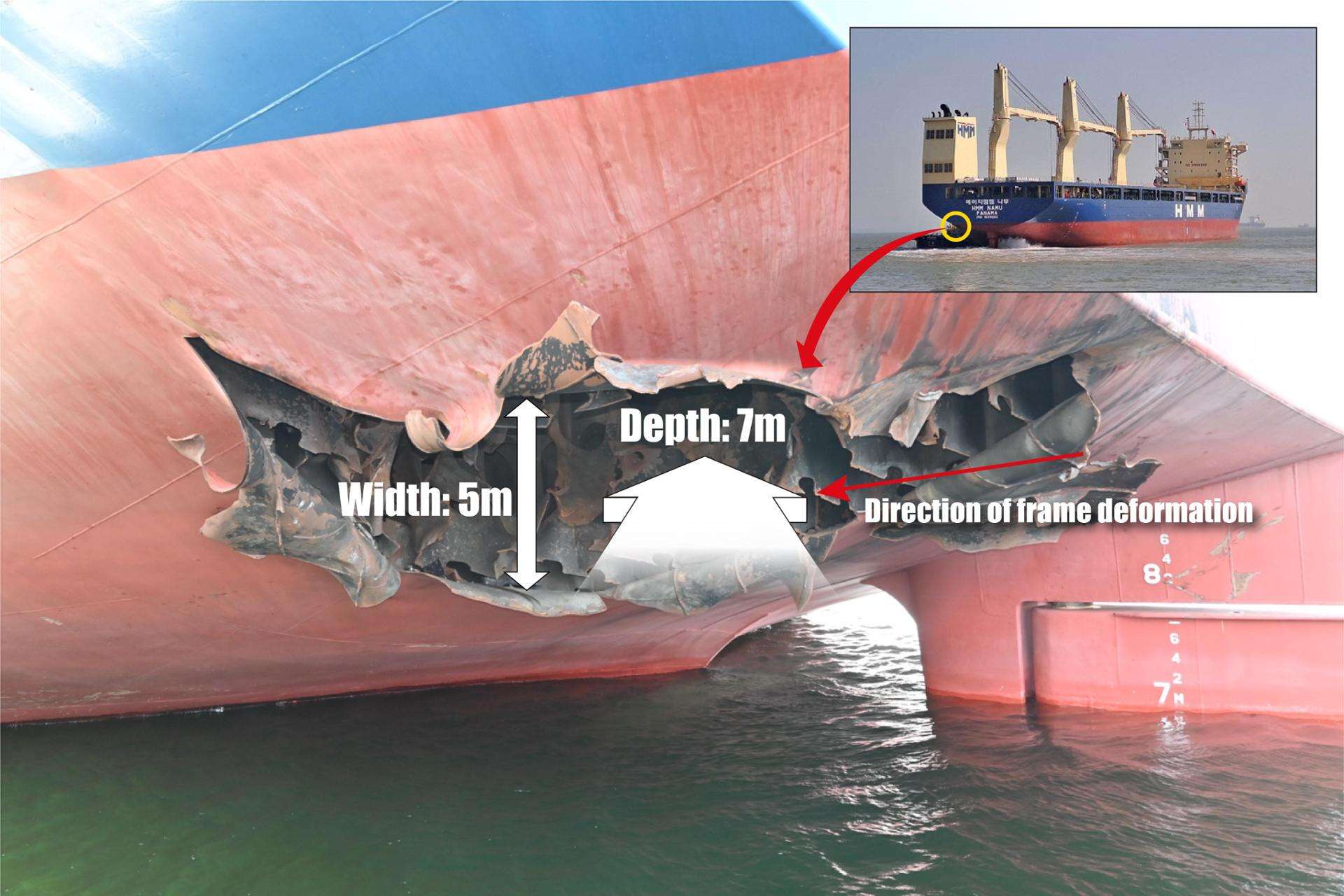
The Korean government said Wednesday that Iranian anti-ship missiles attacked a Korean vessel in the Strait of Hormuz earlier this month, based on an inspection by a Korean government team.
“Much evidence suggests that Iran (is behind the attack),” Park Yoon-joo, first vice minister of the Ministry of Foreign Affairs, said during a briefing, Wednesday.
It was the first official confirmation by the Korean government regarding the exact cause of the incident. Suspicions had also been raised that the damage might have been the result of drone attacks.
Park said the inspection team reached its conclusion after investigating the HMM Namu, the Panama-flagged cargo ship operated by Korean shipping company HMM, which has been anchored at a port in Dubai following the attack. Debris from the flying object used to attack the ship was also present for their inspection.
“The investigation showed the attack was highly likely to have been made by Noor-series anti-ship missiles developed by Iran," Park said. "Two missiles were fired; the first missile failed to explode and the second one exploded. When it comes to the engine, it is similar to the Iranian turbojet engine. It is confirmed that parts were engraved with markings showing they are produced in Iran.”
One piece of debris carried the inscription "TEM-T05003," which investigators traced to an Iranian entity believed to be Turbine Engineering Manufacturing.
"Debris from the flying object was painted sky blue, which is a known feature of Iranian-made anti-ship missiles," Park said, adding that electronic components suggest the missile was manufactured some 20 to 30 years ago.
"Given the year of production, it appears to be an older-model Noor missile," he said, noting the engine appears to be of the Toloue-4 type, a reverse-engineered Iranian turbojet.
The vice minister said, however, that it is difficult to conclude the attack was intentional, as determining intent remains highly subjective.
Republic of Korea Navy Admiral Ryu Young-sang, who joined the briefing, said it is highly possible that Iran-related entities are behind the incident based on the use of the specific missiles.
“It is widely known that the missiles were used by the Iranian Navy, the Islamic Revolutionary Guard Corps and pro-Iran entities and were exported to Syria,” Ryu said.
“It is hard to know the intention of the attacker, but firing two missiles is usually meant to create some damage (to the ship).”
Following the briefing, the ministry summoned Iranian Ambassador to Korea Saeed Koozehchi. Seoul lodged a formal protest, demanded an apology and called for measures to prevent a recurrence.
The ambassador, however, denied all allegations and rejected any Iranian involvement in the incident. Answering reporters' questions through an interpreter after the summons, he expressed regret over the damage to the ship, but called for caution against false flag operations by enemy states.
The announcement was made weeks after HMM Namu was attacked by two unidentified flying objects on May 4 while being stranded in the strait. The strike rendered the ship inoperable and left one crew member injured, out of a total of 24 members, including six Korean nationals.
While U.S. President Donald Trump said immediately after the attack that Iran shot at the vessel, the Ministry of Foreign Affairs and Cheong Wa Dae had only stated that it was an external attack and remained cautious about identifying who was responsible — a stance seen as a balancing act between Iran and the United States.
Korea dispatched a joint inspection team to Dubai to check the ship's hull and the team brought debris from the unidentified objects back to Korea to determine the exact cause of the incident.
The waterway has been effectively blockaded by Iran since the outbreak of war with the United States and Israel on Feb. 28. Including HMM Namu, 26 ships in the strait were either Korean-flagged or operated by Korean companies. One crude oil carrier operated by HMM passed through the strait on May 21 without paying any fees.
The attack on the HMM Namu was the 33rd such incident in the waterway, according to the government, adding that previous cases and responses are also being taken into consideration to handle the situation.
manniesalado on May 27th, 2026 at 11:16 UTC »
Somebody forgot to pay their toll.
Scared-Discussion443 on May 27th, 2026 at 10:46 UTC »
I think Korea probably wanted to avoid getting pulled too deeply into this situation from the beginning.
From Seoul’s perspective, there are already a lot of sensitive things happening around the Korean Peninsula and Northeast Asia right now, so they may not want another major security issue escalating at the same time.
That might partly explain why the response initially seemed cautious and focused on investigation first. It’ll be interesting to see how Korea handles this going forward.
marketrent on May 27th, 2026 at 10:22 UTC »
Excerpts from article by Park Ji-won:
The Korean government said Wednesday that Iranian anti-ship missiles attacked a Korean vessel in the Strait of Hormuz earlier this month, based on an inspection by a Korean government team.
It was the first official confirmation by the Korean government about the exact cause of the incident, while there had also been suspicions raised of possible drone attacks.
The Ministry of Foreign Affairs said it would soon call in Iranian Ambassador to Korea Saeed Koozechi to protest.
The announcement was made weeks after HMM Namu, the Panama-flagged cargo ship operated by Korean shipping company HMM, was attacked by two unidentified flying objects on May 4 while being stranded in the strait. The strike rendered the ship inoperable and left one crew member injured, out of a total of 24 members, including six Korean nationals.
[...] The waterway has been effectively blockaded by Iran since the outbreak of war with the United States and Israel on Feb. 28. Including HMM Namu, 26 ships in the strait were either Korean-flagged or operated by Korean companies. One crude oil carrier operated by HMM passed through the strait on May 21 without paying any fees.
The attack on the HMM Namu was the 33rd such incident in the waterway, according to the government, adding that previous cases and responses are also being taken into consideration to handle the situation.