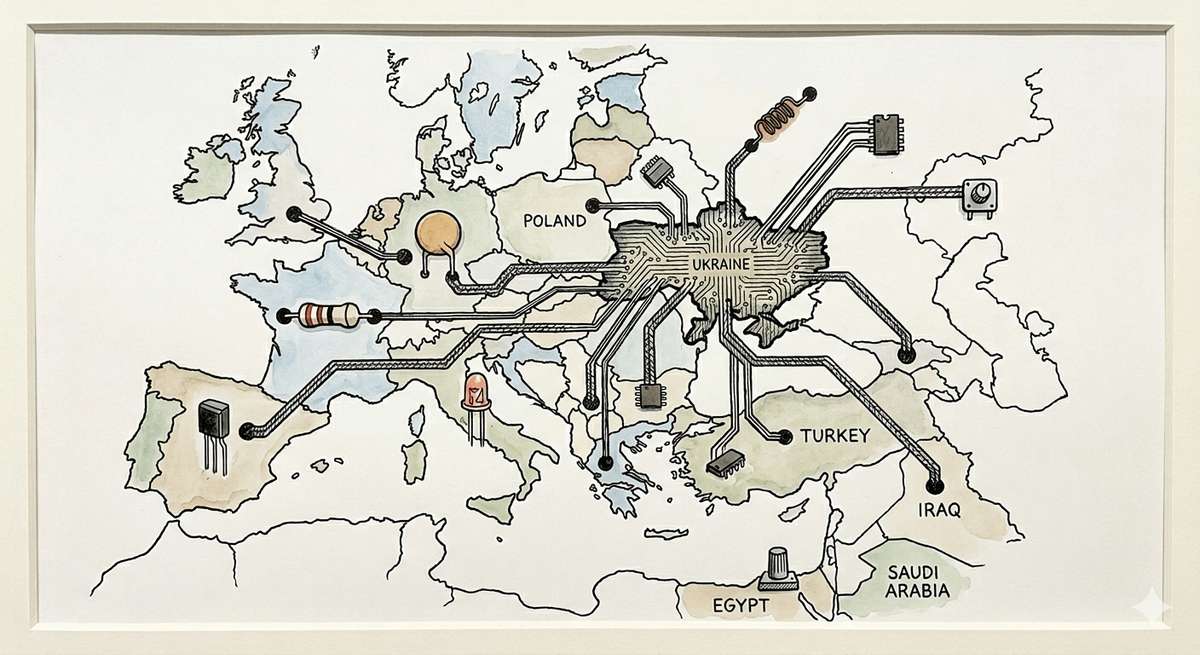
Ukraine is spreading its influence and building relationships in a way to help guarantee its safety, open up new economic opportunities, but also alliances, making it hard for Russia to isolate Ukraine.
Ukrainian officers are training American war fighters on a Ukrainian acoustic detection system at an American air base in Saudi Arabia, and the reason they are doing this is humiliating for everyone involved except the Ukrainians. Over $1.3 billion in American hardware (a $300-million AWACS aircraft, a THAAD radar, a KC-135 tanker) got gutted by drones that cost less than a used Honda Civic, the kind of attack Ukraine has been swatting out of its own sky for 3 years while Washington was still commissioning studies on whether the threat was real. Trump said on March 6 that "we don't need their help in drone defense." The Pentagon deployed the Ukrainian system weeks later. You know the move: call the plumber, don't tell your wife, pretend you fixed the sink yourself.
That scene, Ukrainian expertise plugging American failures on Saudi soil, contains the entire argument of this piece in a single image. Ukraine has been assembling something across 3 continents with a speed and cunning that most coverage has been too polite, and too condescending, to properly acknowledge, coverage that keeps calling Ukraine an 'emerging arms exporter,' which doesn't begin to cover what they are actually doing.
Ukraine is rewiring the fuse box of European and Middle Eastern security while everyone is looking at the meter.
Ukraine did not choose this path. It was forced into it after the NATO door shut. Rather than hammering on the door and collecting vague promises and platitudes, Ukraine took a route it controlled, one designed to produce the same protection NATO membership would have offered.
Ukraine walked around the back of the building and started bolting its own furniture to the floor of every room it could get into, drone factories in Bavaria, combat drone production in Suffolk, rocket fuel in Jutland, 201 military specialists physically embedded in Gulf air defenses, a Ukrainian drone platform being evaluated to replace a British weapons system. Every bolt it sinks makes removal more expensive for the country hosting the furniture, not for Ukraine. An embassy does the same thing with chandeliers and visa counters, but Ukraine figured out how to build them from titanium instead of marble, and nobody has ever demolished titanium with a change in government.
Israel wrote the exam, Ukraine is sitting it during an earthquake
Israel learned in 1967 that a patron's loyalty lasts exactly until the patron finds something more interesting to do, when France slapped on an arms embargo and demonstrated that decades of alliance can evaporate in the time it takes a president to eat lunch.
Israel spent 40 years turning arms exports into structural alliances. Ukraine is running the same playbook in 4, without the security guarantee Israel started with. Sources: BESA Center/Bar-Ilan; Breaking Defense; Defense News; Jamestown Foundation; EU Council, 2023–2026.
The Israelis spent the next 40 years building the answer: a defense industry so entangled with its customers that abandoning Israel meant losing your own equipment, your own training pipeline, your own spare parts. A relationship where leaving hurts you more than staying, which is the only kind of relationship that survives contact with politics.
Corporate America ran the same calculation with AI spending, building dependencies so expensive to unwind that continuation became cheaper than cancellation, a playbook that works equally well whether you're selling missile systems or automation fantasies.
The BESA Center at Bar-Ilan University called it a central extension of the nation's foreign policy, but that's generous to the diplomats. The arms deals built the friendships. The Foreign Ministry showed up afterward with a card and flowers. Azerbaijan, the only majority-Shia nation Israel has good relations with, did not arrive at that relationship through civilizational affinity or shared values or any force a diplomatic textbook would predict. It arrived through purchase orders.
Israeli defense exports hit $13 billion in 2023, and Abraham Accords countries accounted for nearly a quarter of that. Those normalization deals everyone celebrated as a diplomatic masterstroke were, in large part, paperwork catching up with plumbing that had been connected for years.
Ukraine is sitting the same exam but the room is on fire and the clock is broken and nobody will tell them how long they have left. 4 years instead of 40, building the industry and the export network simultaneously while being shelled, which is either reckless or brilliant depending on whether it works, and so far, infuriatingly for the people who wrote Ukraine off as a charity case, it is working.
The caveat matters: wartime innovation has a habit of wilting in peacetime, and Israel survived the transition by iterating obsessively for decades. Whether Ukraine can do that without the luxury of peace is genuinely unknown. But the ambition is staggering, and the execution has been better than anyone outside Kyiv predicted, which is a sentence I suspect Ukraine is getting tired of hearing.
The Munich drone factory (Quantum Systems, Frontline Robotics, 10,000 drones a year, 200 employees) matters less than what sprouted around it in a single month. Six new joint ventures. A deep-strike drone program reaching 1,500 km, which is to say, Moscow. And a 2027 defense budget of €144.9 billion with €11.6 billion earmarked for Ukraine, a country Germany was sending helmets to four years ago. Ukraine has threaded itself into the German defense economy the way bindweed gets into a garden. By the time you notice, pulling it out means pulling out everything it has wrapped itself around, and what it has wrapped itself around is German jobs, German taxes, German supply chains, German voters whose representatives would need to stand up in the Bundestag and explain why a mood swing in foreign policy should cost their constituents their mortgages. No politician in Berlin has ever wanted to have that conversation, and the fact that they will keep not wanting to have it regardless of which coalition holds power is the entire mechanism, reluctance as structural guarantee, more durable than any treaty because treaties require political courage to honour and cowardice requires nothing at all.
Germany's €11.6 billion earmarked for Ukraine represents the kind of fiscal commitment that survives coalition changes because it has been threaded through the budget in ways that make reversal look like economic vandalism, the state changing clients but keeping the same appetite for spending that feels productive whether or not it solves anything.
Reluctance as structural guarantee, more durable than any treaty because treaties require political courage to honour and cowardice requires nothing at all.
Britain has gone further, and the dependency runs deeper. UkrSpecSystems builds its Shark drone on British soil. Skyeton's Raybird is being assessed to replace Britain's own Watchkeeper, which means a country the UK was training on light infantry tactics in 2015 may soon be building the surveillance platform the British Army relies on. 2,000 combat drones a month out of Mildenhall. $2.4 billion defense framework ratified. If this unwinds, the British military has a hole shaped like Ukrainian technology and no off-the-shelf plug that fits.
Denmark built the template, Norway and Bulgaria and Italy copied it fast enough to suggest they had been waiting for permission, and in May 2026 five nations signed the CORPUS procurement coalition with Ukraine. Moscow published a list of 11 Ukrainian drone branches across Europe in April. This is the thing you only bother doing when the thing you are listing has grown from an annoyance into something that keeps you up at night.
The Gulf, where nobody pretends this is charity
The Gulf deals are where the mutual dependency stops wearing a suit and shows up in overalls.
In late March 2026, Ukraine signed 10-year frameworks with Saudi Arabia, Qatar, and the UAE, the kind of deals that look boring on paper and are designed to. Zelensky called it the 'Drone Deal,' at least 10 agreements. These are scaffolding, not binding contracts, and this is a big difference. But inflating what these are would weaken an argument that is strong enough without inflation. But 201 Ukrainian specialists are physically embedded across 3 Gulf states, and a specialist plugged into your air defense grid cannot be shredded like a document. Removing them means admitting your defenses have a hole, publicly, and defense ministries would rather eat glass than hold that press conference.
Prince Sultan Air Base is the image that carries this entire piece. American systems failed. Ukrainian systems worked. Sky Fortress, a startup that learned its trade by being bombed every day for 3 years, has deployed over 10,000 acoustic sensors across Ukraine, brought its Sky Map platform to Saudi Arabia, the same system that detects drones America's billion-dollar radars missed. A Ukrainian officer told the Jamestown Foundation he was stunned that Gulf states had been lobbing 8 Patriot interceptors at a single drone, over $4 million a shot against a $70,000 target. You know that annoying fly you get in your house during the summer? Imagine tearing the entire house down then burning it to ashes - that's basically what this is.
Gulf states fired 8 PAC-3 MSE interceptors at a single drone. The salvo cost 480 times more than the target it destroyed. Ukraine's acoustic detection system costs a fraction of either. Sources: US Army FY2025 budget (PAC-3 MSE ~$4.2M/unit); Jamestown Foundation, April 2026.
Ukraine gets 700,000 tons of diesel a month and potentially Patriot missiles. The Gulf gets expertise forged under fire, three years of getting bombed every day and turning each hit into better engineering. The dependency runs both ways and the piece is lying if it hides that. Ukraine needs its buyers scared roughly as much as those buyers need Ukrainian solutions. If Iran calms down, those 10-year frameworks have the potential to turn to wallpaper. But right now the house is on fire and Ukraine is the only country selling extinguishers that actually work at a price that won't bankrupt you, and that is a position of leverage Kyiv earned in blood and is converting into infrastructure as fast as it can pour, because it knows the fire won't burn forever.
The Gulf states are running the same risk calculation American tech companies ran with layoffs, betting that cutting one dependency and replacing it with something cheaper and untested will work out fine despite all evidence suggesting the replacement rarely performs as advertised until it's too late to reverse course.
The prize nobody wanted that might outlast the one everybody did
Under the EU's SAFE fund (€150 billion in defense procurement), contracts must source 65% of components from the EU, EEA-EFTA states, and Ukraine. Ukraine is written into the threshold alongside member states. Fifteen EU countries plan to buy Ukrainian weapons through it, which is the kind of sentence that would have been satire in 2021. The EU took a country it will not admit as a member and welded it into the procurement architecture of European defense, a classification that lives in legal plumbing and survives every election because no incoming government rewrites procurement law in their first hundred days, or their second, or usually ever. Ukraine learned, repeatedly, expensively, in ways that cost lives, that affection is what evaporates first, and so it started building with structural architecture, the kind that is harder to pour but does not care who wins the next election.
Every connection Ukraine builds is designed so that leaving costs more than staying. Factories create jobs, embedded specialists create gaps, procurement law creates inertia. The alliances which survive are the ones where leaving costs you something you cannot replace. Sources: Defense News, EU Council, Al Jazeera, Jamestown Foundation, Defense Express, 2025–2026.
Israel constructed defense diplomacy on top of an American security guarantee it already held. Ukraine is constructing it because the guarantee never showed up, which makes the whole thing bolder and more breakable at the same time: a country pouring foundations before the land title cleared, because standing around waiting felt more dangerous than building on uncertain ground, and because Ukraine has been right about that calculation at every point in this war where the comfortable consensus said otherwise.
The question worth sitting with is whether this playbook travels. Other countries will watch NATO's door stay closed. Others will never reach the door. And the lesson Ukraine is welding into the walls of factories in Munich and air bases in Riyadh, that the alliances which survive are the ones where leaving costs you something you cannot replace, may prove to be the most important thing to come out of this war. A foreign policy conducted through procurement, hiding in plain sight, denominated in the only currency that holds when the political weather turns: mutual, structural, inconvenient, expensive-to-exit necessity.
bushcamper_aiis on May 25th, 2026 at 15:27 UTC »
This article was written by AI.
In any case, I wonder what Ukraine’s moat is. Drone tech is relatively simple, and the US is already competitive (sometimes ahead) on intercept cost. The ME should have ordered cheap interceptors (from US, Ukraine, etc.) before the war so they didn’t have to launch patriots at everything.
It’s great Ukraine already has the manufacturing capacity set up during a period of high demand tho.
tvtowers on May 25th, 2026 at 14:03 UTC »
Read this yesterday, it's very in-depth and reflects the value of Ukrainian innovation, adaptation and refining of weapons and tactics under duress, and the lessons (and technology) benefit to their defense partners.
CriticalSink3555 on May 25th, 2026 at 13:53 UTC »
This article examines Ukraine's emerging defense export strategy as a case study in alliance-building outside formal treaty architecture. Rather than framing Ukraine purely as an aid recipient, the piece argues that Kyiv is constructing a network of bilateral industrial dependencies. designed so that severance costs for partner nations exceed maintenance costs.
The analysis draws a direct comparison to Israel's post-1967 defense diplomacy, where arms exports created structural relationships that survived changes in political leadership across buyer nations. The key difference the article identifies is compression --> Israel built this architecture over 40+ years atop an existing American security guarantee, while Ukraine is attempting it in roughly four years without one.
What makes this geopolitically significant beyond the Ukraine-Russia context is the potential precedent. If this model proves durable, it offers a template for states that cannot secure formal alliance membership or security guarantees.
I'm not sure it hits everything but this is a different take that I haven't really read much, and raises some novel and interesting takes in Ukraines strategy, especially when you examine it through the lens that Ukraine will want to make sure any peace guarantee is for life not just a brief repreive.