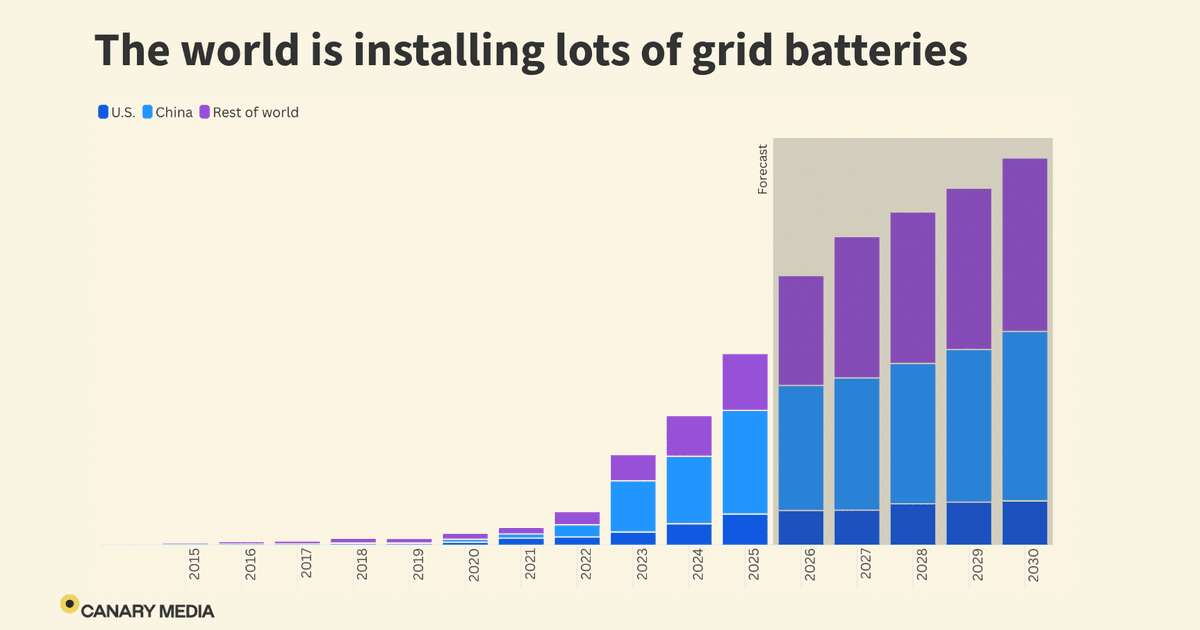
See more from Canary Media’s “Chart of the Week” column. First came the solar. Now, the batteries have arrived.
Installations of grid batteries, which can store solar and other energy for later use, surged by 48% in 2025 from the year prior, per new data from BloombergNEF. A total of 112 gigawatts of battery storage capacity was installed worldwide in 2025 — a record high that represents a tenfold increase over the amount constructed in 2021.
So, where are all of these batteries sprouting up? The short answer: mostly in China and the United States. China alone installed more than half of the world’s grid battery capacity last year. The U.S., meanwhile, accounted for 16%.
Other places are seeing rapid uptake, too. Sun-soaked Australia grew its battery installations by a factor of nearly six last year, albeit from a pretty small base of just 827 megawatts in 2024. The U.K., which shuttered its last coal plant in 2024, saw installations nearly double between 2024 and 2025, to 2.6 GW. Meanwhile, across the broader sub-Saharan Africa region, installations roughly quintupled to 4.3 GW.
Battery installations are now starting to catch up to solar installations, BNEF says. A decade ago, the world was installing 56 MW of solar for every 1 MW of storage. Last year, that ratio was 6-to-1. This year, BNEF expects it to drop to 4-to-1.
The key driver of this growth is the ever-decreasing cost of energy storage, with lithium-ion battery prices dropping by more than 90% over the last 15 years.
The case for batteries is also strengthening as the world builds an incredible amount of wind and solar, since the technology can stockpile wind and solar power when it’s abundant to dispatch later when the grid needs it.
BNEF expects the storage boom to continue as data centers surge onto the grid — especially in the U.S. — and as power demand rises because of the electrification of vehicles and buildings.
Equivalent-Ask2542 on May 17th, 2026 at 21:20 UTC »
The whole world? No, not all of it. A small gas-lobby in the centre of Europe has its grip firmly on the electricity grid plans of the German Economics minister Katherina Reiche
no_awning_no_mining on May 17th, 2026 at 18:43 UTC »
... they measure capacity in GW
dietl2 on May 17th, 2026 at 18:37 UTC »
The projection of this graph looks pretty conservative. I expect a much larger rise in the next few years. Prices are still falling and there's more room for innovation.