close Cancel email WhatsApp link share Share bookmark Save
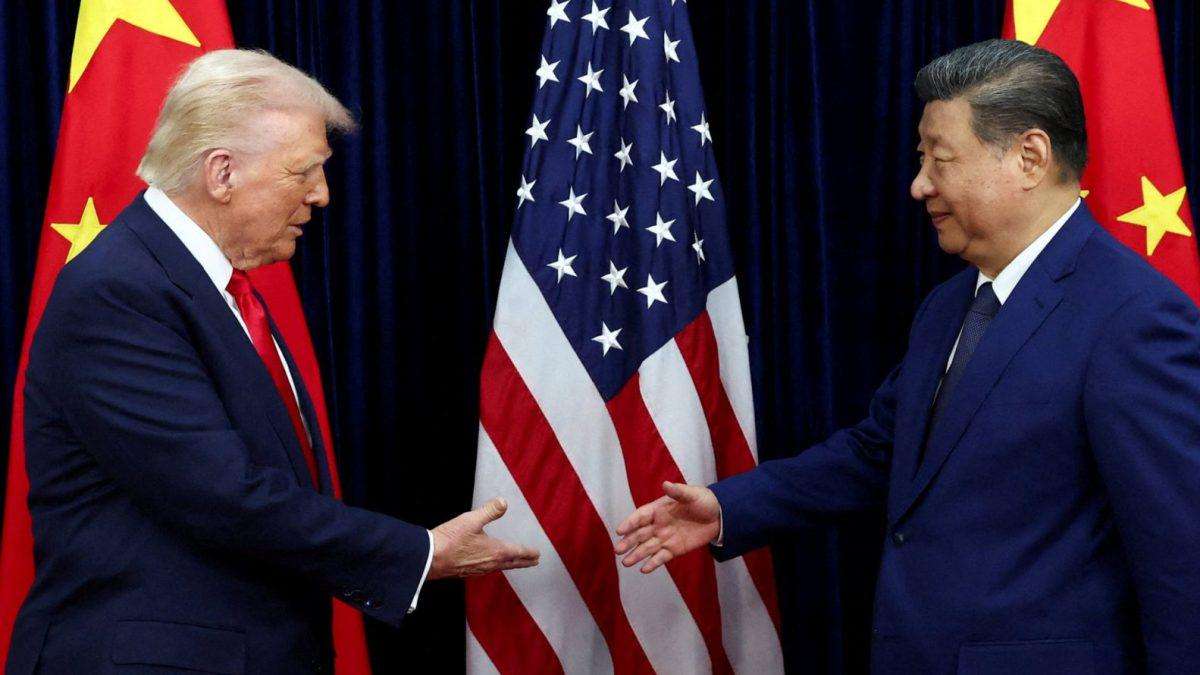
When Donald Trump touches down in Beijing on Thursday, for his long-delayed summit with China’s leader Xi Jinping, he will be hoping to project an aura of US power.
Accompanying the US President’s long motorcade will be military personnel and an entourage of corporate titans, including Elon Musk, Apple’s Tim Cook and Boeing’s Kelly Ortberg. But the optics of this state visit mask the major challenges awaiting the US delegation.
Trump arrives in a China that has spent years making itself more resilient to US influence and pressure, leaving him attempting to secure rapid, transactional victories with a weakened hand.
One challenge for the White House is its diminishing economic leverage. For the past year, Trump’s administration has pushed its sweeping tariff measures, including global duties and triple-digit levies on Chinese goods. These were seen as the ultimate tool to force Beijing’s co-operation. Yet this strategy is unravelling at home.
A string of US court rulings, culminating on 7 May, has dismantled the legal architecture of Trump’s approach, striking down his unprecedented use of Section 122 of the Trade Act of 1974. The US delegation arrives in Beijing with its primary economic weapon heavily restricted.
China, by contrast, has demonstrated its willingness to deploy its own economic arsenal, notably its near-monopoly on critical minerals. In response to US technology restrictions, Beijing has already squeezed the export of rare-earth elements and permanent magnets.
This raises a critical question for Washington: who is hurting more? While China has undoubtedly felt the sting of restrictions placed on US semiconductor exports, America’s defence industry and technology sector are feeling the squeeze of China’s mineral chokehold. Those materials are critical to modern munitions and advanced manufacturing.
The make-up of the US President’s delegation illustrates the possible limits of this summit.
While the presence of executives like Musk, Cook and Ortberg suggests a desire to strike headline-grabbing deals – potentially large commercial aircraft orders or agricultural purchases to appease Trump’s rural voter base – one last-minute inclusion is telling.
Trump is greeted by cheers and flag-waving as he arrives at Beijing Capital International Airport (Photo: Evan Vucci/Reuters)
Jensen Huang, the Taiwanese-American chief executive of chipmaker Nvidia, boarded Air Force One during an Alaska layover following an apparent 11th-hour invitation from the President. As the head of the world’s most valuable company and the lynchpin of the global artificial intelligence race, Huang’s initial omission highlighted the deep national security sensitivities surrounding US semiconductor export controls.
According to Trump, Huang’s inclusion will allow him to pressure Xi to – in the US leader’s words – “open up” China to American technology in a mutually reinforcing way. The problem here is that, like so many times in the past, China will only be opened up on its own terms, and if it sees an asymmetric advantage.
Perhaps the most visible challenge constraining Trump is the US-Israeli conflict with Iran. The war has dragged on far longer than the White House anticipated, generating a global energy shock that has sent fuel prices soaring in the US, and has seen the President’s approval rating drop markedly.
With US naval forces tied down in Iran, Washington’s diplomatic and military bandwidth in the Indo-Pacific, where China is increasingly pushing its influence, is more and more stretched. The Iran crisis has also allowed Xi to project a calm and methodical leadership style that contrasts sharply with Trump’s own.
While US forces manage a Middle Eastern blockade, Beijing has exploited its non-aligned stance. China recently hosted Iran’s foreign minister, backed a Pakistan-brokered ceasefire, signed a new trade deal with Nato member Spain, and secured 24 investment and trade agreements with the UAE.
The contrast in demeanour and strategy between Xi and Trump affects US structural power, which Beijing has done its best to weaken. While the West cannot claim to be unaware of China’s domestic censorship and repression, Trump’s mercurial and transactional foreign policy style makes it easier for China’s leadership to make it look the other way.
Trump’s controversial moves since returning to office, including snatching the president of Venezuela in a military raid, threatening to annex Greenland from Denmark, and persistent trade frictions with traditional allies like Canada and Europe, have often caught the US’s international partners off guard.
The South China Morning Post reported that this image, seen on social media, shows the US presidential limousine – The Beast – driving down a Beijing highway ahead of Trump’s arrival
Xi has capitalised on this by hosting multiple European leaders seeking economic stability, while dispatching his commerce minister to solidify trade ties with India, further insulating China’s supply chains from future US disruptions.
Nowhere is the danger of diminished US leverage more acute than across the Taiwan Strait. And sensing American distraction, Beijing is pressing its advantage. During a recent meeting with Cheng Li-wun, Taiwan’s opposition leader, Xi explicitly weaponised the crisis in the Strait of Hormuz, pointing to the fragility of distant maritime lifelines to imply that US security guarantees are an illusion.
Trump has, in the past, voiced ambivalence about defending Taiwan. The greatest risk of this summit in Beijing is that the US President, eager for a political win to reverse sagging poll numbers, might agree to alter Washington’s long-standing diplomatic language on Taiwan in exchange for superficial economic deals.
This week’s summit is about playing the long game, which isn’t Trump’s strength. He desires quick victories, ones that can be used to boost his domestic position, while Xi will look to secure control over the supply chains, minerals and diplomatic relationships that will define the mid-21st century.
If the White House trades long-term economic statecraft for short-term political gains, it will validate the exact narrative that China is attempting to project around the world: that US leverage is quietly but steadily waning, as its own grows.
James Rogers is a co-founder and director of research at the Council on Geostrategy
sighborg90 on May 13rd, 2026 at 10:46 UTC »
Is his fatal flaw being simultaneously inept and overconfident? Because the world’s known that for quite some time.
rlaw1234qq on May 13rd, 2026 at 09:56 UTC »
Oh I think all his flaws have been exposed to the world
Cheap_Coffee on May 13rd, 2026 at 09:34 UTC »
Paywall so I don't know what Trump's fatal flaw is.