DUBAI, April 28 (Reuters) - The United Arab Emirates on Tuesday said it was quitting OPEC, dealing a blow to the oil producers' group as an unprecedented energy crisis caused by the Iran war exposes discord among Gulf nations.
The exit of the UAE - one of the group's biggest producers - weakens OPEC's control over global oil supplies and widens a rift between the UAE and its neighbour Saudi Arabia, effectively the leader of the Organization of the Petroleum Exporting Countries.
It could also free the UAE to increase output once exports via the Gulf resume as it would no longer be governed by OPEC quotas.
In his first public comments since the announcement, UAE Energy Minister Suhail Mohamed al-Mazrouei told Reuters in a telephone interview that the decision was taken after examining the country's energy strategies.
He said the UAE had not discussed the issue with any other country.
"This is a policy decision, it has been done after a careful look at current and future policies related to level of production," Mazrouei said.
He also said the world would demand more energy, implying the UAE would be positioned to meet that need.
Oil prices on international markets trimmed gains on Tuesday following the UAE's announcement it would on May 1 leave OPEC and OPEC+, which brings together OPEC and allied producers.
Mazrouei said he did not expect much immediate market impact from the news because of constraints in the Strait of Hormuz.
OPEC Gulf producers have been struggling to ship exports through the Strait, a chokepoint between Iran and Oman through which a fifth of the world’s crude oil and liquefied natural gas normally passes, because of Iranian threats and attacks against vessels.
As Gulf supplies have become stuck, the International Energy Agency said OPEC+'s share of global oil output fell to 44% in March from about 48% in February. It is likely to fall further in April as production shut-ins become more pronounced - and then further in May as the fourth biggest producer leaves the group.
A WIN FOR US PRESIDENT DONALD TRUMP?
The UAE's exit represents a win for U.S. President Donald Trump, who in a 2018 address to the U.N. General Assembly accused the organisation of "ripping off the rest of the world" by inflating oil prices.
Trump has also linked U.S. military support for the Gulf with oil prices, saying that while the U.S. defends OPEC members, they "exploit this by imposing high oil prices".
Analysts said it was also positive for consumers and the broader economy.
"This opens the door for the UAE to gain global market share when the geopolitical situation normalises," said Monica Malik, chief economist at ADCB.
Jorge Leon, analyst at Rystad, noted the UAE's significance as one of the few members of OPEC, apart from Saudi Arabia, with spare production capacity that allows it to add extra oil to the market.
"Outside the group, the UAE would have both the incentive and the ability to increase production, raising broader questions about the sustainability of Saudi Arabia’s role as the market’s central stabiliser," he said.
WIDENING RIFT BETWEEN UAE AND SAUDI ARABIA
Once firm allies, Abu Dhabi and Riyadh have developed a simmering rivalry, clashing on issues from oil policy and regional geopolitics to the race for foreign talent and capital.
The UAE is a regional business and financial hub and one of Washington's most important allies. It has pursued an assertive foreign policy and carved its own sphere of influence across the Middle East and Africa.
Especially after coming under attack during the Iran war, the UAE has strengthened its relationships with the United States and Israel, with which it opened ties in the 2020 Abraham Accords. It views the relationship with Israel as a lever for regional influence and a unique channel to Washington.
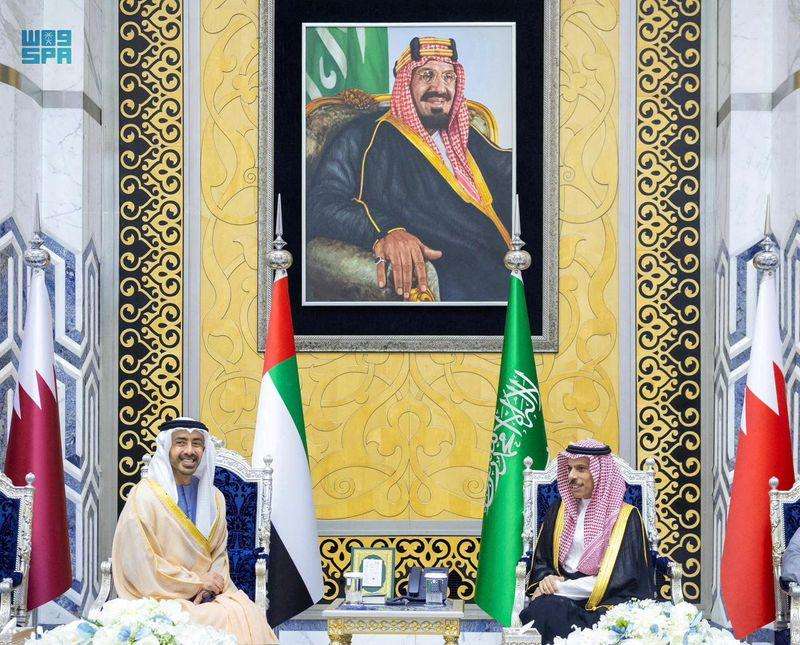
Some Gulf leaders, meanwhile, met in person on Tuesday in Saudi Arabia, a summit that a Gulf official said aimed to craft a response to the thousands of Iranian missile and drone strikes their nations have faced since the U.S. and Israel launched their war on Iran in late February.
Additional-Library55 on April 28th, 2026 at 13:46 UTC »
This is a massive news! Esp. For people like me from the region. This shows the silent rift between KSA and UAE is quickly turning into a gulf.
Pretty early to comment, but I don’t think other comments who are linking this with oil quotas, US pressure etc. are correct here. Traditionally UAE has been a highly diplomatic country - always working silently behind the scenes. They don’t like to show disunity publicly, esp with KSA. They had coordinated their actions in very much lock step - Yemen attacks or stabilizing oil prices post Covid with production cuts.
But more recently UAE seems to have broken ranks - first they publicly asked for more militaristic response to Iran, then shunned Pakistan for being too diplomatic (and not standing in their corner against Iran) and now left Opec.
What will happen to cartel - it already was difficult for KSA to control all members with production cuts with news that Iraq frequently surpassed its quotas. Now it will feel even more difficult to control the members. It can eventually lead to the cartel collapsing. Only time will tell, but surely this is a very significant geopolitical move by UAE, and completely out of its nature
itchslap on April 28th, 2026 at 13:42 UTC »
OPEC is a Saudi controlled organization and it has been a source of a bottleneck for the UAE. This is a direct effect of the GCC and Arab League being weak in terms of their response to the Iranian attacks. Saudi Arabia benefits the most from OPEC while smaller countries like Qatar and UAE are bottlenecked by the quotas imposed by their neighbor. Qatar had already taken the 2017 diplomatic rupture as a prelude to exit it.
UAE has endured the brunt of the Iranian attacks, and Qatar lost major gas production capabilities. Bahrain and Kuwait are also not in a good shape. Iran has targeted these smaller countries particularly because their response and diplomatic outlash is not as effective and the damage can be severe.
This is technically UAE saying to Saudi Arabia and Russia, we have our own back and we do not need you to cap our capabilities specially when we are under attack. Since there is no GCC united front against Iran and no Russian leash on Iran, then we are on our own as well and will not follow your demands.
NickInTheMud on April 28th, 2026 at 12:38 UTC »
United Arab Emirates just announced it’s leaving OPEC after more than 60 years as a member. This is a blow to Saudi Arabia, the de facto leader of OPEC.
UAE blames the other gulf countries for not doing more to protect the UAE during the recent Iran war.