Powered by Yahoo Scout. Yahoo is using AI to generate key points from this article. This means the info may not always match what’s in the article. Reporting mistakes helps us improve the experience.
Key takeaways Powered by Yahoo Scout. Yahoo is using AI to generate key points from this article. This means the info may not always match what’s in the article. Reporting mistakes helps us improve the experience.
Researchers in Japan have developed a new material that allows solar cells to generate an amount of energy from sunlight that was previously thought impossible.
The discovery, made by a team at Kyushu University, involves a special “spin-flip” emitter that can harvest energy from the Sun that is typically lost as heat.
The breakthrough overcomes the long-standing limit of conventional solar cells to achieve an energy conversion efficiency of 130 per cent – opening up new possibilities for ultra-efficient solar panels.
With conventional solar cells, a single particle of light called a photon can generate one energy carrier, known as an exciton.
Until now, solar cell technology has only been able to harvest energy from about one-third of the available sunlight due to higher-energy photons, like blue light, being lost as heat.
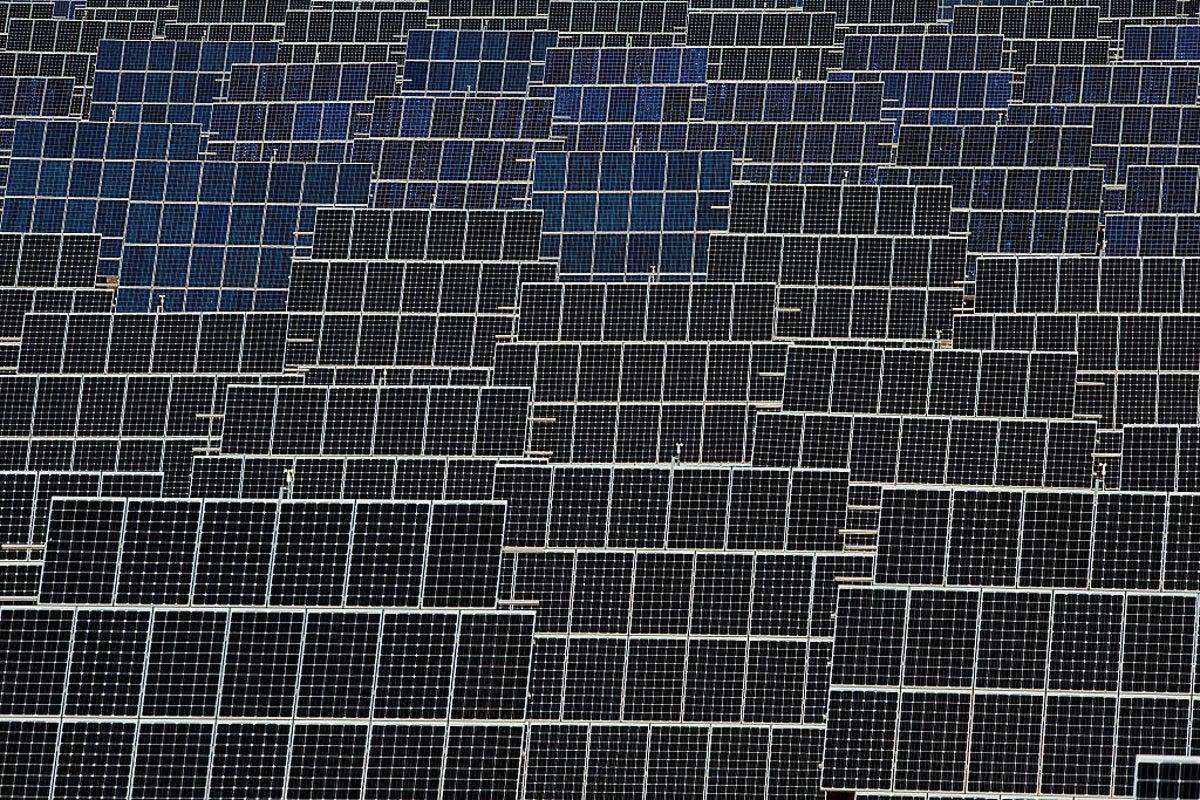
Photovoltaic power solar panels in El Bonillo, Albacete province, Spain on 2 December, 2015 (Getty Images)
The researchers used a process called singlet fission to split the excitons from the higher-energy photons into two lower-energy excitons – theoretically doubling the energy.
“We have two main strategies to break through this limit,” said Yoichi Sasaki, Associate Professor at Kyushu University’s Faculty of Engineering.
“One is to convert lower-energy infrared photons into higher energy visible photons. The other is to use singlet fission to generate two excitons from a single exciton photon.”
The research was published in the Journal of the American Chemical Society, in a study titled ‘Exploring spin-state selective harvesting pathways from singlet fission dimers to a near-infrared-enissive spin-flip emitter’.
The discovery is the latest in a string of recent breakthroughs with solar technology, making the renewable energy sector increasingly efficient and cost effective.
Earlier this month, a team in Switzerland set a new efficiency record for a new type of solar cell using the ‘miracle material’ perovskite.
By combining it with silicon, the researchers were able to achieve efficiency levels that rival satellite-grade solar panels at a fraction of the cost.
jugalator on April 1st, 2026 at 12:58 UTC »
Solar power is such a beautiful story.
Did you know that more electricity is produced through solar than coal in the world and it's set to eclipse even nuclear?
https://www.reuters.com/markets/commodities/world-solar-generation-set-eclipse-nuclear-first-time-maguire-2025-05-21/
Chart: https://fingfx.thomsonreuters.com/gfx/ce/myvmjlxqgpr/WorldSolarvsNuclearMay2025.png
otirk on April 1st, 2026 at 12:50 UTC »
Maybe I'm just an idiot or my English isn't good enough but how exactly do you have an energy conversion rate of 130%? That would mean it's generating more energy than was put into it. Or do they mean it's 130% higher than what was possible before?
The article is from 31.3., so it can't be an April Fools joke, so what is it?
Mysterious-Outcome37 on April 1st, 2026 at 12:43 UTC »
This better not be an April fools joke!