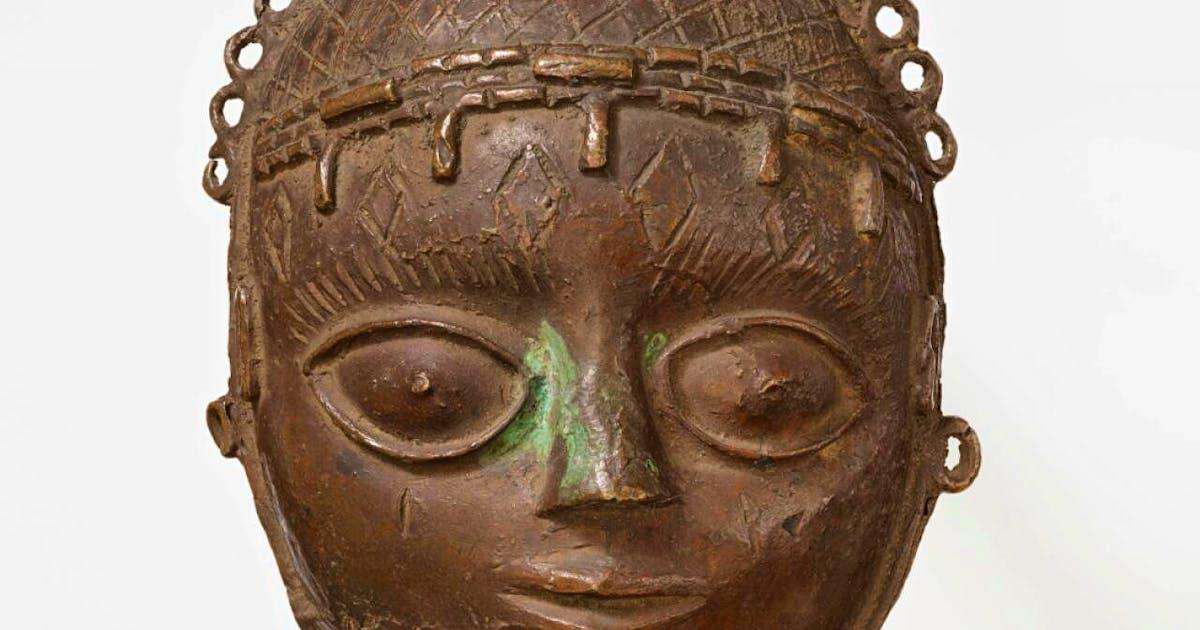
The Uhunmwu-Ẹkuẹ pendant mask was looted at the end of the 19th century in what was then the Kingdom of Benin (now Nigeria) and later came to the Rietberg Museum in Zurich. It is one of the Benin objects that are now being returned to Nigeria. sda
It has been a long process, but now three Swiss museums are returning Benin objects once looted by the British to Nigeria. However, some of them will remain on loan.
No time? blue News summarizes for you Three Swiss museums are returning a total of 28 Benin objects to Nigeria.
These are Benin bronzes that can be traced back to the raid by the British colonial army in 1897.
Some of the works will remain on loan to the Museum Rietberg in Zurich.
In Switzerland, there are around one hundred objects in various museums that originally came from Benin.
Investigations by the Benin Initiative Switzerland have revealed that around half of these are of problematic origin. They were "certainly" or "probably" looted. Show more
Two museums in Zurich and one in Geneva are returning a total of 28 objects from their collections to Nigeria. These so-called Benin bronzes are proven to come from the British colonial army's raid in 1897.
The Ethnographic Museum of the University of Zurich is returning 14 objects to the Federal Republic of Nigeria, the Museum Rietberg in Zurich eleven and the Musée d'ethnographie de la Ville de Genève a further three. The restitution decision was made by the University of Zurich, the City of Zurich and the City of Geneva. The corresponding ownership agreement and the restitution agreement were signed on Friday at the Stadthaus in Zurich. Olugbile Holloway, Director General of the National Commission for Museums and Monuments (NCMM) in Nigeria, was also present.
The Museum Rietberg has also agreed with the NCMM that some of the works will remain in the museum on loan. The aim is to "continue to make the cultural significance of the works visible in Switzerland and to strengthen the dialog with Nigeria in the long term", according to a statement from the City of Zurich. The other Benin objects from all three museums are due to travel to Nigeria next summer. They will be transferred to the Nigerian National Museum in Lagos.
The NCMM had officially submitted restitution applications on behalf of the Nigerian government in 2024 and 2025. Previously, a total of eight museums in Switzerland had researched the provenance of their Benin works together with representatives from Nigeria as part of the Benin Initiative Switzerland (BIS). Under the leadership of the Museum Rietberg, the Bernisches Historisches Museum, the Museum der Kulturen in St. Gallen, the Musée d'ethnographie de la Ville in Geneva, the Museé d'ethnographie Neuchâtel, the Museum der Kulturen Basel, the Museum Schloss Burgdorf and the Ethnological Museum of the University of Zurich were involved.
In Switzerland, around one hundred objects originally from Benin can be found in the various museums. Research carried out as part of the BIS has revealed that around half of them are of problematic origin; they were "certainly" or "probably" looted.
From war trophies to trade goods
The historical background to this is that British troops stormed the capital Benin City in 1897, then reduced the palace to rubble and drove King Oba Ovonramwen into exile. Before they burned down the royal palace, they looted it. Around 10,000 elaborately crafted objects, fine ivory carvings, memorial figures and brass relief plates fell into their hands. They were torn from their original context. As a result, the war trophies became commodities and eventually exhibits in European museums.
These so-called Benin bronzes came to Switzerland during the colonial and post-colonial periods, the last of them in 2022. Today, the three museums that are now returning the objects are in favor of the transfer of ownership. It is a "necessary step in historical reappraisal, a sign of respect - and an expression of active international cooperation", the three museum directors were quoted as saying in a press release.
In addition, the restitution "creates the basis for Nigeria to research, preserve and communicate its history in its own way", the directors continued. And Olugbile Holloway was quoted as saying that the restitution decision would "definitely" help to "heal certain aspects of our colonial past".
Incidentally, before the three Swiss museums, museums from Germany (2022) had already returned around 1,100 objects to Nigeria, 119 objects were restituted by the Netherlands (2025) and just last February, the University of Cambridge transferred ownership of 116 objects to Nigeria.
LunarBIacksmith on March 21st, 2026 at 15:13 UTC »
I’ve said it before, but at this point we have great 3D scanning and printing technology. Take some scans, print out a copy and return the original. The display of the culture is still there in the museum to inspire and educate, but the original is returned to the people it was taken from. It shouldn’t be that complicated, but humans make everything more complicated than it needs to be.
UnclassifiedPresence on March 21st, 2026 at 14:50 UTC »
They’ve Benin the wrong hands for far too long
VagueSomething on March 21st, 2026 at 14:49 UTC »
Unfortunately these stories rarely have good endings and simply end up being good intentions leading to disappointment. A shocking amount of these feel good stories of rightly returning items have follow-up news of the items going missing shortly after return and being stolen by rich people or destroyed to harvest parts from.
It would be nice for many more items to return to their country of origin and it would be great for native homes to have displays of their native culture they can also loan out to other museums and allow for history to be seen and shared.
Museums are a good thing born of bad deeds, a great many vital historical pieces only exist because of colonisers taking trophies home. This subject is incredibly nuanced and many people resort to being unhelpful and sometimes harmful by applying Twitter length thoughts onto a complex situation.