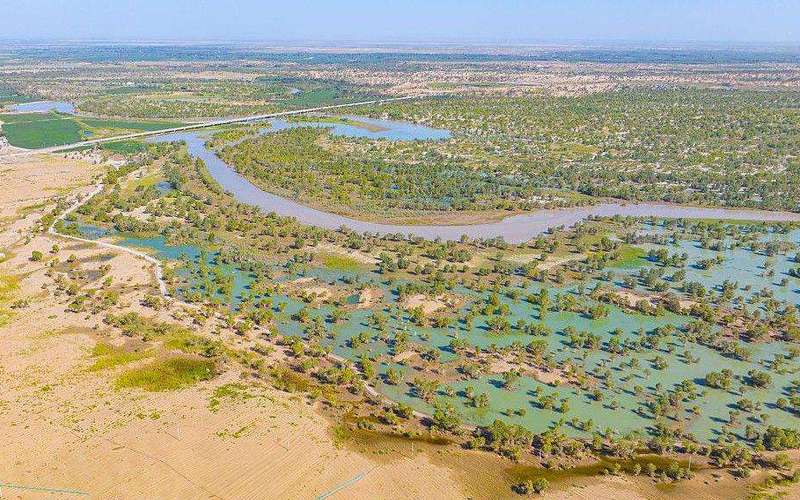
The Taklamakan Desert (also spelled Taklimakan or Takla Makan) is slightly larger than Montana, stretching across about 130,000 square miles (337,000 square kilometers).
Over 95% of the Taklamakan Desert is covered in shifting sand, meaning it has long been considered a "biological void," according to the study.
The desert has been growing since the 1950s, when China underwent massive urbanization and farmland expansion.
Heavy machinery is used to level sand dunes where China wants to plant trees and shrubs along the edges of the Taklamakan Desert.
Previous research indicated that the Taklamakan Desert may be a carbon sink, but those studies focused on CO 2 that is absorbed by the desert's sand.
"Based on the results of this study, the Taklamakan Desert, although only around its rim, represents the first successful model demonstrating the possibility of transforming a desert into a carbon sink," Yung said.
The Great Green Wall's potential to slow desertification remains unclear, but its role as a carbon sink "may serve as a valuable model for other desert regions," he added. »


![image for [OC] TURN THE FILES INTO TRIALS - Cleveland](d4f8c41d-00ae-5ca4-acd5-85fe3df3bf26_thumb.jpg)


![image for [OC] I made a lingerie set out of metal for Valentine's Day](179138d7-013e-5a3d-be02-00f920967c3c_thumb.jpg)

![image for [OC] The Price of Liberty digital illustration](f05ed98b-8e64-5042-9a2f-c3edc96b118e_thumb.jpg)