Sign up for the Slatest to get the most insightful analysis, criticism, and advice out there, delivered to your inbox daily.
Late Thursday night, former CNN anchor Don Lemon was arrested by federal agents at the direction of Attorney General Pam Bondi. Independent journalist Georgia Fort was arrested as well, along with activists Trahern Jeen Crews and Jamael Lydell Lundy. The arrests stem from a protest at Cities Church in St. Paul, Minnesota, where the pastor is also an Immigration and Customs Enforcement agent. Protesters entered the church chanting “ICE out,” disrupting services. Troubling though this may be—places of worship have often been considered off-limits for political protest—the protesters did not assault anyone or even destroy property. Whatever protesters did or didn’t do, Lemon was not demonstrating; he identified himself as a journalist and was clear he was documenting the protest, not participating in it. These arrests came after the Trump Department of Justice’s original criminal complaint against Lemon was rejected because a federal judge—a man who was a former clerk for conservative icon Supreme Court Justice Antonin Scalia and a George W. Bush appointee—found there was no probable cause to arrest him.
Still, Lemon found himself under arrest for the crime of doing journalism. The White House tweeted out: “When life gets you lemons…” followed by two chain emojis and an image of Lemon, accusing him of “involvement in the St. Paul church riots.”
Even for an administration that has spent a year violating the First Amendment in all kinds of novel ways, the arrest of a prominent journalist is a shock—a five-alarm fire moment.
It also shows just how far this administration is willing to go to solidify its control. And it raises the question of just how far Donald Trump’s most loyal followers will follow him. Already, some of them have ceded their fealty to their most valued constitutional amendment—not the First, but the Second. And that willingness to quickly shake off once-sacrosanct beliefs does not bode well for all of our freedoms to speak, protest, and publish.
The Second Amendment, conservatives and Supreme Court justices have complained, is a “disfavored right.” In arguments earlier this month over a Hawaii gun law that limited the ability of people to carry a concealed weapon onto private property, Chief Justice John Roberts asked Neal Katyal, the attorney for the state of Hawaii, why a political candidate door-knocking could under the First Amendment approach private homes and make his case, but under Hawaii’s law couldn’t do so with a gun on him. The conservative justices seemed largely united in their view that the Second Amendment allows an expansive individual right to carry a firearm—a right that is just as expansive as the First Amendment’s protections of free speech and assembly.
Just days after those oral arguments, Alex Pretti was shot multiple times by Customs and Border Protection agents. The conservative reaction to his killing has raised important questions of just how much the right actually cares about gun rights, if the person exercising those rights is a liberal. But it’s raised even more important, and less-discussed, questions about the First Amendment, and the troubling ways in which the rights to speak and protest are being aggressively eroded by this administration and its supporters—including the one-time self-styled conservative warriors for free speech.
This administration’s about-face on the Second Amendment has rightly merited accusations of hypocrisy, and has signaled the willingness of its followers to again relinquish a once-foundational principle out of unbroken loyalty to their Dear Leader. In reality, though, this administration is not going to strip gun rights away from American citizens—at least not those who support the MAGA movement. Despite Trump’s complaints about guns at anti-ICE actions, the legal interpretations of the Second Amendment will likely only grow more ludicrously capacious under this regime.
The First Amendment, though, is a different matter. And it’s the rights within it—to assemble, to speak, to protest, to practice one’s religion, to petition one’s government, to a free press—that are quickly becoming, to both paraphrase Roberts and understate the urgency of the matter, disfavored.
In Minneapolis, Pretti’s gun was holstered. He wasn’t wielding it or intimidating anyone with it, let alone threatening anyone’s life. The Trump administration has nevertheless branded him a “domestic terrorist” and a “would-be assassin.” They have suggested that any opponent of the administration who peacefully exercises their Second Amendment right might forfeit their right to life.
And even more troubling: The administration and its agents are arguing that opponents might lose their lives or their liberty for peacefully exercising their First Amendment rights.
“When politicians, community leaders, and some journalists engage in that heated rhetoric we keep talking about, when they make the choice to vilify law enforcement, calling law enforcement names like Gestapo or using the term kidnapping, that is a choice that has made their actions and consequences that come from those choices,” Border Patrol commander-at-large Greg Bovino said in a press conference over the weekend. “When someone chooses to listen to a politician, a so-called journalist, or a community leader that spouts that type of vilification towards law enforcement or anything else … there are consequences and actions there also, I think we saw that yesterday.”
The “consequences” he’s referring to: Alex Pretti’s death.
Bovino is not the only administration official who has implied that the consequences for free speech might be death. “For months, we’ve been warning politicians and the media to tone down their rhetoric about ICE law enforcement before someone was killed,” Department of Homeland Security Secretary Kristi Noem said in early January. “This shooting must serve as a wake-up call to the far left that their rhetoric about ICE has consequences. Comparing ICE day in and day out to the Nazi Gestapo, the Secret Police, and slave patrols has consequences.”
Last summer, DHS Assistant Secretary for Public Affairs Tricia McLaughlin claimed that “videotaping ICE law enforcement and posting photos and videos of them online is doxing our agents” and threatened to “prosecute those who illegally harass ICE agents to the fullest extent of the law” (photographing and videotaping law enforcement in public is legally protected behavior). Noem defined as “violence” “anything that threatens [DHS agents] and their safety. It is doxing them. It is videotaping them where they’re at.”
White House border czar Tom Homan also blamed “the rhetoric,” not trigger-happy agents, for violence against demonstrators. “I said in March—if the rhetoric doesn’t stop, there is gonna be bloodshed,” he said at a press conference on Thursday. “And there has been.” What Homan actually said back in March was this: “Do I expect violence to escalate? Absolutely.” In February, he warned, “I’m coming to Boston and I’m bringing Hell with me.” Over the summer, he publicly fantasized about beating up a Democratic member of Congress.
In his most recent press conference, Homan referred to ICE agents in Minneapolis as being in “theater”—a term usually used for a region to which soldiers are deployed in combat.
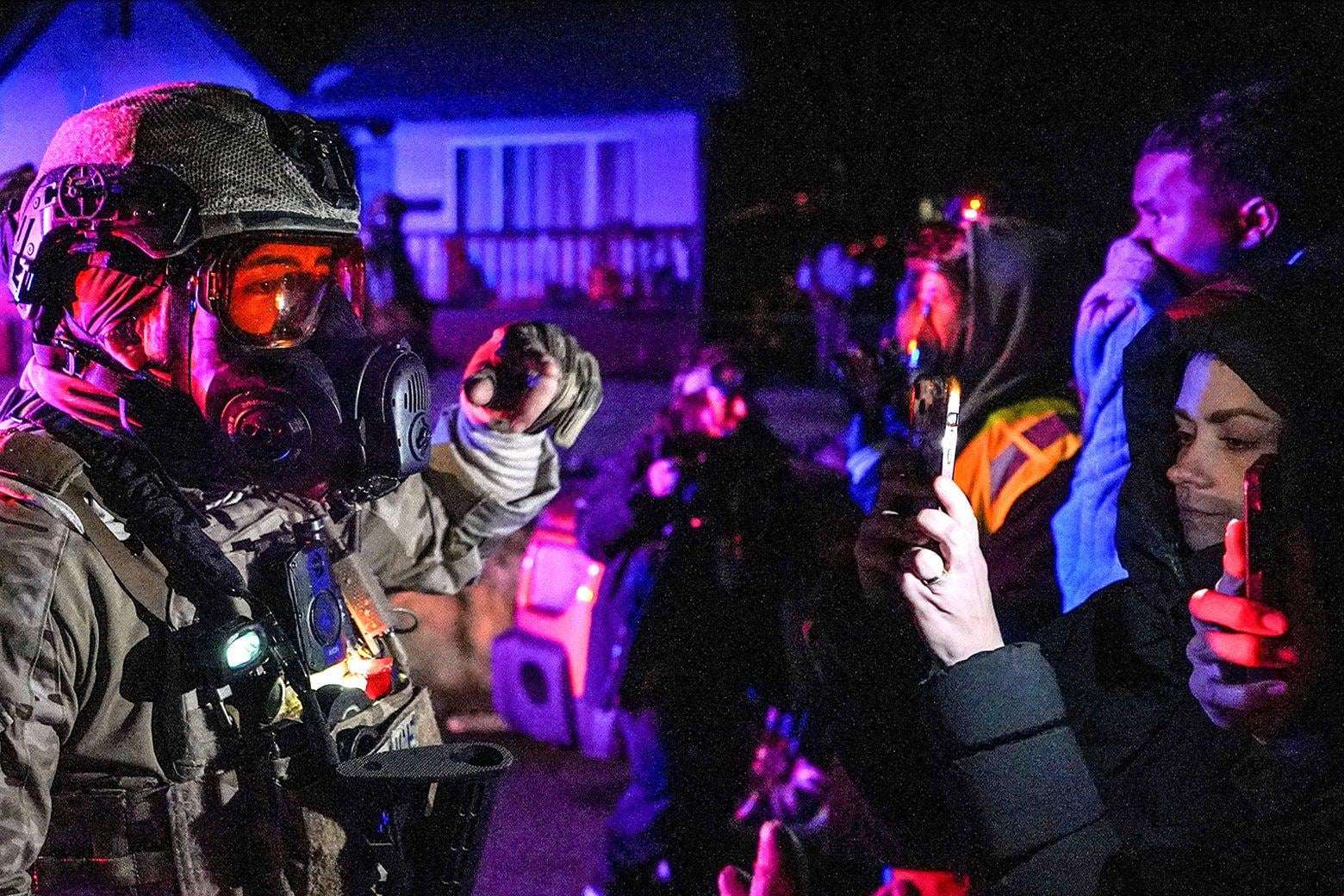
ICE and Customs and Border Patrol agents seem to have gotten the message that they are at war, that the penalty for speech they don’t like might be death, and that they have free rein to assault or even kill those who offend, challenge, or simply just annoy them. “You raise your voice, I erase your voice,” one officer is seen on video saying to an observer. “Listen, have y’all not learned from the past couple of days?” another agent asked citizens who were (legally) filming him in public soon after the Renee Good killing. “Have you not learned?” Agents have, without charges, been detaining witnesses to their violence, it seems to simply intimidate them into shutting up. Yet another federal agent told a woman filming him, “We have a nice little database and now you’re considered a domestic terrorist.”
After Good’s killing, Trump threatened to invoke the Insurrection Act “if the corrupt politicians of Minnesota don’t obey the law and stop the professional agitators and insurrectionists from attacking the Patriots of I.C.E.” Members of his administration have defined “attacking” ICE as filming them, alerting the public to their presence, or calling them fascists—all protected forms of speech, protest, and expression. Right-wing members of the House have renewed calls for the use of the Insurrection Act in the wake of Pretti’s killing. The Insurrection Act would allow Trump to put U.S. soldiers on the streets, and while it does not impose martial law or formally suspend the civil liberties guaranteed to Americans by the Constitution, it is an enormous escalation that treats protesters as domestic enemies. It would almost surely curtail civil liberties by default, if not by law. And while it briefly seemed that Trump and administration officials had somewhat cooled their rhetoric in the wake of a mass publish backlash over the Pretti killing, their arrest of Lemon suggests that they’ve again changed tactics—and that they remain willing to bring the full force of the federal government down on U.S. citizens simply for exercising their First Amendment rights.
This is all coming in the context of an administration that has been more overtly hostile to the First Amendment rights of free speech and expression than any in modern history. The FBI recently searched the home of Washington Post reporter Hannah Natanson, claiming they were looking for “illegal leaks”; Natanson had been reporting on the administration’s gutting of the federal workforce. Tufts University student Rümeysa Öztürk was walking home when masked federal agents grabbed her off of the street, forced her into a van, and ferried her off to a detention center thousands of miles away where they continued deportation proceedings against her—not because she had broken the law, but because the government didn’t like the content of a pro-Palestinian op-ed she wrote. Emmy Award–winning journalist Mario Guevara, who spent two decades covering immigration and the Latino community in Atlanta and had a valid work permit, was arrested by ICE, detained for more than 100 days, and eventually deported to El Salvador. The administration claimed Guevara’s filming of ICE officers—his reporting—constituted a risk to public safety. Retired police officer Larry Bushart of Tennessee was arrested and jailed for more than a month over a Facebook post about Charlie Kirk (the post quoted Trump saying “we have to get over it” about a school shooting).
The existing infringements on the First Amendment have been bad. But what this administration is signaling may be coming could be much worse.
Back in September, the White House released a memo promising to crack down on “domestic terrorism,” which they say is “under the umbrella of self-described ‘anti-fascism.’ ” When it comes to anti-fascism, the memo says, “Common threads animating this violent conduct include anti-Americanism, anti-capitalism, and anti-Christianity; support for the overthrow of the United States Government; extremism on migration, race, and gender; and hostility towards those who hold traditional American views on family, religion, and morality.” Acts of domestic terrorism, they say, include “doxing”—which the administration has defined as simply identifying an ICE officer—and “civil disorder,” by which they mean protest.
Many conservatives spent the whole of the Biden administration crowing about infringements on their First Amendment rights—the wokescolds who wouldn’t let them use racial slurs anymore, the tyrannical government that set limits on public gatherings in the midst of a deadly pandemic. Now that their side is in charge, though, any commitment to the freedoms of speech and assembly seems to have evaporated in favor of retribution and crushing the opposition. This is exceedingly dangerous: Rights are meaningless if the only people who have them are those the regime believes will submit.
Liberals should hope that the administration’s willingness to infringe upon Second Amendment freedoms will be a wake-up call to the gun-obsessed right. Maybe threats to the Second Amendment, even if they’re largely rhetorical, will make a few conservatives take notice of how this regime is on a mission to actually obliterate the First.
Snakesandrats on January 30th, 2026 at 17:35 UTC »
What the hell kind of demonic shit is this? Disgraceful
Painterzzz on January 30th, 2026 at 17:27 UTC »
Why was the other big post about this topic removed by the mods?
It had thousands of comments and about 25k upvotes or something? But the mods removed it because it 'wasn't about US politics'?
Why is this topic being censored?
jrsinhbca on January 30th, 2026 at 17:22 UTC »
Arresting journalists was on my bingo card.