Finally, the minibus addresses a key concern that many in the space community had in 2025: the impoundment of funds. Impoundment is when an Administration refuses to spend the money Congress allocates to it. OMB Director Russ Vought gave weight to these concerns by repeatedly stating his intent not to spend all of the money Congress allocates to agencies, calling appropriations a "ceiling, not a floor" for federal spending, and to send the money back with so little lead time before the end of the fiscal year that Congress can’t act. OMB attempted only one so-called pocket rescission in 2025, and it was aimed at funding for the State Department and U.S. Agency for International Development.
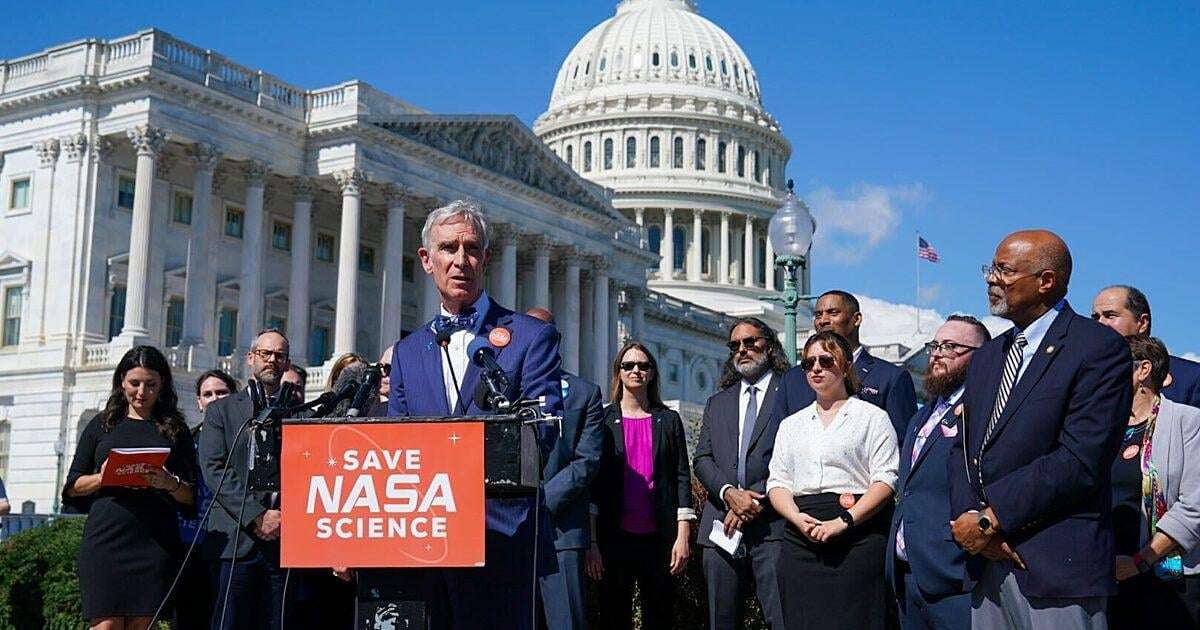
A provision in the House budget proposal from last July would prevent this from happening to NASA by requiring the agency to spend “no less than” the allocated amount on each science division. This was a key priority for the Save NASA Science Day of Action, and the minibus includes exactly the language requested. The threat of impoundment isn’t gone, but there is now a legal backstop in place to prevent it from happening to NASA.
More good news is that, according to publicly available data on science mission budgets, no mission funding was impounded by OMB in FY 2025.
Though these legislative victories are to be celebrated, the flat funding provided by the minibus should be cause for concern. NASA’s budget has not seen meaningful growth since FY 2022. The enactment of the Fiscal Responsibility Act in 2023 limited growth across all discretionary spending accounts in FY 2023 and 2024, and the year-long continuing resolution for FY 2025 kept funding at FY 2024 levels. This has significantly impacted the Science Mission Directorate, which now has almost the same purchasing power it had in FY 2016.
One mission canceled by the OMB proposal that made its way into the final budget was Mars Sample Return. The top priority of the last two planetary science decadal surveys, sample return from Mars, is key to helping scientists better understand the geological and possible astrobiological history of Mars. Samples collected by the Perseverance rover, including the tantalizing Cheyava Falls rock core, may be the most valuable objects in the Solar System. Returning these samples would be one of the greatest feats in human history and could be key to discovering if life ever existed on the Martian surface.
But the fact of the matter is that the Mars Sample Return program has been in limbo for over two years. NASA does not have a plan, despite soliciting feedback from industry and multiple companies publicly announcing their ideas. Though the FY 2026 minibus formally closes down the MSR program office, it was former NASA administrator Bill Nelson’s deference to then-incoming Administrator Jared Isaacman, who then didn’t start the job for another 11 months after this decision was made, that was actually the death knell for Mars Sample Return.
Those samples are not abandoned on the surface of Mars. Congress offers a beacon of hope for the future of sample return. Included in the minibus is a provision that allocates $110 million to a new Mars Future Missions project, with the intended goal of developing a common set of technologies that NASA can use for robotic and eventually crewed missions to Mars. Sample return is among them. As stated in The Planetary Society’s principles for Mars Sample Return, the scientific case has been made for the importance of the samples collected by the Perseverance rover. This could potentially lay the groundwork for a new era of Mars exploration that enables sample return and other Mars science and human exploration goals.
But more than the funding stagnation or mission cancellations, the greatest casualty of 2025 was the loss of expertise at NASA and its partners around the country. Early in the Trump administration’s second tenure, civil servants were offered a choice: stay employed and potentially get laid off through a Reduction in Force (RIF), or take a buyout — the government would still pay their salary, but they’d be placed on leave until the end of the year.
sami_exploring on January 16th, 2026 at 08:13 UTC »
This was an incredibly successful grassroots campaign. Congrats everyone! From the article:
sfworkwork on January 16th, 2026 at 07:35 UTC »
This subreddit is keeping me sane
Sophia8Inches on January 16th, 2026 at 07:15 UTC »
Congress has just passed the FY2026 NASA budget, rejecting deep proposed cuts and providing the agency with robust funding for the next financial year. Accounting for the additional $10 billion allocated to NASA over the next six years by supplemental appropriations, the resulting NASA budget for FY 2026 is the largest in nearly three decades!