lighning bolt icon An icon in the shape of a lightning bolt.
lighning bolt icon An icon in the shape of a lightning bolt. Impact Link
This story is available exclusively to Business Insider subscribers. Become an Insider and start reading now.
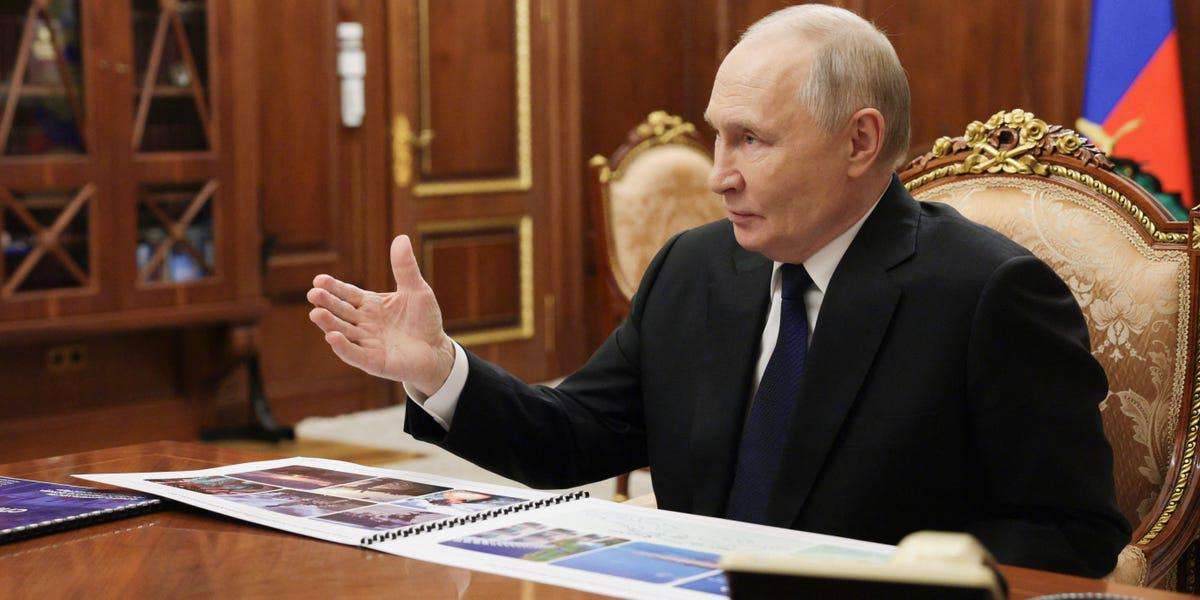
Russian President Vladimir Putin has ordered a "significant increase" in tax collection and compliance this year as Russia's wartime economy continues to lose momentum.
The Kremlin announced the directive on Saturday following an early December meeting of the Council for Strategic Development and National Projects.
A share of that increase is set to come from higher consumption taxes, which rose from 20% to 22% on January 1. This bump is expected to generate about 1 trillion rubles, or $12.3 billion, in tax revenues.
Russia is also planning to introduce a new tax on electronics in September.
The push for more aggressive tax collection comes as Russia's growth has slowed to a near standstill nearly four years after its full-scale invasion of Ukraine.
Follow Huileng Tan Every time Huileng publishes a story, you’ll get an alert straight to your inbox! Stay connected to Huileng and get more of their work as it publishes. Sign up By clicking “Sign up”, you agree to receive emails from Business Insider. In addition, you accept Insider's Terms of Service and Privacy Policy.
While Russia's sanctions-hit wartime economy appeared resilient in the first years of the war, cracks are emerging as persistently low oil prices are taking a toll.
In November, GDP expanded by just 0.1% from a year ago, according to official data. Industrial output declined 0.7%.
In the third quarter, Russia's GDP grew 0.6% from a year ago — sharply lower than the 1.1% in the second quarter and 1.4% in the first.
Putin has also ordered officials to restore economic growth and investment activity, while addressing structural problems across key sectors of the economy.
At the same time, the government is expected to keep inflation in check, with the target rate by the end of 2026 set within the central bank's forecast range of 4% to 5% — down from below 6% expected in 2025 and 9.5% in 2024.
Oil prices fell 20% in 2025 due to ample supply and slowing demand growth.
Developments in the global oil market could add to that pressure. The US raid on Venezuela over the weekend is set to change the calculus for energy markets.
"Big Short" investor Michael Burry wrote on Monday that Russian oil "just became less important" in the mid- to long-term. He said tapping Venezuelan oil could strengthen the US and "reduce Russia's income and power."
That view was echoed by John E. Herbst, the senior director of the Atlantic Council's Eurasia Center and a former US ambassador to Ukraine, who pointed to President Donald Trump's plans for Venezuelan oil.
"Trump has said he intends to put Venezuelan oil — still under tough sanctions — back on the market," wrote Herbst on Monday.
"While this may take some time, it will help him reach his goal of driving down oil prices for US (and therefore global) consumers. This will be another big hit to the Russian economy," he added.
Venezuela holds some of the world's largest oil reserves. But analysts say reviving the country's oil industry could take years due to aging infrastructure, decades of under-investment, sanctions, and political instability.
GabettiXCV on January 6th, 2026 at 09:35 UTC »
Kind reminder that the war economy creates no long-term value.
They're pissing away what little they have left.
IndividualSkill3432 on January 6th, 2026 at 09:27 UTC »
Many people confuse the US experience in WWII with how large scale wars go, the US grew more prosperous from the war. For most participants in WWI and WWII those wars were economic catastrophes, all other major nations were economically collapsing during the war even if the short term war economy measures helped them appear to be in a better place in the first couple of years. This is true for both Ukraine and Russia. Some people like to take a laughing position that people have predicted Russias collapse but it grew! Yes in a war economy you can turn on all the spending, all the debt and all the productive capacity for a year or two and the economy grows. But it's always at the huge expense of all actual productive activity that sustains the current infrastructure and creates the new economic activity for new growth.
To this end both Ukraine and Russia are economically collapsing. The early part of the war had seen Russia reach 100% production capacity, but also very high inflation that for war warworkers was met with rising wages but not for those in the rest of the economy.
Both are collapsing and this will become more evident, it's just who collapses faster.
I am not saying they are cooked in a month, but they are running out of tricks to keep the facade of a peace time economy with a bit more spending. Is a war economy that is eating into everything in the economic system.
CucumberWisdom on January 6th, 2026 at 08:43 UTC »
Can't get blood from a stone