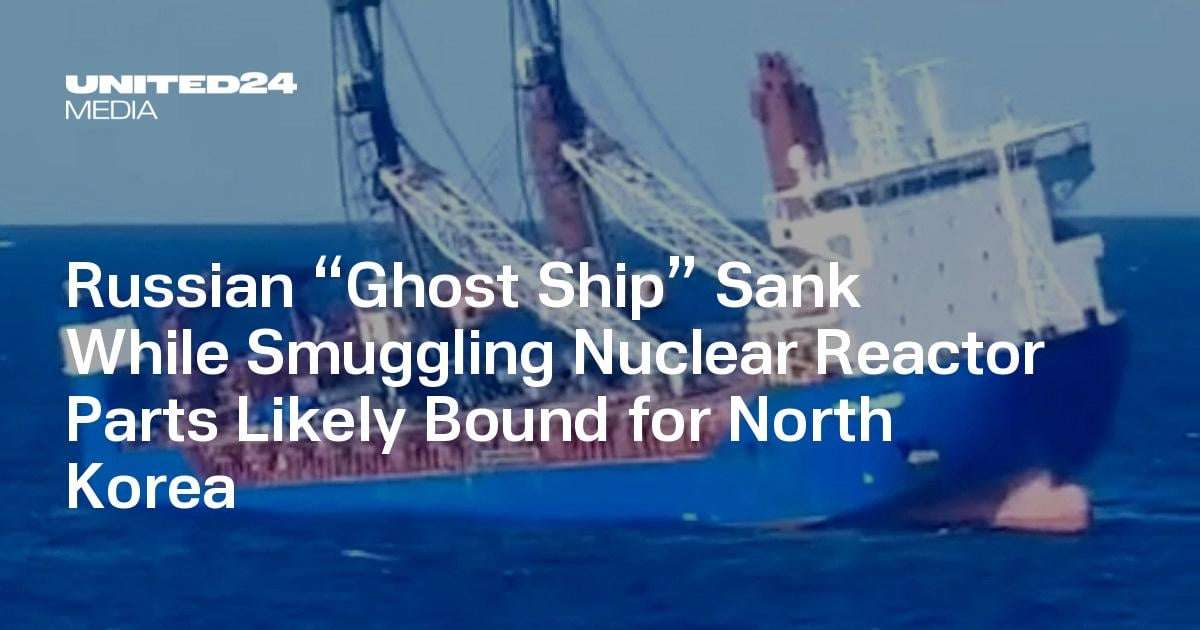
Spanish investigators have confirmed that the Russian cargo vessel Ursa Major, which sank off the coast of Cartagena in December 2024, was carrying undeclared nuclear reactor components likely bound for North Korea.
According to La Verdad, the ship was part of Russia’s shadow fleet and took an unusual route from St. Petersburg to Vladivostok through the Mediterranean.
Though the ship’s manifest listed only empty containers and port equipment, aerial images revealed two large, undeclared containers at the stern. Authorities later identified them as housings for VM-4SG nuclear reactors.
Route of the Russian ship Ursa Major prior to its sinking. (Source: La Verdad)
Spain concluded the shipment was headed for the North Korean port of Rason, which lacks the infrastructure to handle such cargo without specialized cranes—also found onboard.
On December 22, Spanish maritime controllers noticed the vessel losing speed and listing without explanation.
A distress signal followed on December 23. Spanish rescue units responded and found the ship heavily tilted. The captain claimed mechanical failure, but hull damage showed signs of an external strike consistent with a supercavitating torpedo.
The Russian warship Ivan Gren soon arrived, demanded control of the site, and launched flares—likely to disrupt satellite surveillance. Shortly after, the Ursa Major disappeared from the surface. Seismographs recorded underwater explosions, and the ship sank to a depth of 2,500 meters.
The cargo ship Ursa Major. (Source: Jens Smit)
Days later, the Russian vessel Yantar, capable of deep-sea recovery, arrived at the site—suggesting an effort to retrieve or destroy sensitive equipment. Spanish officials believe the reactor parts were part of a covert nuclear cooperation deal between Moscow and Pyongyang, following recent military agreements.
According to La Verdad, the ship was operated by Oboronlogistics, a defense-linked firm that regularly transports military cargo for the Kremlin. While Russia accused Spain of interfering, Spanish officials maintain their actions were in line with international maritime law.
Earlier this month, a shipment of Russian crude oil sold by US‑sanctioned energy giant Rosneft reached Chinese waters after an unusually long and convoluted journey involving multiple tanker‑to‑tanker transfers and route changes aimed at avoiding sanctions scrutiny, according to Bloomberg on December 9.
ghost_n_the_shell on December 30th, 2025 at 15:31 UTC »
I listened to a podcast on Russias dark fleet (basically tankers they are using to bypass sanctions).
They took the shitiest of the shit of shipping containers and basically slapped a coat of paint on them and set sail.
What reckless idiots.
Stereo-soundS on December 30th, 2025 at 15:18 UTC »
Payment to NK for sending their citizens to die in Ukraine, now at the bottom of the ocean.
pinewind108 on December 30th, 2025 at 12:53 UTC »
The weird part is, they chose to go by sea, rather than railroad through Russia. It's all Russian territory from St Petersburg to North Korea. Why not just load the stuff up on a train if it fit in shipping containers?