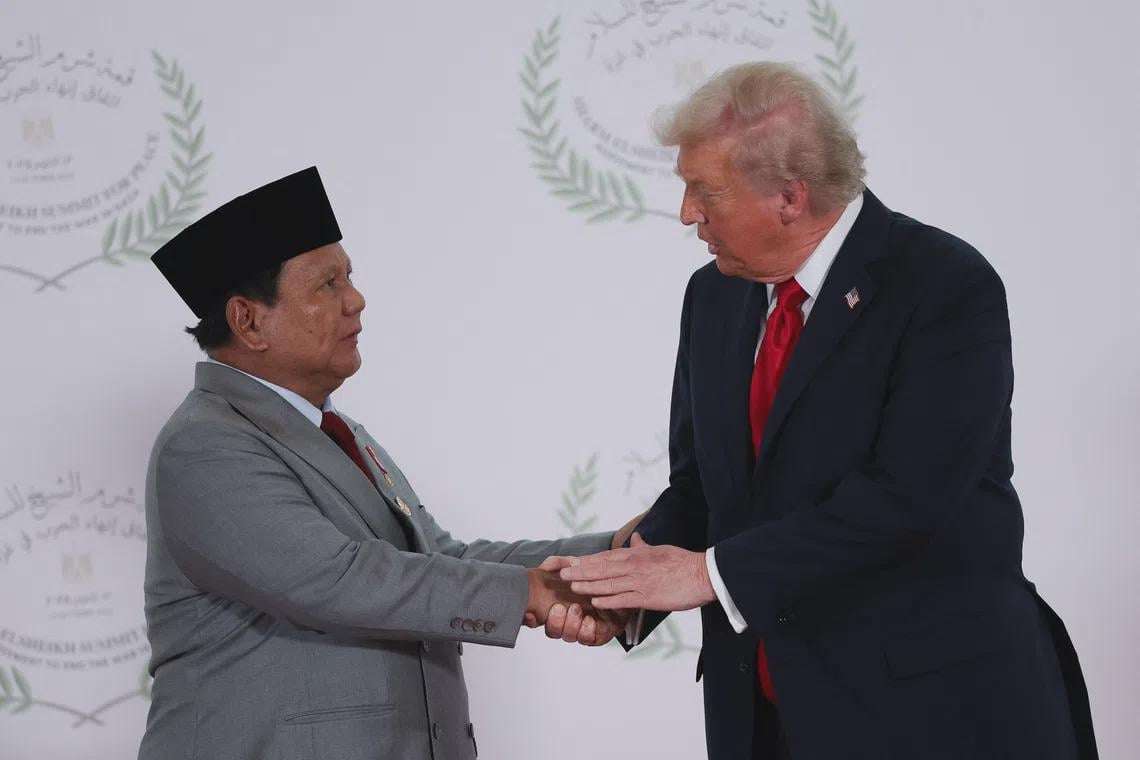
Indonesian President Prabowo Subianto and US President Donald Trump are set to sign a trade agreement at the end of January 2026.
– Indonesia has denied that a tariff agreement with the US, expected to be signed at the end of January 2026, will compromise the South-east Asian nation’s policymaking sovereignty, as it is limited solely to trade matters.
Speaking from Washington, its Coordinating Minister for Economic Affairs Airlangga Hartarto said that Jakarta expects the deal to be signed in the US by President Prabowo Subianto and his US counterpart Donald Trump.
Mr Airlangga made this statement after meeting US Trade Representative Jamieson Greer on Dec 22.
“Other than trade matters, we didn’t touch on any other matters because this would be purely an agreement on reciprocal trade,” he said during an online media briefing.
He stressed that Indonesia is sticking to its pledges to remove non-tariff barriers and various deregulations for fairer trade as conditions in the agreement. However, he did not elaborate further.
In July, Indonesia committed to a series of strategic measures to balance trade with Washington. These included removing non-tariff barriers such as a requirement to have locally made parts in foreign products, such as Apple’s iPhones.
Indonesia in 2024 ran a US$18 billion (S$23 billion) trade surplus with the United States. The US had imposed a 32 per cent tariff on Indonesian goods, but its implementation was paused until July 2025 to make room for negotiations.
South-east Asia’s largest economy and the US are ironing out details on a deal reached in July 2025, under which Indonesia’s exports to the US would face a tariff rate of 19 per cent instead of 32 per cent.
In return for the tariff reduction, Indonesia, among other things, pledged to import US$15 billion worth of energy products and US$4.5 billion worth of agricultural commodities from the US.
Malaysia and Cambodia in October 2025 separately signed their respective Agreement on Reciprocal Trade (ART) with the US. These agreements included controversial “security clauses” which critics argued effectively subcontracts the countries’ foreign policies to Washington.
The clauses authorise the US to unilaterally terminate the deal and reimpose high tariffs if Malaysia or Cambodia makes a new trade deal with a third country that jeopardises vital US interests.
It also means that if the US imposes a restriction on a third country for national security reasons, Malaysia and Cambodia must adopt a measure with an equivalent restrictive effect.
“The meeting went well,” Mr Airlangga said after his meeting with Mr Greer, adding that Indonesia presented issues of importance to Indonesia, just as the US presented issues of primary importance to the US.
“The emphasis was placed on safeguarding the mutual interest of both nations,” he said.
More than half of Indonesia’s fuel imports are currently from Singapore, which refines crude oil from the Middle East, Australia and Malaysia.
In 2024, Indonesia imported petroleum worth US$11.4 billion, or 53 per cent of its total petroleum imports, from Singapore, while only US$19 million worth of the commodity came from the US, which was less than 0.1 per cent of the total petroleum imports, according to government data.
Most of the remaining fuel imports were from Malaysia (valued at US$4.5 billion), China (US$1 billion) and Saudi Arabia (US$825 million).
“The technical teams from both nations in the second week of January will continue to meet for ‘a legal scrubbing’… which we target to complete in one week,” Mr Airlangga said, adding that the targeted completion date is tentatively between Jan 12 and 19, 2026.
Legal scrubbing, or legal review, is the final clean-up of an agreement text after political negotiations are completed and before the document is officially signed. During the legal review process, the substance of the agreement can no longer be changed.
“After all technical processes are complete, it is expected that by end-January we can prepare documents for official signing by President Prabowo and President Trump. The US is making preparations to arrange for a meeting between both leaders,” Mr Airlangga added.
Lone-T on December 23rd, 2025 at 13:15 UTC »
SS: Indonesia has firmly denied sovereignty risks in its impending US tariff deal—set for signing by Presidents Prabowo and Trump in late January 2026—insisting it remains "limited solely to trade matters" after resolving sticking points, including apparent exclusion of controversial "security clauses" found in similar US pacts with Malaysia and Cambodia that allow unilateral termination over third-party deals jeopardizing American interests.
The agreement slashes US tariffs on Indonesian exports from 32% to 19%, mandates removal of non-tariff barriers (e.g., local content rules), and commits Jakarta to US$19.5B in US energy/agricultural imports, while granting US access to critical minerals. Amid Trump's bilateral blitz to counter China's regional sway and Jakarta's non-aligned hedging (including deeper Russia ties), does this "reciprocal trade" framework secure economic wins for Southeast Asia's largest economy without subcontracting foreign policy, or subtly entrench US leverage in a multipolar Indo-Pacific where great-power coercion masquerades as fair trade?