The audio version of this article is generated by AI-based technology. Mispronunciations can occur. We are working with our partners to continually review and improve the results.
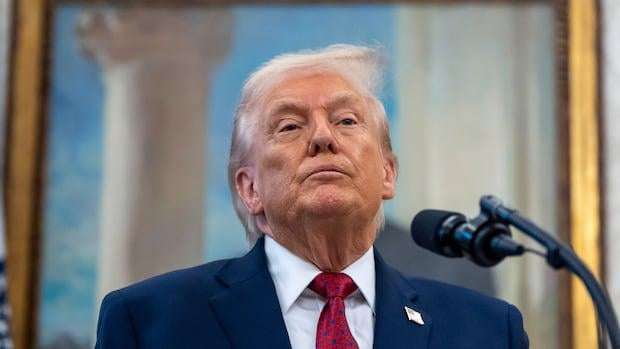
U.S. President Donald Trump signed an executive order on Monday declaring fentanyl a weapon of mass destruction, a move that dramatically expands the U.S. government's authority to fight the synthetic opioid blamed for tens of thousands of American overdose deaths each year.
The designation, unprecedented for a narcotic, signals Trump's intent to treat fentanyl not merely as a public health crisis but as a national security threat on a par with chemical warfare.
The classification, ratcheting up an assault on what he says are gangs hell-bent on flooding the U.S. with drugs, empowers the Pentagon to assist law enforcement and allows intelligence agencies to deploy against drug traffickers the tools normally reserved for countering weapons proliferation.
"We're formally classifying fentanyl as a weapon of mass destruction, which is what it is," Trump said at a White House event honouring service members tasked with helping to police the U.S. southern border with Mexico. "They're trying to drug out our country."
"Illicit fentanyl is closer to a chemical weapon than a narcotic," Trump's order said.
Democratic House Rep. Jim McGovern of Massachusetts criticized the move, referencing Trump's pardon earlier this year of Ross Ulbricht, the founder of the Silk Road marketplace, which prosecutors alleged was used to sell more than $200 million US worth of drugs during a two-year period described at trial.
"Reminder: Trump pardoned the founder of a black market that imported fentanyl from China into the U.S.," McGovern posted on social media.
Justin Amash, a former Republican Congress member, said on X it was "just the latest example of the state twisting the plain meaning of words to expand its power."
"Like 'emergency,' 'terrorist,' and 'defensive'— all stretched to near-limitless scope to justify almost any executive overreach," said Amash.
Trump's designation of drug cartels this year as foreign terrorist organizations has opened the door to military action against them. Since early September, the Trump administration has carried out 25 known strikes against suspected drug vessels in the Caribbean and Pacific, killing 95 people.
The U.S. military said Monday that it attacked three boats accused of smuggling drugs in the eastern Pacific Ocean, killing three people in the first vessel, two in the second boat and three in the third. It didn’t provide evidence of their alleged drug trafficking but posted a video of a boat moving through water before exploding.
WATCH | Venezuela slams 'blatant theft' of U.S. seizing oil tanker: Venezuela denounces U.S. oil tanker seizure as 'piracy' | Duration 5:31 Venezuela's government says the U.S. seizure of an oil tanker off the coast of Venezuela 'constitutes a blatant theft and an act of international piracy.' U.S. Attorney General Pam Bondi says the FBI, the Department of Homeland Security and the U.S. Coast Guard carried out a seizure warrant for the tanker, alleging it was transporting sanctioned oil from Venezuela and Iran.
Legal experts say the strikes may be illegal. There has been little or no proof made public that the boats are carrying drugs or that it was necessary to blow them out of the water rather than stop them, seize their cargo and question those on board.
Trump has repeatedly threatened strikes on land in Venezuela, Colombia and Mexico to battle drug trafficking. In a sweeping strategy document published last week, Trump said his administration's foreign policy focus would be on reasserting U.S. dominance in the Western Hemisphere.
Democrats and some Republicans have pushed back, saying the White House needs congressional authorization for the boat strikes.
Opioid overdoses have killed at least 68,000 Americans every year since 2020.
Mexico is the largest source of U.S.-bound illicit fentanyl. Many of the chemicals used to manufacture the drug are sourced from China.
Venezuela, according to policy experts at Insight Crime and the United Nations Office on Drugs and Crime, produces some cocaine but is more known as a transit point for cocaine produced in Colombia, Peru and Bolivia.
"I served on the select committee on China last Congress and was the co-lead on the fentanyl working group, and I can say with assurance that 99 per cent of fentanyl precursors are coming from China, not from Venezuela," Jake Auchincloss, a Democratic congressman who served in drug interdiction missions in Central America while with the U.S. military, told broadcaster MS Now last month.
ApexAurajin on December 16th, 2025 at 13:13 UTC »
Walgreens has one of the largest WMD arsenals in the world, and these "insurance" companies are funding their regime!
AechCutt on December 16th, 2025 at 13:11 UTC »
So we can imprison the Sackler family, right?
TreeRol on December 16th, 2025 at 12:57 UTC »
Welp, here's the official pretext for war.