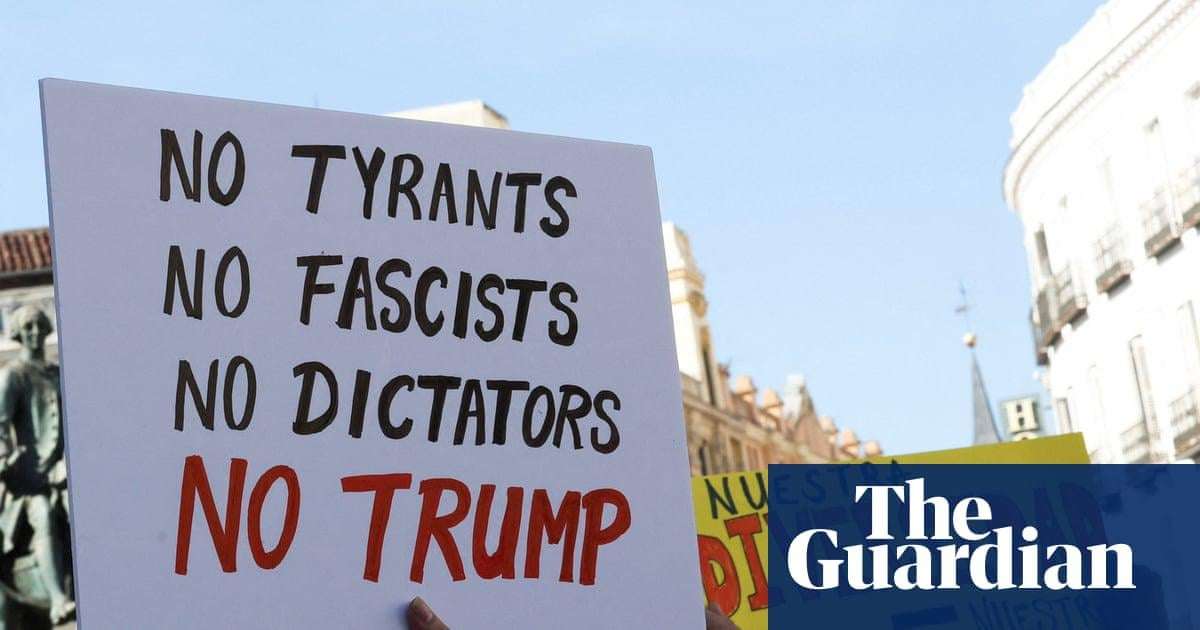
Nearly half of Europeans see Donald Trump as “an enemy of Europe”, rather more rate the risk of war with Russia as high and more than two-thirds believe their country would not be able to defend itself in the event of such a war, a survey has found.
The nine-country poll for the Paris-based European affairs debate platform Le Grand Continent also found that nearly three-quarters of respondents wanted their country to stay in the EU, with almost as many saying leaving the union had harmed the UK.
Jean-Yves Dormagen, a political science professor and founder of the polling agency Cluster17, said: “Europe is not only facing growing risks, it is also undergoing a transformation of its historical, geopolitical and political environment. The overall picture [of the survey] portrays a Europe that is anxious, that is deeply aware of its vulnerabilities and that is struggling to project itself positively into the future.”
The polling found that an average of 48% of people across the nine countries see Trump as an outright foe – ranging from highs of 62% in Belgium and 57% in France to lows of 37% in Croatia and 19% in Poland.
“Across the continent, Trumpism is clearly considered a hostile force,” Dormagen said, adding that this perception was hardening, with fewer people than in December 2024 describing Trump as “neither friend nor foe” and more as definitely hostile.
However, Europeans still view the relationship with the US as strategically important: when asked what position the EU should adopt towards the US government, the most popular option (48%) was compromise.
The survey in France, Italy, Spain, Germany, Poland, Portugal, Croatia, Belgium and the Netherlands also found a relative majority (51%) felt the risk of open war with Russia in the coming years was high, and 18% considered it very high.
Dormagen said such a result “would have been unthinkable just a few years ago and signals the shift of European opinion toward a new geopolitical regime in which the possibility of direct conflict on the continent is now widely accepted”.
skip past newsletter promotion Sign up to This is Europe Free weekly newsletter The most pressing stories and debates for Europeans – from identity to economics to the environment Enter your email address Sign up Privacy Notice: Newsletters may contain information about charities, online ads, and content funded by outside parties. If you do not have an account, we will create a guest account for you on Newsletters may contain information about charities, online ads, and content funded by outside parties. If you do not have an account, we will create a guest account for you on theguardian.com to send you this newsletter. You can complete full registration at any time. For more information about how we use your data see our Privacy Policy . We use Google reCaptcha to protect our website and the Google Privacy Policy and Terms of Service apply. after newsletter promotion
View varied strongly according to proximity to Russia, with 77% of respondents in Poland considering the risk of war to be high, compared with 54% in France, 51% in Germany, 39% in Portugal and 34% in Italy.
Confidence in national military capabilities was low everywhere, the survey found, with 69% of respondents across the nine countries saying they thought their country was “not really” or “not at all” capable of defending itself against Russian aggression.
French respondents were the most confident, but it remained a minority opinion at 44%. In Poland, which shares a border with Russia, 58% were not. Dormagen said: “We are entering an age of danger while feeling a persistent sense of national weakness.”
Feelings of vulnerability were widely shared, the survey found, with only 12% of respondents saying they did not feel particularly threatened by a raft of sources of insecurity ranging from technological and military to energy and food.
Although there were significant national differences, tech and digital security was the most frequently cited threat (28%), then military security (25%). There was strong demand for European help, with 69% of people saying the EU should play a protective role.
The vast majority of respondents across the nine countries backed EU membership: 74% said they wanted their country to stay in the bloc, with that sentiment highest in Portugal (90%) and Spain (89%) and lowest in Poland (68%) and France (61%).
Five years after Brexit, the UK’s decision to leave is overwhelmingly seen as a failure: 63% believed it had had a negative impact on Britain and just 19% thought it had been positive, including 5% who saw it as very positive.
humbleObserver on December 4th, 2025 at 17:10 UTC »
Half of Americans see Trump as the enemy of America
mehupmost on December 4th, 2025 at 16:56 UTC »
It's funny how the percentage drops significantly the closer the country is to Russia.
They aren't as caught up in the media hate machine on Trump - and grounded by the real threat invading Europe right now.
Nitzelplick on December 4th, 2025 at 16:36 UTC »
This may be the only issue about which VP Vance agrees with half of Europe.