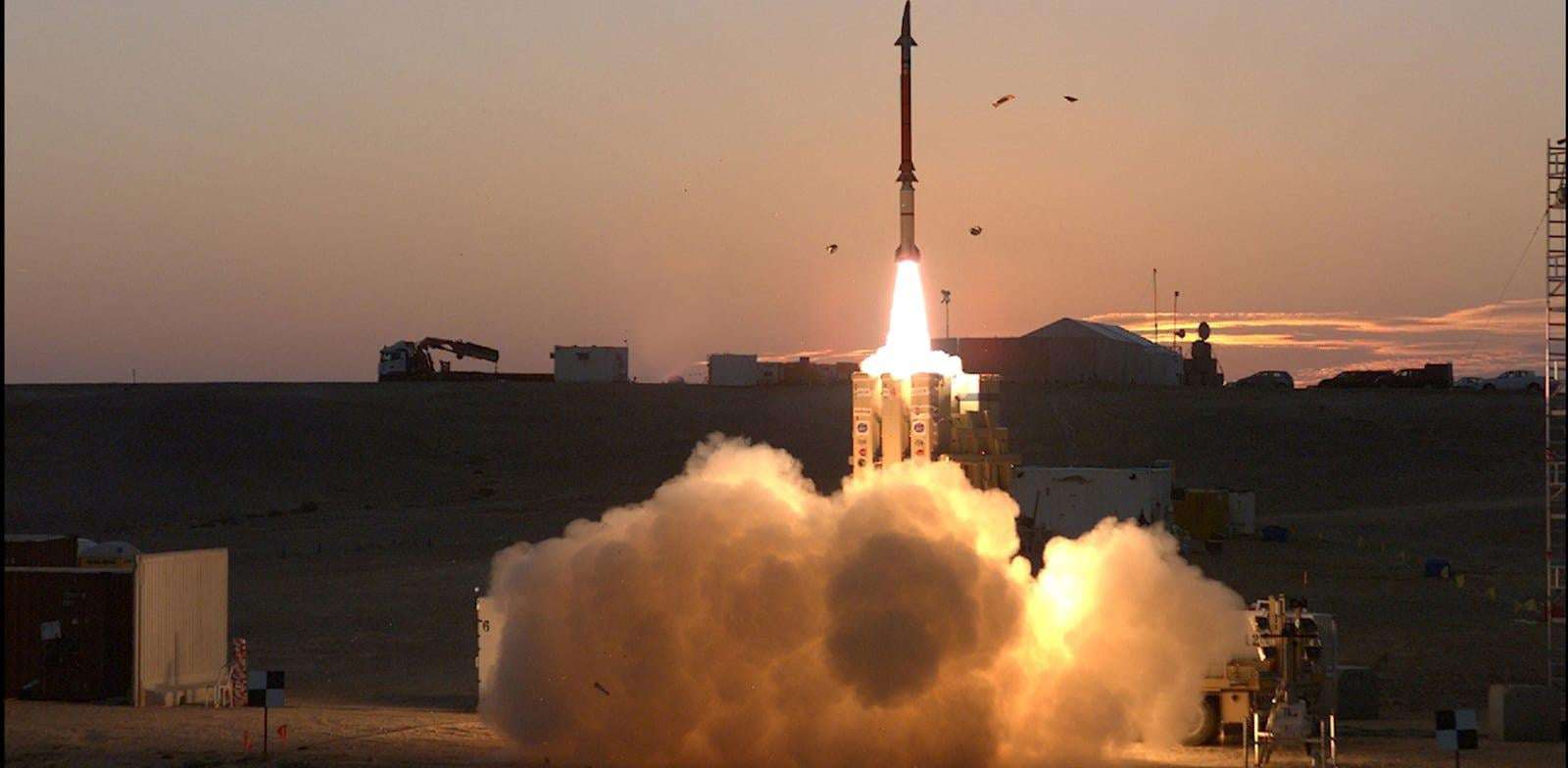
The ceasefire in Gaza is holding, Turkey continues its regional aggression, and the two issues have led Greece, according to reports in the country, to speed up talks to procure three Israeli air defense systems from Israel for €3 billion. The systems, produced by Israel Aerospace Industries (IAI) and Rafael Advanced Defense Systems, will create a new multi-layered defense system.
For many years, Greece has not invested in military technologies, and now they find themselves at a disadvantage in general and facing the main threat, Turkey, in particular. The huge investment will initially cover only the areas of Thrace and the eastern Aegean Sea, with additional deals expected later as Turkey's missile and rocket threat that covers the entire country, Greece is interested in IAI’s Barak MX missile defense system, Rafael's David's Sling, which is also an integral part of the Israeli multi-layered defense system, as well as Spyder, another system manufactured by Rafael.
Barak MX has been sold to a number of countries worldwide
The Barak MX system supports various radars and launchers for coverage against fighter jets, helicopters, UAVs, cruise missiles, surface-to-air missiles and surface-to-surface missiles. The system is based on a smart and operationally proven control center, which allows the integration of additional interceptor missiles: the Barak MRAD short-range interceptor is launched vertically at high speed, adapted to deal with threats at a range of up to 35 kilometers and includes a radar homing head with a single pulse engine; The Barak LRAD interceptor is a medium-range, vertically launched, high-speed interceptor adapted to deal with threats at a range of up to 70 kilometers and includes a radar homing head with a bi-pulse engine; and the Barak ER interceptor is a long-range, vertically launched interceptor that includes a booster engine, a bi-pulse rocket engine, and an advanced radar homing head. The Barak ER interception range is increased by adding a rocket booster and adjusting the communications and radar capabilities to a range of 150 kilometers.
All propulsion engines for the interceptors are manufactured by Israeli government company Tomer, which is the source of national knowhow in the field. The only model used in the Israeli air defense system is the LRAD, which is used in Saar 6 ships. IAI's Barak MX system has been sold to a number of countries around the world, including Azerbaijan, which procured it in November 2024 for $1.2 billion.
Rafael presented its Spyder system to the Greek Air Force senior command in April 2024. The system, which has also attracted interest from other customers such as Kenya, is already in use by several countries - including the Czech Republic. Spider is a defense system that provides air defense solutions at different ranges and against a variety of aerial threats, including drones, aircraft, helicopters and short-range ballistic missiles.
The system intercepts threats using two families of interceptors manufactured by Rafael - Python and Derby. A few months ago, Rafael introduced the All in One configuration for the Spyder system, which offers a complete air defense system including: integral radar, dedicated electro-optical payload, advanced command and control system and Python and Derby interceptors, all installed on just one vehicle. In January 2024, Rafael, in cooperation with the Ministry of Defense R&D Organization (DRDO) (MAFAT) completed a trial of the All-in-One Spyder system.
This configuration constitutes an optimal air defense solution for point defense or as air defense for maneuvering forces, as part of a Spyder battery or in an independent deployment with a small team of operators. In a trial conducted in January in Israel, several scenarios simulating existing and future threats were tested, during which the Spyder system, in its new configuration, intercepted a UAV in a challenging operational scenario with a direct and precise hit. Reports say that Greece plans to deploy the Barak MX throughout mainland Greece with all its ranges: MRAD, LRAD and ER. The Spyder's versatility will be utilized for the deployment of batteries in the Aegean islands up to Crete.
The medium range layer: David’s Sling
Between the Barak MX for the upper layer and the Spyder in the lower layer is David's Sling, which was sold to Finland in August 2023 for €316 million. The system has a range of up to 300 kilometers, a speed of 2.55 kilometers per second (Mach 7.5), and the cost of the interceptor is $700,000. Its first operational interception was before the war, in May 2023 as part of the operation in Gaza against Islamic Jihad.
The David's Sling system is intriguing in the global arena because it also has maneuvering capabilities, and is relevant for intercepting cruise missiles, aircraft, and drones. The system also reflects domestic Israeli cooperation: it includes an MMR radar developed by IAI’s Elta, and the golden Almond command and control system developed by Elbit’s Elisra unit.
The success of David's Sling led the Ministry of Defense to decide in May 2024 to decommission the US Patriot batteries, which was an achievement for Rafael and made world headlines. The decision stemmed, in part, from the fact that David's Sling is a national system - meaning that one system covers the territory of a country - while Patriot is based on batteries that cover only a specific area.
David's Sling is a product that is very close to the PAC3 level, the most advanced interceptor in the Patriot series but in contrast, the Israeli interceptor is cheaper. Thus, each PAC3 interceptor costs an estimated $6 million, while a David's Sling interception costs Israel about $700,000. In addition, a study by the Center for Strategic and International Studies (CSIS) from December 2022 found that buying a new Patriot battery costs $1.1 billion, while the David's Sling system was sold to Finland for $353 million.
Published by Globes, Israel business news - en.globes.co.il - on November 12, 2025.
© Copyright of Globes Publisher Itonut (1983) Ltd., 2025.
leto78 on November 12nd, 2025 at 17:32 UTC »
Given the political situation in Turkey with the crackdown on the opposition, a border conflict with Greece would be the typical justification for another wave of arrests against anyone potentially derailing Erdoğan's hold on power.
jrgkgb on November 12nd, 2025 at 17:00 UTC »
But I was told that Israel is an international pariah no one will do business with?
It was in an internet comment so it must be true.
NotSoSaneExile on November 12nd, 2025 at 15:29 UTC »
Greece is speeding up a €3 billion deal with Israel to buy advanced air defense systems from Israel Aerospace Industries and Rafael.
This comes as Turkey continues its military buildup and regional aggression, while the ceasefire in Gaza remains in place.
After years of little investment in new defense technology, Greece now finds itself at a disadvantage, especially against Turkey, and wants to quickly strengthen its air defenses.
The deal will give Greece a multi-layered defense system similar to Israel’s. It includes the Barak MX, a flexible system that can shoot down aircraft, drones, cruise missiles, and rockets at ranges of up to 150 kilometers.
The David’s Sling system provides a medium-range defense, intercepting threats up to 300 kilometers away at high speed and at a much lower cost than the American Patriot system.
The Spyder system will protect Greek islands and moving forces, using quick-response launchers on vehicles to defend against short-range threats like drones and missiles.
This agreement could become one of Israel’s biggest defense exports to Europe and shows how Greece and Israel are becoming closer partners.
It also reflects Greece’s push to modernize its military and reduce its reliance on older NATO systems, while trying to balance Turkey’s growing power in the eastern Mediterranean.