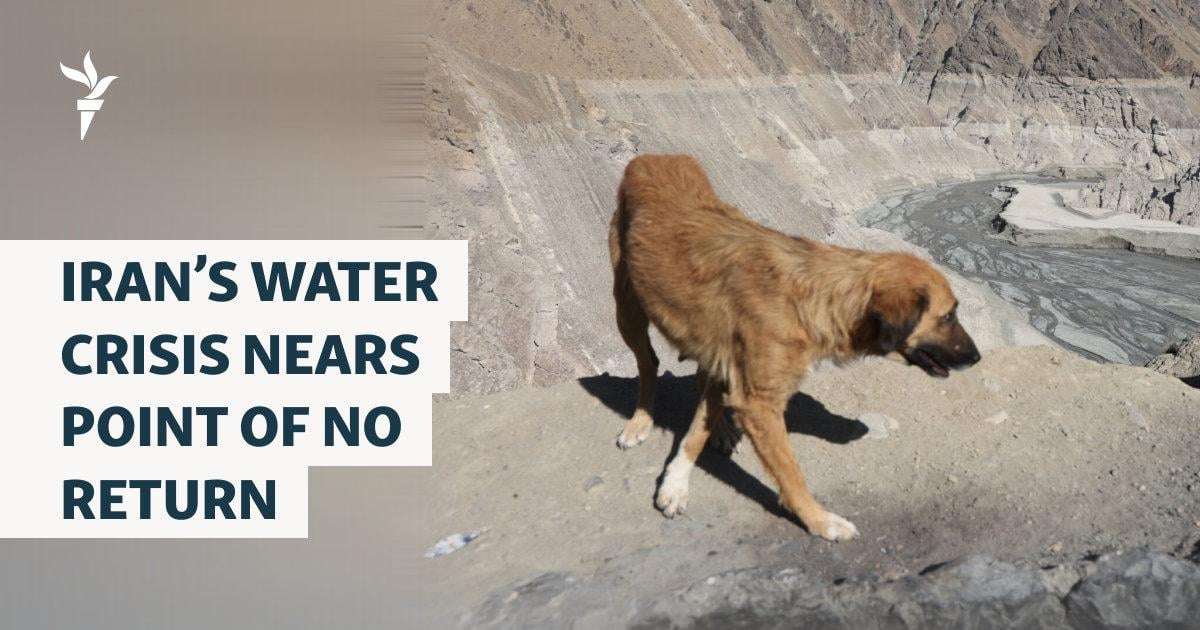
Decades of mismanagement compounded by prolonged drought have pushed Iran to the brink of what experts call water bankruptcy.
With reservoirs running on empty and rainfall at a record low, the authorities have begun rationing water supplies in the Iranian capital, Tehran, a city of some 10 million people.
President Masud Pezeshkian has warned the water crisis could lead to the evacuation of parts of Tehran and went as far as floating the possibility of moving the capital.
Kaveh Madani, director of the Canada-based United Nations University Institute for Water, Environment, and Health, said the warnings by the authorities didn't go far enough.
"The level of their warnings is too low compared to the reality on the ground," Madani, who previously served as deputy head of Iran's Department of Environment, told RFE/RL's Radio Farda.
"The government is being too cautious because it doesn't want to stress the public and upset people even more," he added.
Water bankruptcy is when consumption exceeds supply and the depletion of resources is irreversible. It is often driven by what experts say is misguided government policies intended to boost agriculture and development.
How Bad Is Iran's Water Crisis?
Iran is currently in the grips of the worst drought in some 60 years.
"If it doesn't rain, we'll have to start rationing water in [November]. If the lack of rainfall continues past that, we simply won't have water and will have to evacuate Tehran," Pezeshkian said earlier this month, though other officials have sought to downplay the need to move the capital.
Since last week, water supplies have been cut off in the evenings in Tehran. The authorities have also called on people to curb consumption during the day. Water rationing has not yet been reported in other parts of Iran.
Gallery Compare: Iran's Devastating Drought Crisis Seen From Space Satellite images of key lakes and reservoirs across Iran reveal the extent of the country's crippling drought crisis. New photos show how water levels have dropped dramatically compared to images taken a year ago. Iran's water crisis stems mainly from reduced rainfall and mismanagement of resources. Facebook
The five main reservoirs supplying water to Tehran are at historically low levels, currently holding just 11 percent of overall capacity.
In Mashhad, Iran's second-largest city with 4 million residents, reservoirs have fallen below 3 percent capacity, with three of the four dams supplying the city now out of operation.
Nationwide, 19 major dams -- accounting for 10 percent of Iran's reservoirs -- have run completely dry, and more than 20 dams are holding under 5 percent of their capacity.
Iranian officials have not yet presented a concrete plan to tackle the emergency.
The authorities in Iran typically downplay crises to deflect blame and avoid spreading panic. But officials raising the possibility of evacuating Tehran has underscored the severity -- and the urgency -- of the situation.
Addressing the parliament earlier this week, Pezeshkian told his critics in the chamber that he will "give those who claim they can resolve the water problem full authority" to tackle the water shortage.
Compounding matters, Madani said, is the public's lack of trust in the authorities.
"Society is not aware of how terrible the situation is, and the government is scared of asking people to reduce consumption," he said.
Water shortages have repeatedly sparked protests across Iran in recent years, most notably in Khuzestan Province, where demonstrations in July 2021 were met with a deadly crackdown.
Short-term fixes exist, but experts say fundamental reforms and tough policy decisions are needed to avert a catastrophe.
Azam Bahrami, a sustainable development expert based in Italy, told Radio Farda there needs to be planning and an assessment on where water is wasted to fix the problem in the long term.
"We've wasted a lot of water trying to become self-sufficient in the production of many things," she said.
Iran reportedly produces 85 percent of its food needs domestically -- a self-sufficiency strategy driven by decades of international sanctions and aimed at reducing dependence on global grain markets.
But experts have been warning for years that Iran, which is largely arid, does not have the water resources to sustain it.
Hannah Kaviani and Roya Karimi Majd of RFE/RL's Radio Farda contributed to this report.
The-Intermediator141 on November 13rd, 2025 at 15:17 UTC »
Sad that Iran would be significantly better off if the Shah hadn’t been overthrown. I mean he was your typical corrupt dictator and I’m not defending him, it’s just a fact the Theocratic regime has f*cked up Iran way worse than someone like that could. I mean GDP per capita alone is nearly what it was in 1979 when inflation is factored in.
A revolution of negative progress.
Firecracker048 on November 13rd, 2025 at 13:23 UTC »
BTW the entire crisis is entirely man-made thanks to the Iranian government and IRGC. Real-life lore did a great video on it
Known_Week_158 on November 13rd, 2025 at 11:36 UTC »
This is what happens when you combine corruption, incompetence, and a government more concerned with proxy conflicts than domestic policy.
The IRGC help keep the Ayatollahs in power so their corrupt network of construction companies were allowed to build pretty much whatever they wanted, regardless of how much damage it'd cause to the long-term viability of Iran's natural environment.
While it made strategic sense to locate the nuclear and other key industries in the centre of Iran, that's also where there's some of the least water, which means moving water costs a lot more than usual, and that cost is added to the water loss caused by poor infrastructure.
And Iran has fought proxy or direct wars with the world's leaders in large scale desalinisation technology - the UAE, Saudi Arabia, and Israel. And it isn't worth it for a country like Algeria to work with Iran given the risk of sanctions, while countries like Australia and Morocco are allied to Iran's enemies.
This was an easily avoidable problem. The post-revolution government could have fixed the problems with dams from the Shahs. Instead they made things, far, far, far worse. And now regular Iranians are left to suffer the consequences of the poor decisions of their rulers.