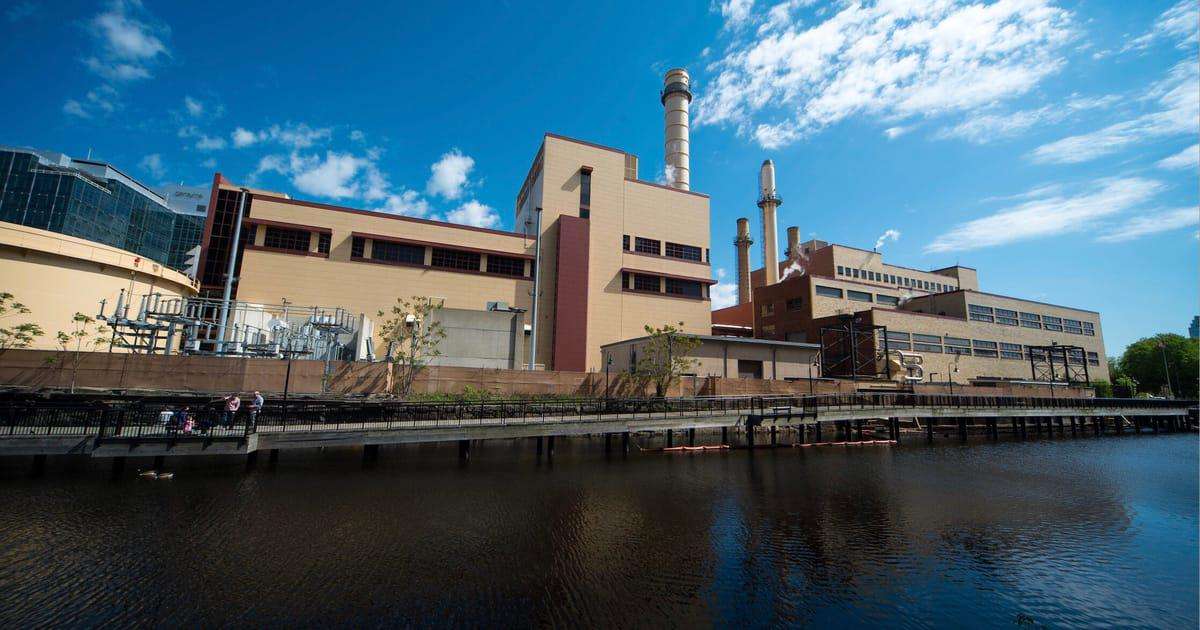
“It’s about one-half to one-fifth the cost for buildings to use our eSteam and electrify through the district energy system than it is for them to locally electrify and decarbonize,” Hagerty said.
Most of those savings come from the fact that the Kendall facility’s electric grid substation and steam pipe network are already built, he said. That obviates the need to retrofit individual buildings with electric heating — or for utilities to make distribution grid upgrades to accommodate a heat pump at every building.
District energy systems like Vicinity’s also benefit from economies of scale, Hagerty said. Large, centralized networks can mix and match mutually reinforcing technologies like electric boilers and heat pumps. They can recapture waste heat from other parts of the system and use it to make more steam, as is being done with the Kendall facility’s gas-fired electricity-generation turbine, which provides peak power and “black start” services for the local grid.
District energy systems can also store and shift energy, as Vicinity plans to do with the thermal energy storage that makes up the next stage of its eSteam conversion plan. It’s looking at systems that can convert electricity into heat storage, which would “allow us to relieve the stress on the electric grid and be a lot more flexible,” he said.
If anything, the Boston-Cambridge system is only starting to utilize the cost-effective decarbonization strategies that district energy systems enable, Hagerty said. Europe is leading the way on that front, with showcase projects such as the 70-megawatt industrial heat pumps now using the chilly water of the Baltic Sea as a thermal exchange to heat water to keep buildings warm in the city of Esbjerg, Denmark.
“They currently have the largest industrial-scale heat pump for district energy in the world,” said Alejandro Gorosito, U.S. national sales manager for Everllence, which provided the heat pump for the Danish city. It won’t hold that distinction for long, he said — Everllence is building a 150-megawatt heat pump for a similar project in Cologne, Germany.
In Europe, adoption of industrial heat pumps is helped along by the fact that fossil fuels tend to be more expensive than electricity. Because heat pumps are far more efficient than fossil-fueled options, they can be the most cost-effective choice when electricity is cheaper, Gorosito said — a fact that can push companies without climate goals to pursue the clean-heat technology.
In much of the United States, where fossil fuels are abundant and power prices are rising fast, the math doesn’t favor heat pumps, Hagerty conceded. But for Boston and other cities that require building owners to reduce their carbon emissions, and for states like Massachusetts that aim to decarbonize their economies, district energy systems can serve as a “regulatory hedge for our customers,” he said.
Warlord68 on November 9th, 2025 at 20:49 UTC »
How is the electricity being generated?
iani63 on November 9th, 2025 at 19:27 UTC »
Cambridge and Boston are both in the UK, please confirm which country?
could_use_a_snack on November 9th, 2025 at 19:12 UTC »
This is where you should put data centers, pull the heat from them to help heat surrounding buildings.