The discovery came at a remote army checkpoint in North Darfur in April, when Sudanese troops stopped a convoy and began unloading crates of ammunition. One box was marked in Cyrillic letters, unusual in a place where few could read them.
Inside were mortar rounds stamped with serial numbers that would later lead United Nations investigators to a Bulgarian arms factory — and then to the United Arab Emirates (UAE), which had bought them from there five years earlier.
It appeared to confirm what had long been suspected: Sudan’s civil war — a violent struggle between the national army and the powerful Rapid Support Forces (RSF) — has become a proxy for rival nations and their ambitions abroad.
• What is happening in Sudan? The civil war explained
Once a ragtag band of desert fighters, the RSF is descended from the Janjaweed militias notorious for the slaughter of black Africans in Darfur two decades ago. Since then it has become, thanks to foreign arms deliveries, one of the most heavily armed irregular armies in Africa.
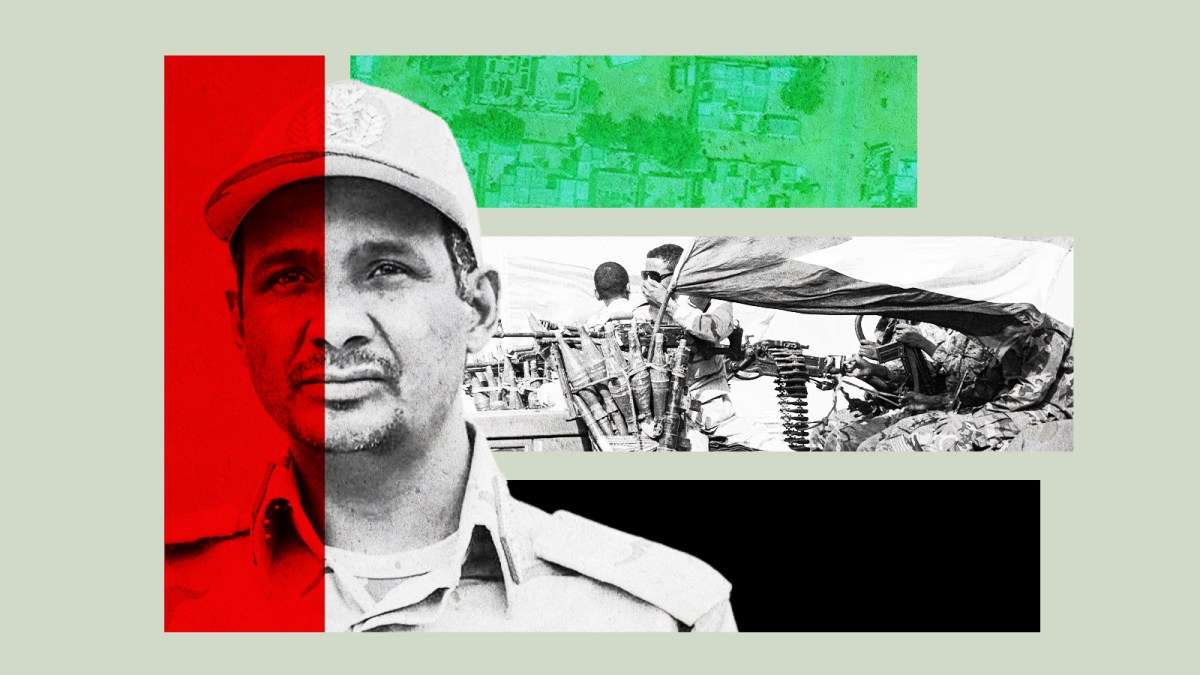
Its leader, Mohamed Hamdan Dagalo, known as Hemedti, is a former camel trader from Darfur’s hinterland who has turned the RSF into a private empire built on gold, guns and foreign patrons. Evidence linking the firepower he has unleashed against civilians to the Gulf — and in particular to the UAE — is mounting.
Mohamed Hamdan Daglo in Khartoum in 2020 EBRAHIM HAMID/AFP/GETTY IMAGES
“UN monitors and US intelligence agencies have reportedly mapped out strong evidence alleging the complicity of the UAE in the flow of arms to Sudan,” said Michael Jones of the Royal United Services Institute (Rusi), a security think tank in London. “With the help of a network of middlemen across Libya, Uganda, the Central African Republic and Chad, the RSF has seemingly received everything from drones to howitzers, vehicles, ammunition and logistical equipment.”
The UAE has always denied arming the RSF. Anwar Gargash, the top diplomatic adviser to the UAE leader, called for a ceasefire last week. “This is what we want: we want negotiations, we want transition to civilian rule and most importantly we need a ceasefire.”
But UN investigators and human-rights monitors say they keep finding patterns: cargo manifests that don’t match deliveries; munitions with serial numbers leading back to Emirati depots; and RSF commanders boasting of outside help.
Sudanese army officers inspect a weapons storage site belonging to the RSF in Khartoum in May 3 AP
In April, a leaked UN experts’ report documented “multiple” flights of transport planes from the UAE that had deliberately tried to avoid detection as they flew into bases in Chad, the key smuggling route into western Sudan. The UAE has insisted that flights it has sent into Chad carry only humanitarian supplies.
The New York Times reported in September 2023 that satellite imagery and officials said flights to Chad had been “near-daily” since June.
“The United Arab Emirates are seeking to cement their position as a middle order power,” said Ahmed Soliman, a senior research fellow at the Chatham House think tank. He added that “the UAE leadership is anti-Islamist”. Although it includes elements of the country’s former Islamist regime, it has been attempting to reframe its political vision as secular.
But the UAE is by no means the only foreign player.
Across the Red Sea, Saudi Arabia and Egypt have thrown their weight behind the Sudanese Armed Forces (SAF), the country’s official army. Cairo sees Sudan’s generals as a bulwark against Islamist influence and a guardian of the Nile waters on which Egypt depends. Saudi Arabia, meanwhile, fears the RSF’s growing ties to rival Gulf networks and wants to keep the conflict from spilling across the region.
Iran, too, has played a role, quietly resupplying the army with drones and missile systems, trading hardware for influence in the Red Sea. Turkey’s drone industry and defence exporters have also found their way into the fight; and, to the west, Libya’s de facto leader Khalifa Haftar has given the RSF a rear base in eastern Libya and a corridor across the desert through which fuel, weapons and fighters move freely into Darfur.
The carnage in El Fasher, which fell to the RSF on October 27 after an 18-month siege, has sharpened international focus on the foreign weapons fuelling the war. Those who escaped tell of mass rape, abductions and massacres. Images of pools of blood saturating the ground are visible even from space.
RSF fighters celebrate in El Fasher on October 26 AFP/GETTY IMAGES
A satellite image shows fires and smoke around El Fasher airport VANTOR/EPA
Western diplomats say quiet pleas have already been delivered to the UAE, while human rights groups are demanding a formal investigation into whether its weapons exports breach a UN arms embargo.
Even in Washington, where the Emirates remain a close ally of President Trump, officials privately concede that the evidence of complicity is becoming harder to ignore.
The UN’s investigation into how the Bulgarian mortar rounds made their way to Sudan found that they were exported legally to the UAE in 2019. The serial numbers led investigators to Bulgaria’s state arms factory, VMZ Sopot, which confirmed the sale but said it had issued no licence for re-export. Experts concluded that the shells were almost certainly diverted through Chad.
British-made components have surfaced on the battlefield, too, sold legally to the UAE but apparently re-exported in breach of end-use agreements — another reminder of how blurred the lines have become between legal trade and illicit supply.
A member of the RSF clutches rocket-propelled grenades YASUYOSHI CHIBA/AFP/GETTY IMAGES
Behind the weapons lies another, quieter engine of the war: gold. Sudan is Africa’s third-largest producer of the precious metal, and the RSF controls many of the mines in Darfur. Smuggled bullion moves through Chad and the Central African Republic to Dubai, where it disappears into the Emirati gold market. The trade gives the RSF the cash to buy arms and pay fighters — and gives its foreign backers both profit and leverage.
Gold has helped to draw in a host of outsiders — even Russia’s Wagner Group — and has turned war into a lucrative business. With such resources, the RSF can keep fighting long after its opponents tire or starve.
For civilians caught in the middle, that is catastrophic. Whole towns have been emptied, markets torched, aid convoys looted. Hunger has tightened its grip on Darfur and the neighbouring Kordofan region — perhaps the RSF’s next target. Famine warnings now cover much of western Sudan, where access for humanitarian relief work has all but collapsed.
Displaced Sudanese families shelter at the newly established Al-Afadh camp in Al Dabbah after fleeing conflict zones in North Darfur ANADOLU/GETTY IMAGES
Two decades ago, the genocide in Darfur was curbed only after a wave of international outrage and a “Save Darfur” celebrity campaign led by figures such as Barack Obama, George Clooney and Brad Pitt, which pushed the UN to impose an arms embargo and send in African Union peacekeepers.
This time, diplomats say, the best chance of stopping the killing is to persuade regional sponsors to stop fuelling it. Washington is reportedly negotiating separately with each side in favour of a three-month humanitarian truce.
“The RSF are capable of fighting indefinitely with current backing,” said Solimon of Chatham House. “It’s the long dry season now, there’s a real possibility the fighting will continue for months. Pressure on the warring parties might enable a ceasefire. The question is whether they are genuinely interested in a ceasefire.”
For now, though, the slaughter goes on, sustained by gold, guns and the silence of those who could stop it.
The Sunday Times contacted UAE officials for comment.
shadowfax12221 on November 8th, 2025 at 17:11 UTC »
Wagner PMCs and Local RSF proxies provide security for mineral extraction in exchange for arms and money laundering services. The Russians use these minerals to evade sanctions, and wealthy figures in the UAE profit tremendously as middle men.
LateralEntry on November 8th, 2025 at 15:16 UTC »
I still don’t understand what UAE has to gain from getting involved in such a messy conflict. Yes, Sudan has lots of gold, but UAE already has incredible natural resource wealth. Sudan isn’t good for agriculture, UAE already has coastal access, etc, why risk getting involved with these genocidal maniacs?
TimesandSundayTimes on November 8th, 2025 at 14:43 UTC »
The discovery came at a remote army checkpoint in North Darfur in April, when Sudanese troops stopped a convoy and began unloading crates of ammunition. One box was marked in Cyrillic letters, unusual in a place where few could read them.
Inside were mortar rounds stamped with serial numbers that would later lead United Nations investigators to a Bulgarian arms factory — and then to the United Arab Emirates (UAE), which had bought them from there five years earlier.
It appeared to confirm what had long been suspected: Sudan’s civil war — a violent struggle between the national army and the powerful Rapid Support Forces (RSF) — has become a proxy for rival nations and their ambitions abroad.
The RSF's leader, Mohamed Hamdan Dagalo, known as Hemedti, is a former camel trader from Darfur’s hinterland who has turned the RSF into a private empire built on gold, guns and foreign patrons. Evidence linking the firepower he has unleashed against civilians to the Gulf — and in particular to the UAE — is mounting.
The UAE has always denied arming the RSF. Anwar Gargash, the top diplomatic adviser to the UAE leader, called for a ceasefire last week. “This is what we want: we want negotiations, we want transition to civilian rule and most importantly we need a ceasefire.”
But UN investigators and human-rights monitors say they keep finding patterns: cargo manifests that don’t match deliveries; munitions with serial numbers leading back to Emirati depots; and RSF commanders boasting of outside help.