A poll from the journal Nature found that 75% of researchers in the U.S. are considering leaving the country. That includes a man who’s been dubbed the "Mozart of Math." Stephanie Sy examines what’s behind a potential scientific brain drain.
Notice: Transcripts are machine and human generated and lightly edited for accuracy. They may contain errors.
A poll from the journal "Nature" earlier this year found that 75 percent of researchers in the U.S. are considering leaving the country. That includes a man who's been dubbed the Mozart of Math.
Stephanie Sy examines what's behind a potential scientific brain drain.
And you're only allowed to use it three times.
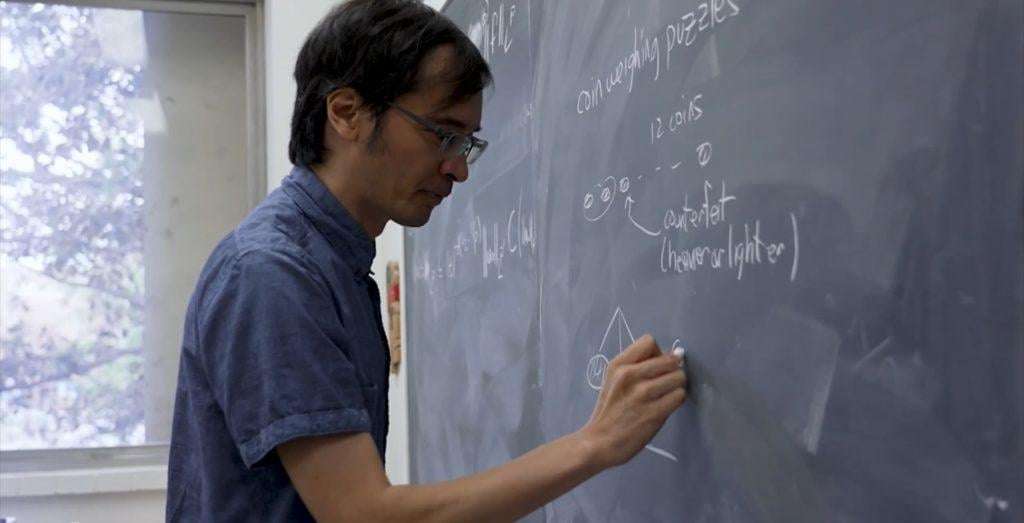
UCLA Professor Terence Tao has spent his entire life solving problems, not just theoretical ones.
And every scan is like taking one measurement.
Tao is explaining how his research led to an algorithm which dramatically cut the time of MRI scans.
MRI scans that used to take, say, three minutes, they cannot take 30, 40 seconds.
Math research has led to countless technological breakthroughs.
These are things that mathematicians played with in like the early 20th century.
Hailed as the Mozart of Math, Tao enrolled in college by the time he was 9. As a teenager, he immigrated from Australia to the U.S. and began a Ph.D. program at Princeton. In 2006, he won math's highest honor, the Fields Medal.
And, today, he's widely considered to be the finest mathematician of his generation.
What was appealing about being a researcher and a Ph.D. student here in the U.S.?
Because there's just this long tradition of excellence and people know that they can come here, they can be welcomed. I was very influenced by American science shows. "Cosmos" in particular had a big impact on me.
Let's count the bets and find out.
I learned to count from "Sesame Street," for instance. Also, they're just — I bet, just because of scale, you have got to have 100 good universities, 100 good math departments. There's just so many conferences and workshops, and there was a really lively ecosystem.
But the lively ecosystem that helped develop his genius is under threat.
For the first time, I'm actually concerned about, like, existential issues. Like, departments could conceivably, like, either close down or drastically reduce their research component.
As part of the Trump administration's push to slash federal spending, the National Science Foundation was forced to suspend $1 billion in grants. The cuts directly hit Tao and UCLA's Institute for Pure and Applied Mathematics, where he directs special projects.
Suddenly, my life is fund-raising and finding alternative sources of funding and making sort of triage plans. If — how do you — like, if funding is — if we can't restore funding, like, what do you cut first?
The White House has cited multiple reasons for federal research cuts, often without clear explanation or connections to its rationale. That includes opposition to DEI policies and an ongoing battle with many universities over antisemitism and what it calls wokeness.
The uncertainty and instability in funding is causing many researchers and scientists, including Tao, to weigh whether to leave the U.S.
I myself have been contacted by departments from Europe and Australia and China.
I mean, until, yes, six months ago, I'd say I'm very happy here, that, I mean, things have worked here for 30 years. But, yes, in the worst-case scenario, which I didn't even think was on the radar, I mean, maybe if the institute closes down, I can no longer fund my students, I have to find another option.
And there's evidence that a brain drain may already be under way.
So I have definitely kind of shifted my focus towards finding a research position abroad, particularly in Europe.
Daniella Fodera is a biomedical engineer who is set to complete her Ph.D. from Columbia University this fall. Back in March, the NIH grant that helped fund her research on uterine fibroids, which affect roughly 80 percent of women, was canceled.
For a condition that affects so many women, the fact that we don't understand why it happens and how we can possibly treat it is a disservice.
Fodera's funding was later restored after Columbia agreed to pay more than $200 million to settle several investigations with the Trump administration. Even so, she's now looking abroad and in the private sector for research opportunities.
Definitely a path that I would never have envisioned, but, in this moment, it is making me consider other options.
Anna Darling, Ph.D, Ohio State University:
I thought the only thing that could stop me from getting a Ph.D. is for the world to end. And the science world is kind of ending, the — at least at the collegiate level.
Last month, Anna Darling started a Ph.D. program in neuroscience at Ohio State University, where she's researching how early life stress and trauma can impact adolescent behaviors.
I wanted to be a professor, just like my mom, who was a science teacher growing up. I wanted to teach science.
But Darling says she recently found out that the funding for her Ph.D. program is no longer guaranteed.
My outlook on being a scientist in this country has definitely changed, because not only is the path a little bit more challenging, but also the freedom to do the research you want to do and to speak on the topics that you truly believe and hold value in is just not as free as it used to be.
One of the things that's always made America great is our research excellence. And that's something that takes a long time to build. And when you lose that, it's really hard to regain it.
Biochemist Stephen Jones has already left the U.S. for Lithuania. In 2020, during the height of the pandemic, he says he began applying for jobs overseas after noticing a rise in anti-science sentiment.
I would really love to be in a place where the type of work that I'm doing is being valued. And that's something that's, once I started interviewing outside of the U.S., I was seeing more of that, sort of this respect, not just by people within the scientific community, but people outside of the scientific community.
Today, Jones is running a research lab at a Lithuanian university. And while many of his American colleagues initially questioned his move, he says some are now asking for advice on how to do the same.
You can tell that people's brains are sort of shifting now. And it's not just like, oh, isn't that cute, to, what if I did that?
Meanwhile, other nations see an opening to bolster their own scientific ranks. The European Union and France recently pledged a half-billion euros in grants to entice scientists to the continent's universities.
Since last year, the number of U.S.-based scientists seeking employment outside of the country has risen by 30 percent, with many applying to jobs in Canada, Europe, and China.
I myself came here from India on an immigrant visa, an H-1B visa here, and I have been given so many amazing opportunities for, which I'm really grateful for.
Vidya Saravanapandian is a neuroscientist at UCLA who studies brain activity in children with developmental disorders.
We have 128 little electrodes here, and you can see them numbered.
She says the consequences of an exodus of research talent will be felt far beyond universities.
Shutting down labs will have huge consequences. Your students will leave. Ideas are lost. Your experiments are ruined. And this will have a huge impact on your economy. All of this is making me really sad and scared for where this is going and what the future of science is for us as scientists, as well as for the younger generation.
Professor Tao has been critical of how the Trump administration has made funding cuts without minimizing harm to research and the people behind it.
To be honest, the mind-set of the administration is rather alien to me. I mean, like, it's — whatever it is, it's not coming from the public interest being the primary objective. For any complex problem, including how to develop a scientific ecosystem, you need a process where many, many voices can be heard, and one person who doesn't understand all the facilities can't just sort of come in and wreck everything.
How to protect America's scientific infrastructure is the latest problem Tao is trying to solve.
For the "PBS News Hour," I'm Stephanie Sy in Los Angeles.
PixelPantsAshli on November 1st, 2025 at 00:15 UTC »
I graduated high school months after 9/11.
Graduated from arts college just in time for the '08 financial crash.
Why in the pissing spectre of fuck I decided to go back to school for my B.S. in Botany, I will never know... but I am once again graduating into a world that has no need for me.
Sorry I'm cursed. I'll stop trying now.
shiny_brine on October 31st, 2025 at 23:43 UTC »
This is how other countries made great gains in science when the Soviet Union collapsed. Those scientist were not getting paid so they went to science facilities in Europe, Asia and the US among other institutions and provided phenomenal additions to their research teams in micro-biology, physics, and many other disciplines. It advanced science in many areas, and now the US giving the rest of the world many of their best scientists and researchers so they can outpace the US in all fields. Trump has efficiently reduced the US position in science research to be a trailing country.
DrexellGames on October 31st, 2025 at 23:42 UTC »
This is what happens when short term politics can dictate long term research. It doesn't come back once a talented researcher is gone