Why Taliban minister's visit to India is so groundbreaking
15 hours ago Share Save Dawood Azami BBC World Service and Cherylann Mollan Mumbai Share Save
Randhir Jaiswal/MEA Twitter Amir Khan Muttaqi arrived in India on Thursday for a week-long trip
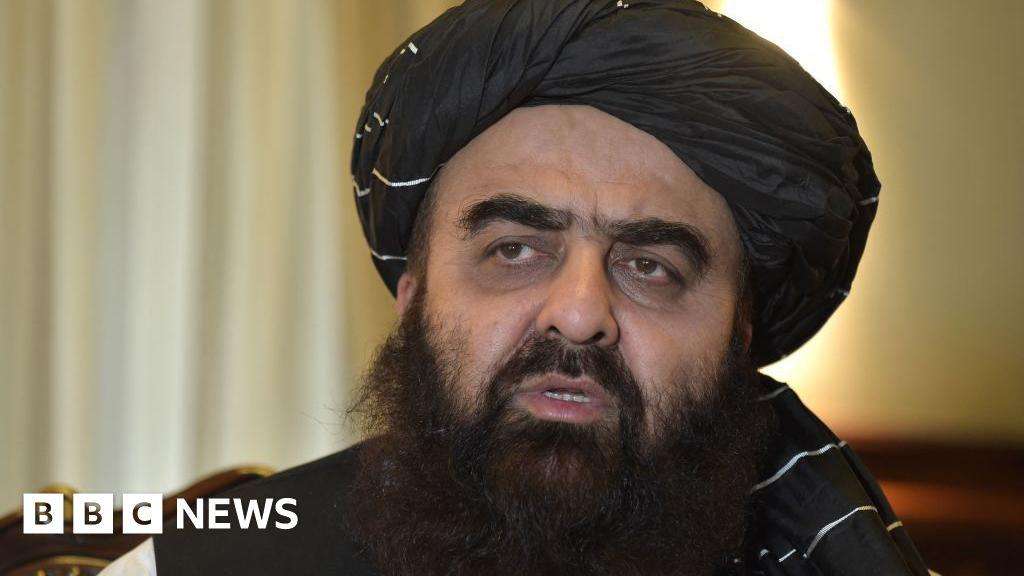
Afghan Taliban Foreign Minister Amir Khan Muttaqi has arrived in India for a week of talks - a visit which had been previously unimaginable. It is the Taliban's highest-level visit to the country since seizing power in 2021, and Muttaqi is due to discuss diplomatic, trade and economic ties with Indian officials during an eight-day stay. The visit is being seen as a ramping up of India's Afghan policy. On Friday, after Muttaqi met Indian Foreign Minister S Jaishankar, Delhi said that it will reopen its embassy in Kabul which was shut four years ago when the Taliban returned to power. Arch-rival Pakistan, which historically had close ties with the Taliban, will be watching closely.
Muttaqi - who was granted a temporary exemption from UN sanctions allowing him to travel - flew into Delhi from Russia, the only country so far to fully recognise the Taliban government. The astonishing fact is that neither Islamabad, Delhi or the Taliban could have anticipated that so soon after taking power, the Taliban's relations with Pakistan would deteriorate to such a degree, while India would establish a multilateral relationship with the new government in Kabul. Delhi used to support the Western-backed Afghan government, which the Taliban drove from power, and this visit illustrates pragmatism and realpolitik on both sides, indicating they are serious about upgrading diplomatic, political and trade links. Muttaqi, accompanied by Afghan trade and foreign ministry officials, held talks with India's Jaishankar in Delhi on Friday. "Closer cooperation between us contributes to your national development as well as regional stability and resilience," Jaishankar said. He also affirmed India's "full commitment to the sovereignty, territorial integrity and independence of Afghanistan". Meanwhile, Muttaqi called India a "close friend" and added that his visit would improve relations between the two countries. The Afghan delegation will also meet representatives of the Indian business community.
Getty Images The Taliban took control of Afghanistan in August 2021
Although India has not formally recognised Afghanistan's de facto rulers, it is one of a number of countries that maintain some form of diplomatic or informal relations with the Taliban. India currently has a small mission in Kabul, and sends humanitarian aid to Afghanistan, one of the poorest countries in the world. The growing engagement between India's right-wing Hindu nationalist government and the Islamist Taliban started not long after the group's return to power in Kabul. This particular trip comes against a backdrop of worsening ties between both India and Pakistan, and Pakistan and the Taliban government. "The deterioration in ties with Pakistan also allows them [Taliban] to hedge their bets and show how it is no longer dependent on Islamabad for its survival - carving out an identity separate from their over-dependence on Pakistan," Harsh V Pant and Shivam Shekhawat, of the Observer Research Foundation think tank, wrote in a piece for NDTV news channel. Deeper engagement with India also gives the group a chance to "create a perception of legitimacy for their domestic constituents", according to Mr Pant and Mr Shekhawat.
Getty Images Muttaqi and Russian Foreign Minister Sergei Lavrov at the Moscow Format consultations on Afghanistan
The visit "represents a setback for Pakistan" and marks a significant step towards the Taliban regime's de facto recognition, said Brahma Chellaney, a strategic affairs analyst on X. It signals "a cautious reset in India-Taliban relations, with both sides prioritising pragmatic engagement to advance their strategic interests", Chellaney added, saying the visit also marks a possible shift in Afghanistan's regional power dynamics. Just more than four years ago, all this seemed unlikely. After a timeline was set for US-led forces to withdraw by mid-2021, panic prevailed in Indian policy circles. As the Taliban captured Kabul on 15 August 2021, India shut its embassy and four consulates in Afghanistan and stopped issuing visas to Afghans from all walks of life, including students, patients, traders and former government officials and politicians. With just one click it cancelled nearly all the visas it had already issued to thousands of Afghans, allegedly due to security concerns. But within a year India had re-established its diplomatic presence, sending a "technical team" to Afghanistan in June 2022, tasked with overseeing the distribution of humanitarian aid. Delhi also started issuing visas to influential Taliban figures, government officials and their family members. Such visits, though not announced officially, helped build trust and understanding. Last November, India allowed the Taliban to appoint an envoy in Delhi and to open consulates first in Mumbai, then a few months later in Hyderabad. Over the past three years, the two countries have been working on gradually rebuilding ties, with Indian officials and diplomats holding several high-level engagements abroad, including a meeting between Muttaqi and India's Foreign Secretary Vikram Misri in Dubai in January this year.
Getty Images Afghanistan is one of the poorest countries in the world
Only_bliss_ on October 10th, 2025 at 16:40 UTC »
There's one more thing to be added to this discussion. The rare earth minerals & gold mines which previously china along with pakistan were trying and now, america is after.. that's why, it's cozying up with a chamellion pakistan... Afghanistan knows this and they always remember that whenever natural calamities take effect, India is always there, tomm India has also built their government office, parliament & what not? Here, this visit was also to3 open their embassy..
ImperiumRome on October 10th, 2025 at 16:22 UTC »
Forget the "enemy of my enemy", it's now "the old friend of my enemy is my new friend".
I hope India knows what it's doing, but for now this empowers the Taliban more so than it helps India. I doubt the Taliban would turn their back on their old friend, another fundamentalist Muslim country, like India hopes, despite whatever schism is developing between them and Pakistan.
r_bradbury1 on October 10th, 2025 at 16:07 UTC »
Submission:
Afghan Taliban Foreign Minister Amir Khan Muttaqi's eight-day visit to India marks the highest-level engagement since the Taliban seized power in 2021. This previously "unimaginable" visit illustrates pragmatism and realpolitik on both sides, as they look to upgrade diplomatic, political, and trade links. The discussions focus on trade, economic ties, and diplomatic relations. Following a meeting between Muttaqi and Indian Foreign Minister S. Jaishankar, India announced it will reopen its embassy in Kabul, which was closed four years ago. Muttaqi, calling India a "close friend," also met with the Indian business community.
This warming relationship between India and the de facto Taliban government is set against a backdrop of sharply deteriorating ties between Pakistan and the Taliban. Pakistan, historically a close ally of the Taliban, is now publicly calling Afghanistan an "enemy country" due to the alleged sheltering of the Pakistani Taliban (TTP), a charge the Taliban rejects.