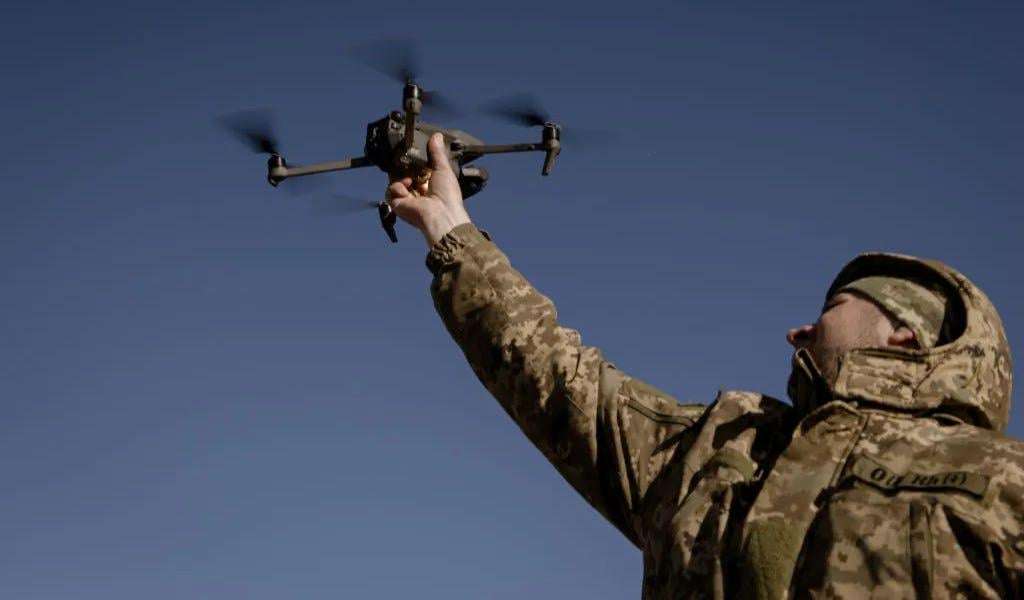
KYIV, Ukraine — The war of the future is already here—and you are not sufficiently scared of it. Unless, that is, you are Ukrainian.
Russia’s full-scale war against Ukraine is now in its fourth year—or its 12th, if you date it from the annexation of Crimea in 2014. Since February 2022, the country has cycled through three wars. First it was a tank war, in which columns of Russian tanks fought a bungled blitzkrieg. Then it became an artillery war, in which the two sides traded fire from entrenched positions. Now, however, it’s almost entirely a drone war, with a supporting role for small and highly vulnerable infantry units.
The question is how well Europeans understand this. The people of Poland, Romania, Estonia, and (perhaps) Denmark all now know that Russian drones are capable of entering their airspace. But have they truly grasped what that implies?
Max Boot’s memorable line—that the Russia-Ukraine War was a cross between All Quiet on the Western Front and Blade Runner—is already obsolete. Ask any of the Ukrainian drone operators and they will tell you: This war is a massive multiplayer game in which the characters you kill cannot respawn. (There is in fact a first-person shooter Ukraine War game that you can play on Steam, Slava Ukraini!, but it doesn’t remotely resemble the control panel of a real military drone operator. This video is more like it.)
The thing that is hard to grasp is the sheer number of drones in the skies. Hundreds can be in the air at any given moment—swarms of them, buzzing overhead like outsize and lethal hornets, some watching with unblinking eyes for targets, others descending inexorably for the kill. Soon there will be thousands.
According to Oleksandr Kamyshin, a key adviser to President Volodymyr Zelensky, 95 percent of the damage inflicted on the battlefield is now by drones. At the same time, only around 20 percent of drone missions are successful. Attrition is very high.
That means there are at least two distinct battlefields. One is the home front: Ukraine’s increasingly vulnerable cities. The other is the enormously long line of contact that stretches from Sumy and Kharkiv in the north to Kherson and Crimea in the south. It is the most lethal strip of territory in the world.
Because surveillance drones are ubiquitous in the sky, the slightest movement by ground forces is picked up. If a potential target is recognized by systems that are increasingly automated, attack drones are immediately dispatched. The phrase you most commonly hear from men who have served at the front line is: “If you hear the drone, then you are dead.” The challenge is that, as the swarms grow in size, the noise becomes more common. In the words of the veteran war correspondent Richard Engel, “The future of war is constant buzz overhead.”
When the United States expanded its use of “unmanned aerial vehicles” in the War on Terror in Afghanistan, Iraq, and Pakistan, drones were big and expensive. Today they are smaller and far cheaper. The key then was exquisite precision. Today, that’s taken for granted.
The key now is mass—or preferably, to use a phrase I learned from the German pioneer of drone software, Lorenz Meier, autonomous mass. In other words, the goal is vast AI-enabled swarms of drones with edge computing. We are getting there fast. The other, harder goal is systems that can defend against autonomous mass. In other words, drones that hunt and kill enemy drones.
Both sides have rapidly increased their drone production in the past year. Ukraine produced 2.2 million FPV (first-person view) drones last year. This year the figure will be close to 6-7 million.
The bad news for Ukraine is that Russia is making even more, especially of the Shahed-136s, based on an Iranian design but now mass produced in Russian factories.
The good news is that Ukraine leads on quality. And the remarkable thing is that most of its technological edge is homegrown.
To read the rest of this essay, go to:
LothorBrune on September 25th, 2025 at 22:31 UTC »
Ferguson knows less than me about military history, and I'm just some random guy who's read some books in his spare time. I'll wait for someone with a minimum of seriousness.
Volodio on September 25th, 2025 at 21:24 UTC »
Not every war is like Ukraine. We should be careful not too learn too much from Ukraine and base our entire strategy based on the war in Ukraine. This is a mistake the author is making. The Ukraine War sees such an importance for drones because there is a parity between both sides, notably on air power (Russia doesn't have air superiority) and drones are used as a cheap replacement for better systems that neither side is able to use. The western doctrine is based around complete air superiority which would prevent the war from turning into a stalemate where drones have such a huge place. Not to say we should ignore drones entirely, but we should not think this represent the future of all wars either.
Thinking this is like thinking that trench warfare was back because of the Iran-Iraq War and we should base our strategy around it. A few years later the US crushed the Iraqi army in a few weeks and there was no trench warfare at all.
HooverInstitution on September 25th, 2025 at 20:01 UTC »
Previewing at his Substack a recent column for The Free Press, Niall Ferguson shares key insights into the future of armed conflict from his recent trip to Ukraine. “The war of the future is already here—and you are not sufficiently scared of it,” warns Ferguson. Extrapolating from trends already present on the battlefields of eastern Ukraine, the historian argues that for today’s war planners, “the goal is vast AI-enabled swarms of drones with edge computing. We are getting there fast.” Ferguson emphasizes in this piece that few have fully grasped the implications of drone-centric warfare for great power military preparedness going forward. Focusing on European sluggishness to adapt, Ferguson writes, “The people of Poland, Romania, Estonia, and (perhaps) Denmark all now know that Russian drones are capable of entering their airspace. But have they truly grasped what that implies?”