Keir Starmer said in a video that 'to revive the hope of peace for the Palestinians and Israelis, and a two state solution, the United Kingdom formally recognises the State of Palestine'
cancel email WhatsApp link share Share bookmark Save
share cancel email WhatsApp link bookmark
The UK has officially recognised the state of Palestine in a symbolic move of support, as the death toll in Gaza continues to rise.
Sir Keir Starmer announced in July that he was preparing to officially recognise the state, but only if Israel failed to meet certain conditions, including a ceasefire in Gaza.
The Prime Minister said the UK was recognising Palestine in order to “keep alive the possibility of peace” in the face “of the growing horror in the Middle East”.
He said: “Today, to revive the hope of peace and a two-state solution, I state clear as Prime Minister of this great country that the United Kingdom formally recognises the State of Palestine.
“We recognised the State of Israel more than 75 years ago as a homeland for the Jewish people.
“Today we join over 150 countries who recognise a Palestinian state also.
“A pledge to the Palestinian and Israeli people that there can be a better future.”
Israeli Prime Minister Benjamin Netanyahu has responded to calls from world leaders to recognise Palestine, branding it an “absurd reward for terrorism”.
Israel has also argued there is no starvation in the enclave and no restrictions on food entering Gaza.
Palestinians inspect the scale of destruction after al-Ghafri Tower is completely destroyed as a result of the Israeli attacks on Gaza City on 15 September (Photo: Hamza Z. H. Qraiqea/Anadolu via Getty Images)
Recognition is unlikely to make any tangible difference to the war in Gaza, but is a symbolic gesture of support.
Several previous British governments have discussed making the move, but wanted it to be part of a peace process.
Prior to recognition from the UK, Palestine was already recognised by 75 per cent of the UN’s 193 member committee.
It has the status of a “permanent observer state”, meaning it is allowed to participate but has no voting rights.
Despite being internationally recognised, competing in sporting events and having diplomatic missions abroad, Palestine has no internally agreed boundaries because of its dispute with Israel.
Israel’s illegal military occupation of the West Bank means that the Palestinian authority, which was set up in the 1990s, does not have full control over its land and its people.
Palestinians at Nuseirat Refugee Camp queue to receive hot meals from charity organisations as people struggle with hunger due to the Israeli food blockade (Photo: Moiz Salhi/Anadolu via Getty Images)
Husam Zomlot, a Palestinian diplomat in the UK, said that recognition would “today end the denial of our existence that started 108 years ago in 1914”.
Zomlot was referring to the Balfour Declaration, supported by the UK, which created the Jewish state in 1917.
The Declaration established “a national home for the Jewish people” in Palestine with a promise that the rights of non-Jewish communities would not be infringed.
“I think today the British people should celebrate a day when history is corrected”, said Zomlot, “when wrongs are being righted, when recognition of the wrongs of the past are beginning to be corrected, and when taking responsibility of that colonial era”.
Recognition means the UK is allowed to enter treaties with Palestine and that the UK supports Palestine’s right to self-determination, that it disapproves of Israel’s refusal to negotiate a two-state solution, and that Israel will not be able to annex land and displace Palestinian people to no consequence.
It is unlikely, however, that recognising the state of Palestine will bring the conflict any closer to ending.
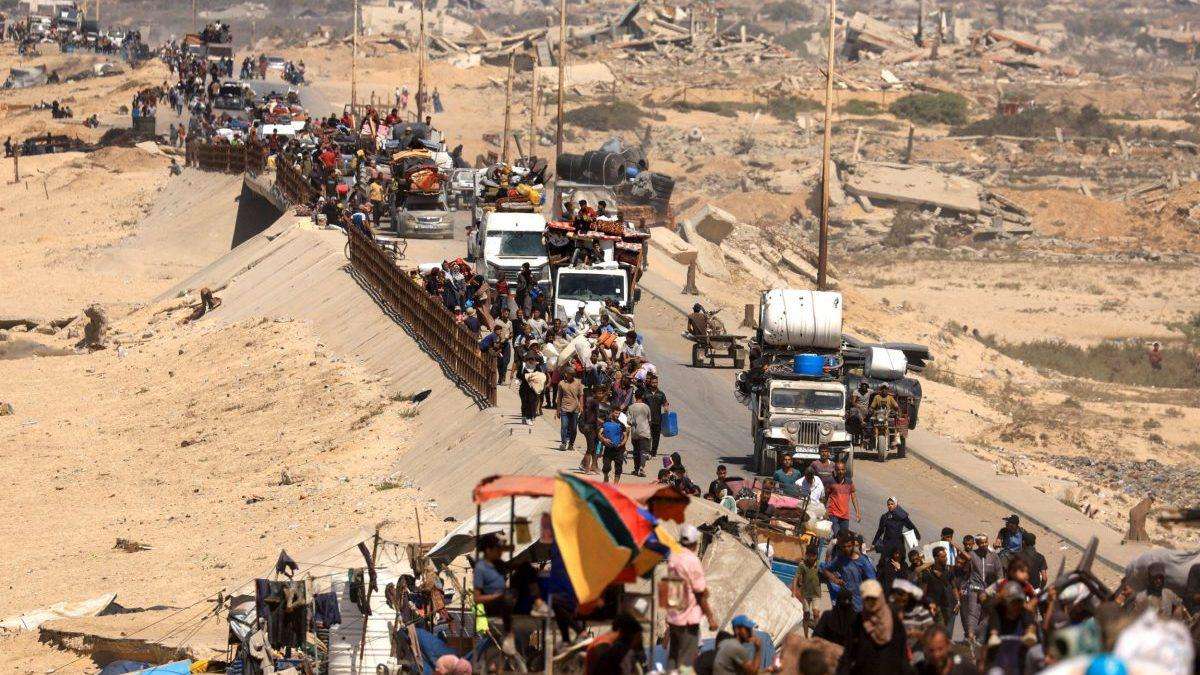
Displaced Palestinians move southwards after Israeli forces ordered residents of Gaza City to evacuate to the south (Photo: Dawoud Abu Alkas/Reuters)
Speaking to Sky News on Sunday, deputy Prime Minister David Lammy, said the prospect of a ceasefire “at this point lies in tatters”.
He added that although the UK has recognised Palestine, doing so would not bring about the creation of a Palestinian state “overnight”.
There has been mounting pressure on the UK to take action, as scenes of destruction and ruin continue to emerge from Gaza.
Palestinian health authorities say Israel’s ground and air campaign in the Gaza Strip has killed more than 60,000 people, and that children make up a third of that figure.
The UN said in July there was mounting evidence that “widespread starvation, malnutrition and disease” was driving a rise in hunger-related deaths.
A food distribution centre in Khan Yunis on 19 September, 2025 (Photo: Abdallah F.s. Alattar/Anadolu via Getty Images)
More than a thousand Palestinians waiting for supplies near food distribution sites in Gaza have also been killed over the past several months.
Food distribution has been managed by the controversial Gaza Humanitarian Foundation (GHF). The organisation, backed by Israel and the US, has claimed that they have distributed hundreds of food parcels to Palestinians.
But UN experts described GHF as “an utterly disturbing example of how humanitarian relief can be exploited for covert military and geopolitical agenda in serious breach of international law”.
The Prime Minister has denied he was waiting for President Trump to leave the UK before going ahead with the move, despite it being a point of tension between the pair.
At a press conference on Thursday, Starmer said he had “made my position clear at the end of July, so the timing, it’s got nothing to do with this state visit”.
Canada has recognised the state of Palestine with Prime Minister Mark Carney saying the country “offers our partnership in building the promise of a peaceful future for both the State of Palestine and the State of Israel”.
Australia followed the UK and Canada in recognising the State of Palestine as part of a “co-ordinated international effort to build new momentum” to a two-state solution.
The US has been public is its opposition to the move, with Trump saying on Thursday that he has a “disagreement with the prime minister on that score”.
Donald Trump and Keir Starmer disagreed over granting Palestine recognition during Trump’s state visit to the UK (Photo: Leon Neal/Getty Images)
Republican members of congress, including its chairwoman Elise Stefanik and Senator Rick Scott, sent a letter to allies calling on them to reverse their position on the recognition of Palestine.
The letter read: “We are writing with respect to your efforts to unilaterally recognise a Palestinian state at the upcoming 80th session of the United Nations General Assembly. This is a reckless policy that undermines prospects for peace”.
It added: “It sets the dangerous precent that violence, not diplomacy, is the most expedient means for terrorist groups like Hamas to achieve their political aims”.
theoceansknow on September 21st, 2025 at 16:35 UTC »
It feels performative to state a recognition for Palestine that doesn't acknowledge the government of Palestine is split between two groups hostile to each other.
Saying the words "two-state solution" is like a balm for first world countries whose citizens don't want to engage with the brick-wall that is "negotiating" and "holding peace talks".
It comes across as these nations needing to make these statements to placate their internal divisions.
It's hard to imagine a different outcome than further simmering war when the negotiating points -- right of return and land transfer of Jerusalem -- aren't acceptable for Israel.
netowi on September 21st, 2025 at 16:02 UTC »
I think what's interesting about the statement is that it doesn't mention who they're recognizing as the State of Palestine. It just says they formally recognize a state of Palestine. But who are they talking about? A state isn't some nebulous concept: it's a polity run by real people. When you recognize a state, you recognize a government that effectively runs territory as a sovereign state, not just a sub-national or breakaway entity.
The Republic of Artsakh, when it existed before the Azeris ethnically cleansed them, or the Republic of Somaliland, both justify recognition as sovereign states better than the "State of Palestine," which has 100 embassies abroad and no real control anywhere it claims as its own territory.
Unique_hobo on September 21st, 2025 at 15:52 UTC »
"What it means?". Nothing. This is a feel-good measure to appease an internal audience by saying "look, we are helping", without having to actually do anything to help improve the situation. Before anyone comes in and says that, yes, this is a moral victory for the Palestinian cause or that it opens the road for peace in the future, I want you to explain to me how it achieves any of that.