Gunmen kill 22 after shooting at baptism ceremony in Niger - reports
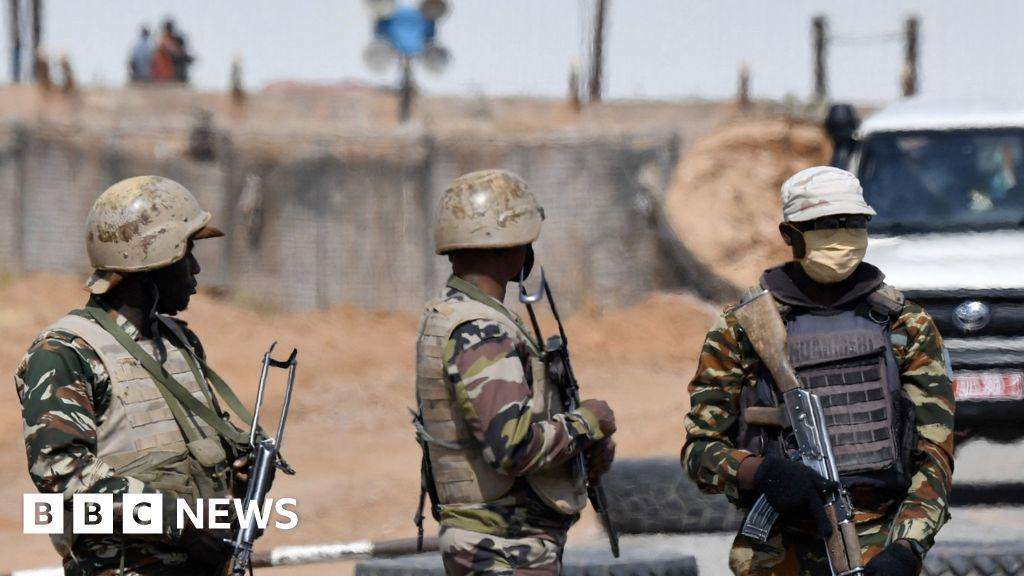
Niger's army has been struggling to contain the jihadist insurgency (file photo)
Niger's military government has struggled to contain jihadist violence in the region, carried out by groups linked to al-Qaeda and Islamic State.
"While people celebrated a baptism ceremony, gunmen opened fire, sowing death and terror," local civil rights activist Maikoul Zodi said on social media.
A resident told the French news agency AFP that 15 people were killed at the ceremony in Tillabéri region, which borders Mali and Burkina Faso, before moving elsewhere and killing seven others.
Gunmen on motorbikes have shot dead 22 people, most of them attending a baptism ceremony, in an attack on a village in western Niger, reports say.
The AFP news agency also cited local media outlet Elmaestro TV as reporting a "gruesome death toll of 22 innocent people cowardly killed without reason or justification".
Niger's authorities have confirmed there was an attack in the area but have not given any casualty figures.
Last week, Human Rights Watch said jihadist groups had increased attacks in the country since March, summarily killing over 127 villagers and Muslim worshippers.
Dozens of homes have been looted and burned over the same period, it said.
The group blamed authorities for not adequately responding to warnings of attacks and ignoring calls for help by villagers.
Last Wednesday, 14 Nigerien soldiers were killed in an ambush in the Tillabéri region, a figure that the army announced in its weekly bulletin on Saturday.
The army said one of its units was deployed following reports of a cattle theft by armed men, but the operation turned out to be "an ambush".
It is often difficult to independently verify the real numbers of casualties in such attacks due to access restrictions and the fear of reprisals among witnesses and local media.
On Tuesday, Mr Zodi questioned why civilians were still being exposed to such insecurity, and urged the government to prioritise the safety and dignity of citizens.
"It is time for concrete answers, strengthen state presence in vulnerable areas, and show that every Nigerien life matters," he posted on Facebook.
Niger has been under military control since 2023 when Gen Abdourahmane Tchiani deposed the country's elected President, Mohamed Bazoum.
Its neighbours Burkina Faso and Mali, battling the same jihadist insurgency, are also ruled by military leaders but have similarly struggled to contain the problem.
The three have expelled French and US forces that were previously heavily involved in the fight against jihadists that operate across the Sahel region.
Besides scaling back their ties with the West, they have since formed an alliance to fight the jihadist threat, turning to Russia and Turkey for their security needs. However, the violence has continued.
Additional reporting by Mariama Soumana in Niamey
Severe_Science9309 on September 18th, 2025 at 18:20 UTC »
There really isn't any way to stop them since they occupy too vast of a territory and the amount of resources and logistic needed to police the region would be insane. Best bet is just to tried to contain them and hope for the best
AgitatedHoneydew2645 on September 18th, 2025 at 16:16 UTC »
Perhaps all the Christian nations of Africa should convene and talk about a defence pact against spiralling Islamist aggression...
r_bradbury1 on September 18th, 2025 at 15:57 UTC »
SS: Gunmen on motorbikes killed 22 people in western Niger, most of them attending a baptism ceremony, in the latest sign of spiraling jihadist violence in the Sahel. The Tillabéri region, bordering Mali and Burkina Faso, has seen escalating attacks by groups linked to al-Qaeda and ISIS, with Human Rights Watch reporting over 127 villagers killed since March. Despite forming an anti-jihadist alliance and expelling French and US forces in favor of Russian and Turkish support, Niger’s military junta, like its neighbors in Mali and Burkina Faso, has failed to stem the violence. The massacre highlights both the weakness of state security capacity and the broader regional struggle as military regimes pursue new foreign alignments while citizens remain vulnerable to insurgent attacks.