In Seoul, alarm bells are ringing. Washington is demanding an eye-watering US$350 billion in direct investment, a sum so vast that economists warn it could tip South Korea into a crisis unseen in its modern history.
US Commerce Secretary Howard Lutnick bluntly asserted last week that South Korea must accept the deal or face higher tariffs – pointing out that Japan had already agreed to similar terms.
Under a framework agreement reached in July, the United States offered to reduce proposed tariffs on South Korean imports from 25 per cent to 15 per cent, but only if Seoul pledged to invest the US$350 billion into sectors chosen by Washington and made additional concessions.
Yet follow-up talks, including during President Lee Jae-myung ’s visit to Washington last month , have reached an impasse over the structure of the investment package, profit-sharing mechanisms and other conditions. “The devil is in the details,” as Lutnick put it on Thursday.
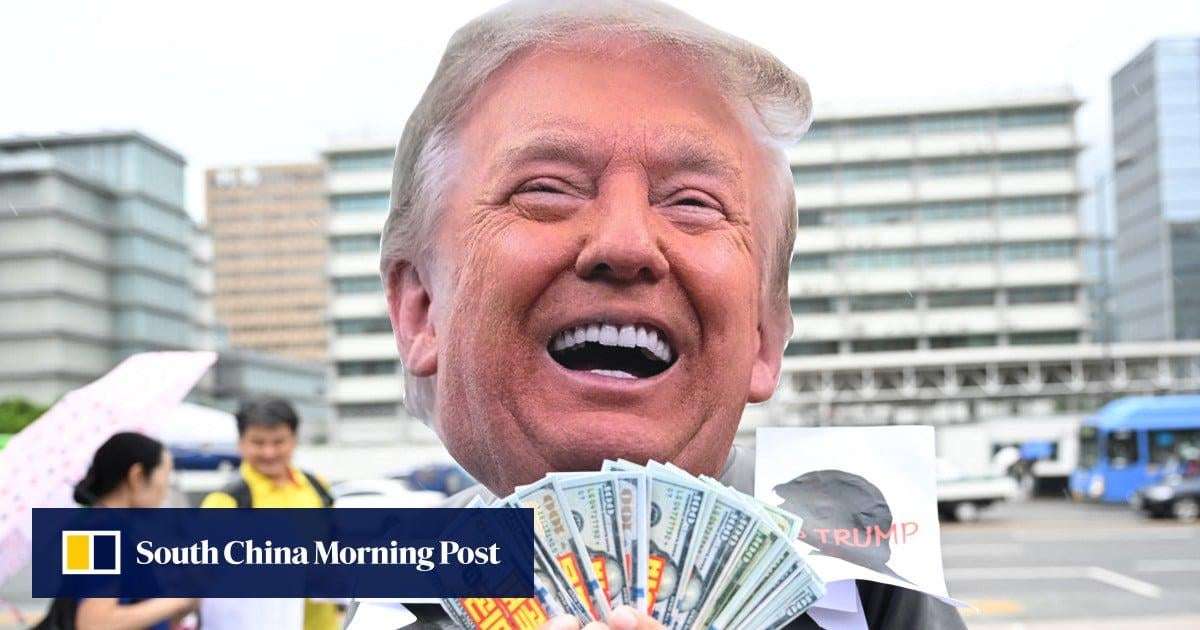
A protester holding US dollar banknotes wears a mask of Donald Trump during a rally in July against Trump’s tariff policy near the US embassy in Seoul. Photo: AFP
US President Donald Trump has been sharply critical of South Korea, calling it a rich “money machine” that exploits its alliance with America, citing trade surpluses he claims are evidence of unfair practices.
Cheerful_Champion on September 17th, 2025 at 12:26 UTC »
Countries should simply present united front against USA. What is Trump going to do? Put tariffs on everyone and kill US economy in a day?
Soepkip43 on September 17th, 2025 at 11:56 UTC »
United we stand, divided we fall. It seems asian countries need to form a union so they can collectively bargain.
1-randomonium on September 17th, 2025 at 11:40 UTC »
The one consistent trend in Trump's foreign policy has been to look for ways to essentially shake down American allies and trading partners for for more money, that is meant to be spent on the US economy and more specifically on American businesses that are linked to Trump's family and backers.
The demands on Japan and South Korea are particularly extortionate because he is essentially asking them to hand over control of most of their national U.S. dollar reserves to the White House. The EU has also offered massive investments in the United States, but those 'promises' are non-binding and they've categorically stated that they are simply referring to potential investments by European private companies, and not pledging their national government reserves.
I suspect that Japan and South Korea's governments are being squeezed more because they are more directly dependent on the United States for their security, against North Korea and China. He has also threatened to withdraw NATO from Europe, but even in that worst-case scenario European countries are capable of defending themselves with the UK and France's nuclear deterrent.
I've read rumours that Trump's negotiators had demanded similar sums of money from India(Which has foreign exchange reserves of over $700 billion) and that was one of the reasons the talks broke down.