US officers tied us up and pointed guns at us, South Korean engineers tell BBC
15 hours ago Share Save Jean Mackenzie Seoul correspondent , Serin Ha BBC Newshour and Yuna Ku BBC Korean Share Save
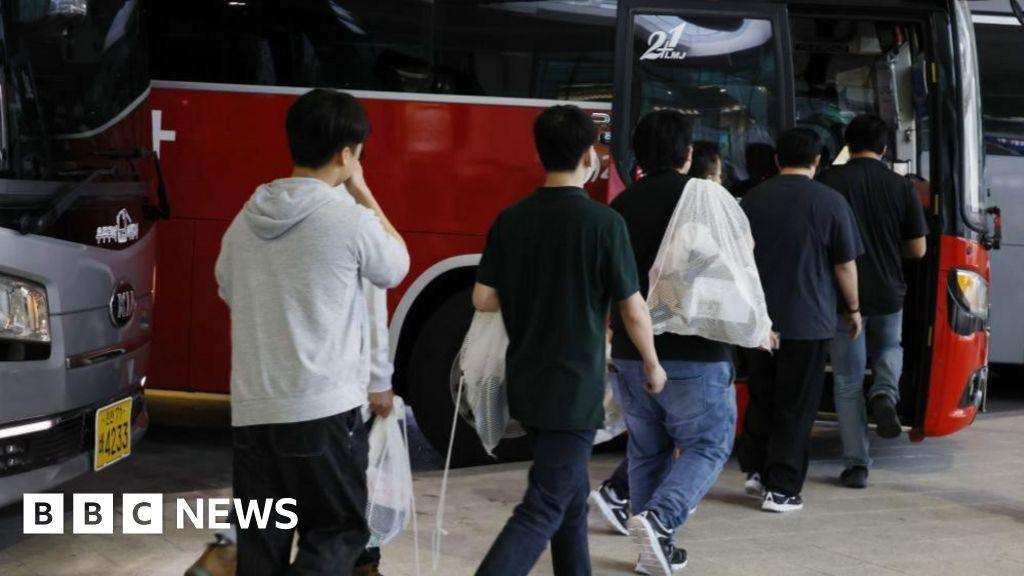
EPA The South Korean workers, seen here boarding buses at Incheon airport, were repatriated last Friday
When Youngjin looked out of his office window and saw armoured trucks and immigration enforcement officers running around with guns, he was surprised, but not worried. The young South Korean was certain it had nothing to do with him. He was in the US only for a few weeks on a short-term visa, he thought to himself. Then the armed agents burst into his room and ordered him outside. They handcuffed him, before attaching chains to his waist and ankles, and loaded him onto a bus bound for a detention centre. "I panicked and my mind went blank. I felt sick," he told the BBC, now back home in South Korea. "I couldn't understand why I was being treated like this." Youngjin is one of more than 300 Korean workers who were detained in the US state of Georgia earlier this month, in one of the largest immigration raids of Donald Trump's presidency to date. He and others interviewed for this article didn't want to reveal their real names in order to protect their identity.
BBC/ Hosu Lee Youngjin, picture, says he's still shaken by the ordeal
'Helicopters and drones… people with guns'
US officials initially claimed the workers had been in the country illegally on incorrect visas, but eventually the two sides struck a deal allowing them to leave voluntarily without any penalties, so they could return to work there in the future. Most of the workers were in the US temporarily, helping to build an electric car battery plant run by two South Korean companies, Hyundai and LG – part of a US push to get foreign companies to invest and manufacture more in the states. LG said that many of its employees who were arrested had various types of visas or were under a visa waiver programme. And so they were especially shocked by the raid. "We just came out for a brief break and I could see a lot of people, officials with guns. As Koreans, we just thought they were here to arrest criminals, but then, they suddenly started arresting us," said Chul-yong, who was also detained that day. He said they tried to explain who they were, but they were terrified: "There were helicopters and drones, armoured vehicles… people with guns." There were some officers pointing guns at workers, he claimed. "You know those red lasers that come out of those guns? It was so shocking that some people were shivering in fear." Even those who managed to share their visa details said they were arrested. "I thought everything would be cleared up but instead, they suddenly shackled us," said Mr Kim, another worker detained, who only wanted to reveal his last name. Chul-yong said there was a shackle around his ankles and another around his waist, connected to handcuffs. "It was so tight, I couldn't touch my face with my hands." They all said they had no idea why this was happening, or where they were being taken. "I later learned that I was detained at the Folkston ICE Processing Center," added Chul-yong, a software engineer. He had been planning to stay for about a month but was arrested on his sixth day there.
How the massive immigration raid on a Georgia car plant unfolded
'It was freezing... the water smelt like sewage'
Youngjin, an engineer and sub-contractor for LG, was scheduled to be there for five weeks to train staff to operate some of the specialist high-tech equipment. The 30-year-old was shaking, still visibly upset, as he described to the BBC being taken to the detention centre and locked in a room with 60-70 other people. "I had a panic attack. I just stood there trembling," he said. The room was freezing, and the new detainees were not given blankets for the first two days, he added. "I was wearing short sleeves, so I put my arms inside my clothes and wrapped myself in a towel to try to stay warm at night," he said. "The worst part was the water. It smelt like sewage. We drank as little as possible." The bunk beds were all taken, Chul-yong said, by the time he arrived, leaving him and others to find any empty spot to rest, even an empty desk where they could put their head down. "We tried to sleep anywhere, really. It was really cold. There were people who found packaged bread, heated it up in the microwave, hugging it throughout the night." For the first few days, Youngjin had no idea how long he would be held for. He feared it might be months. Only after some of the workers were able to meet lawyers and consular staff, did they realise their government was working with the US authorities to get them released. "Even the US side feels it may have gone a bit too far," South Korea's chief trade negotiator told reporters after returning from the US. Seoul says it is now investigating potential human rights violations during the raid by US authorities. Trump acknowledged the need to have specialists from overseas train up US workers, and according to South Korean officials, US Deputy Secretary of State Christopher Landau has expressed his "deep regrets" over the incident. Still, it has shaken relations between the US and South Korea, usually close allies, especially since it came hard on the heels of a trade deal in which South Korean companies pledged to invest $350bn in the US.
BBC/ Hosu Lee Youngjin shows a red band that they put on before he was arrested, which indicated he had to be checked
Outrageous-Dog1925 on September 16th, 2025 at 23:25 UTC »
It's almost like the people running this country want to actively destroy our diplomatic ties with ... everybody?
iimwint on September 16th, 2025 at 23:21 UTC »
Some workers provided visa information and were still detained.
They just took Tori Barnum at her word and couldn't be bothered to verify at all.
VirginiaLuthier on September 16th, 2025 at 23:06 UTC »
Imagine the US jobs that were lost. This could end up being a pretty big deal