The SCO leaders' meeting marks another step in a long-running process to ‘make the West less influential and authoritative’
cancel email WhatsApp link share Share bookmark Save
share cancel email WhatsApp link bookmark
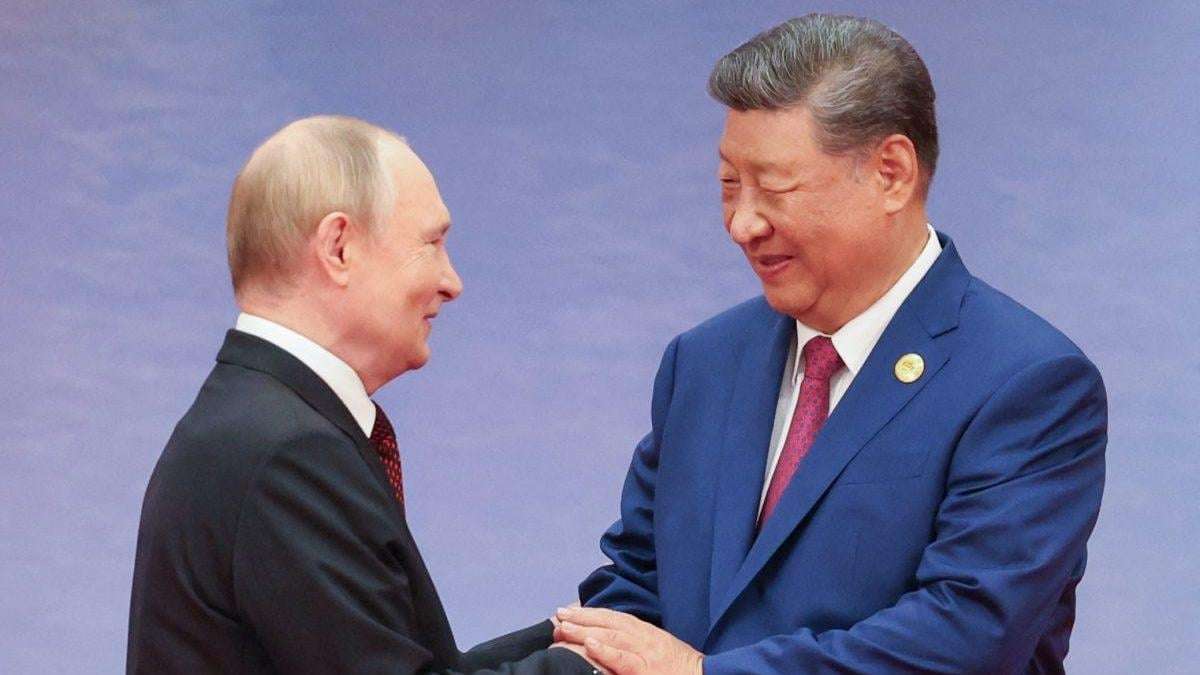
Vladimir Putin hailed the “unprecedented” relationship between Russia and China as he held bilateral talks with Chinese President Xi Jinping in Beijing on Tuesday.
“Dear friend, both I and the entire Russian delegation are pleased to meet once again with our Chinese friends and colleagues,” Putin told Xi, according to a video published by the Kremlin.
“Our close communication reflects the strategic nature of Russia-China relations, which are at an unprecedentedly high level,” he added.
New Feature In Short Quick Stories. Same trusted journalism.
“We were always together then, and we remain together now.”
Xi said that “China-Russia relations have withstood the test of international changes”, adding that Beijing was willing to work with Moscow to “promote the construction of a more just and reasonable global governance system”.
Putin blamed Nato for Russia’s invasion of Ukraine as he met with foreign leaders in China on Monday at the beginning of a summit aiming to challenge Western dominance.
The Russian president joined 20 world leaders in Tianjin, including his Chinese counterpart and Indian Prime Minister Narendra Modi, to attend the largest-ever summit of the Shanghai Co-operation Organisation (SCO).
The SCO’s aim is to boost security and economic co-operation among its member states, which also include Pakistan and Iran.
The leaders of Russia, India and China ahead of the SCO summit in Tianjin, China, on Monday (Photo: Indian PM’s Office via AP)
But experts said that the summit and Putin’s bilateral talks with Xi mark one further step in a long-running process to “make the West less influential and authoritative” and aid the Russian president’s war aims in Ukraine.
Addressing the summit on Monday, Putin said Ukraine’s pro-European uprising that in 2014 toppled the country’s pro-Russian president, Viktor Yanukovych, was the catalyst for Russia’s annexing of Crimea.
“This crisis was not triggered by Russia’s attack on Ukraine, but was a result of a coup in Ukraine, which was supported and provoked by the West,” he said.
He went on to blame Nato expansion for Moscow’s full-scale invasion of Ukraine in 2022.
“For the Ukrainian settlement to be sustainable and long term, the root causes of the crisis must be addressed,” he said, adding that a “fair balance in the security sphere” must be also restored.
Meanwhile, China’s leader condemned the “bullying behaviour” of other countries in apparent swipe at the US. He said global relations were becoming more “chaotic and intertwined”, urging leaders to “oppose Cold War mentality, bloc confrontation and bullying”.
“We must uphold the international system with the United Nations at its core, and support the multilateral trading system with the World Trade Organisation at its core,” Xi added.
Here, The i Paper takes a closer look at what Putin might be seeking to achieve through the summit and bilateral talks, as well as what impact they could have on Ukraine and the West’s next steps.
Anton Barbashin, editor of Russia political analysis journal Riddle, said that Putin’s likely aims during the summit would include fostering economic co-operation with its trade allies to shield it from the impact of financial sanctions, as well as securing international recognition of its territorial gains in Ukraine.
More than 80 per cent of the current sanctions on Russia were imposed because of the full-scale invasion of Ukraine – making it the most sanctioned country in the world.
Up to 7,000 legal entities and 13,000 individuals currently face sanctions from around 50 countries worldwide, including travel restrictions, trade embargoes, asset freezes or confiscation, and a ban on the purchase of Russian government bonds.
“In the long run, Putin would want to see international recognition of his gains in Ukraine, and see financial and trade infrastructure that would help Russia bypass all the sanctions and Russian partners be safe from those sanctions,” Barbashin said.
He pointed to the examples of Russia seeking to continue its oil and gas exports to China and India – a crucial source of funding for its war against Ukraine.
Since Wednesday, tariffs on Indian goods imported into the US, including diamonds and prawns, stand at 50 per cent.
Donald Trump says the tariffs amount to punishment for Delhi’s continued purchase of Russian oil. While Trump has threatened punitive tariffs against China for purchasing Russian oil and gas, he has yet to impose them.
Commenting on the benefits of Russian trade exports, Barbashin said: “It means that Russian economy will be less inclined to collapse because of China’s supply of literally everything and hard currency that Russian gets from oil and gas supplies.
“It means Russia can push harder and stay convinced it can outlive Ukraine and reach its goals.”
He also said that Russia may seek to strengthen alternative financial infrastructure to help it cope with the sanctions imposed on it.
This aim would most likely be achieved via Brics, an intergovernmental organisation that includes 10 countries, chiefly among them Brazil, Russia, India, China and South Africa, as well as the UAE and Iran.
Barbashin added that the “Kremlin would like to see that long-term change that would make the West less influential and authoritative in 2030s, 2040s and further into the future”.
He added that Putin would want to see the “US and EU recognising that key leaders of the non-West are now setting the rules of international norms and that in order to keep peace and development, the West would need to meet them half the way”.
This would involve compromising the West’s demands in Ukraine, Barbashin added.
Lee Jones, professor of political economy and international relations at Queen Mary University of London, said that a further aim for Putin is to reduce Russia’s isolated image on the world stage.
He told The i Paper: “Since the invasion of Ukraine, Putin definitely doesn’t want Russia to be isolated and has worked quite hard to avoid Russia appearing isolated.
“At the margin, participating in an event like this might help Putin to think that he’s winning the discursive war on Ukraine.”
Both experts agreed that the summit does not mark a watershed moment in international relations, but rather a step towards the suppression of the US and Western leaders’ authority on the global stage.
“This is not some big, world-changing event,” Professor Jones said. “It is part of an ongoing contestation of the international order that has been clearly apparent since the late 2010s. All of the Western states have recognised that.
“That international order is much more contested than it used to be. They will see this as one more data point of that contestation.”
The remarks were backed by Dr Giulia Sciorati, fellow at LSE’s department of international relations. She said: “The summit does not create a new bloc, moulded after the Cold War – but it does signal the gradual consolidation of an alternative pole in international politics.”
How will the summit affect Ukraine and the West?
While ameliorating Russia’s image as an isolated state at the summit may make Putin feel more emboldened, Professor Jones said that Russia’s war aims and approach to Ukraine will remain unchanged.
“The causes in the war in Ukraine are structural,” he said. “They have to do with the expansion of Nato towards Russia’s borders.”
He added that Russia has already borne “a cost of perhaps $300bn from the war, a million casualties – dead and wounded – and significant isolation. That tells you that the Russians place extreme importance on a successful conclusion to the war”.
He said: “Russia’s war aims are the same: Ukraine has to be disarmed, and it cannot be allowed to join Nato. Russia has annexed territory and hanging on to that territory have become Russian war aims as well.”
Dr Sciorati said that although closer ties between Russia and China do not change the situation in Ukraine directly, “they do complicate Western efforts to isolate Moscow”.
She explained: “If Russia can access Chinese loans through the SCO, it can sustain the war for a longer time. At the same time, neither China nor India has an interest in endorsing Russia’s war aims, so their support remains careful.”
Asked whether an immediate response can be expected from the US and its allies, she added: “Western governments will watch the summit with concern but are unlikely to change their course of action.
“Washington and its allies will continue to deepen ties with their own partners, including in Asia, while seeking to limit the space in which Russia and China can operate.”
Bob_Spud on September 2nd, 2025 at 13:16 UTC »
The Putin, Xi, Modi summit was created and made possible by Trump and his enablers.
It highlights how Trumps political efforts have spectacularly backfired.
humtum6767 on September 2nd, 2025 at 12:27 UTC »
USA got India involved in anti China coalitions like Quad and then trade embargoed it worse than anyone else, including China and Russia, 😆 . India will never ever trust US again.
theipaper on September 2nd, 2025 at 10:42 UTC »
Vladimir Putin hailed the “unprecedented” relationship between Russia and China as he held bilateral talks with Chinese President Xi Jinping in Beijing on Tuesday.
“Dear friend, both I and the entire Russian delegation are pleased to meet once again with our Chinese friends and colleagues,” Putin told Xi, according to a video published by the Kremlin.
“Our close communication reflects the strategic nature of Russia-China relations, which are at an unprecedentedly high level,” he added.
“We were always together then, and we remain together now.”
Xi said that “China-Russia relations have withstood the test of international changes”, adding that Beijing was willing to work with Moscow to “promote the construction of a more just and reasonable global governance system”.
Putin blamed Nato for Russia’s invasion of Ukraine as he met with foreign leaders in China at a summit aiming to challenge Western dominance on Monday.
The Russian President joined 20 leaders in Tianjin, including his Chinese counterpart and Indian Prime Minister Narendra Modi, to attend the largest-ever summit of the Shanghai Cooperation Organization (SCO).