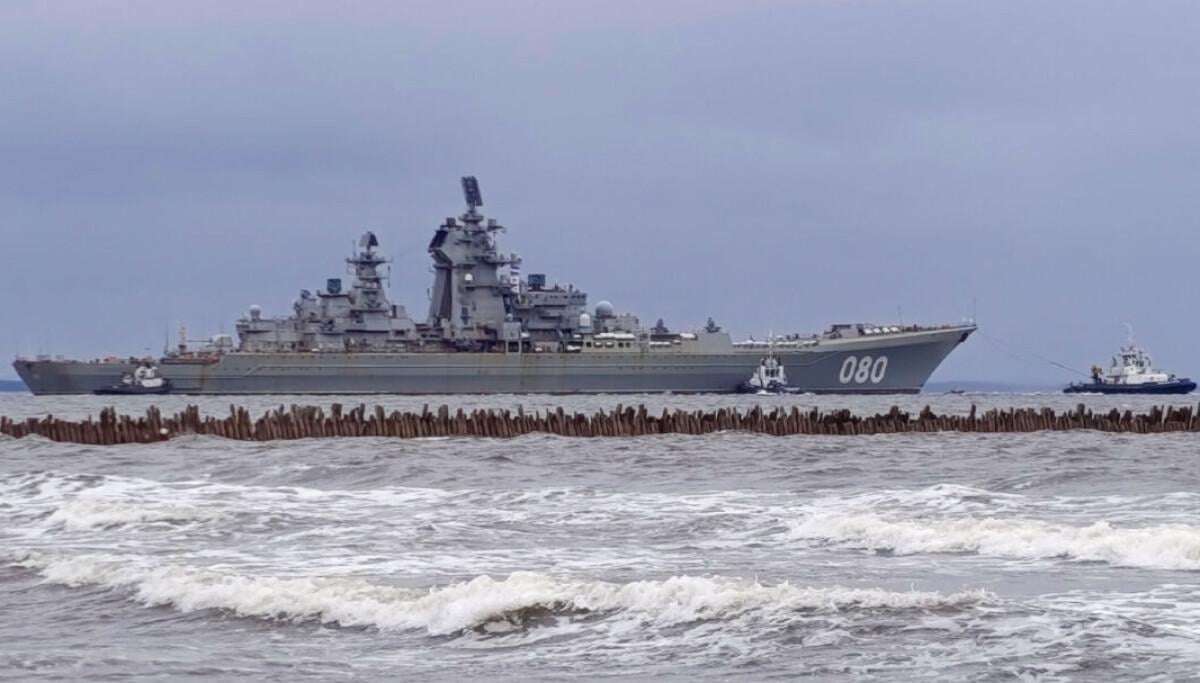
On August 18, the 251-meter-long battle cruiser was assisted by tugs out from the Sevmash shipyard in Severodvinsk in northern Russia.
The shipyard has not officially commented on the departure of the giant warship, but several social media channels from the region posted photos as the Admiral Nakhimov went out to the White Sea for the first time since 1999.
The Soviet built warship sailed for the Northern Fleet for the last time in 1997, and was towed to Severodvinsk in 1999 after being laid up in Severomorsk north of Murmansk for a two-year period.
The state-controlled information agency TASS on Monday confirmed that the nuclear-powered battle cruiser had set out for the first stage of tests. Later, the warship will sail north to the Barents Sea for sea trials that will last for several months before being officially deployed with the Navy for combat operation.
Decades of modernisation of the battle cruiser will eventually give the Northern Fleet a weapons platform packed with rockets, torpedoes, missiles and guns like no other of the surface warships in the Russian Navy.
Russia’s Defense Ministry has previously said that the warship will be armed with the Tsirkon hypersonic cruise missile. This missile can, if launched from a position in the Russian sector of the Barents Sea, fly over land and hit sea targets in the Norwegian Sea with very short warning notice for NATO forces.
Original plans said the battle cruiser would be ready for voyages with the Northern Fleet in 2018. Progress, however, was slow and the one plan after another for sea trials in White Sea were postponed. In 2022, it was said that relaunch should come in 2023, then followed by another announcement saying autumn 2024.
As part of the upgrade, fuel elements for the vessel's two nuclear reactors were changed. Reactor No. 1 was started in the end of December 2024, while reactor No. 2 went active in early February this year.
Although the uranium fuel is new and cooling pipes have been polished, the fundamental design of the two water-cooled reactors is the same as when the vessel was built in the mid-1980s.
The nuclear reactor plant has a thermal capacity of 300 MW, providing 140,000 horsepower (hp) output.
The Admiral Nakhimov will replace the Pyotr Velikiy, a vessel of the same class that since autumn 2022 has been laid up at a pier in Severomorsk. As previously reported by the Barents Observer, the Pyotr Velikiy is likely to be sent to scrap.
h0ls86 on August 20th, 2025 at 08:03 UTC »
A worthy replacement for Admiral Kuznetsov that only ramped up costs over time and drained Putin’s war chest 👌
GoblinTwerk on August 20th, 2025 at 07:41 UTC »
Russia's newest submarine
my-reddit-saga on August 20th, 2025 at 07:40 UTC »
Summary:
Russia's Nuclear-Powered Battlecruiser Admiral Nakhimov Returns to Sea After Nearly Three Decades
Russia's Admiral Nakhimov, a 251-meter-long nuclear-powered battlecruiser, has embarked on its first sea trials since 1997.
Assisted by tugs, the ship departed from the Sevmash shipyard in Severodvinsk on August 18, 2025, marking a significant milestone after years of extensive modernization.
Originally commissioned in the mid-1980s, the Admiral Nakhimov underwent a comprehensive upgrade, including the replacement of its nuclear fuel elements and the overhaul of its reactors.
The vessel is now equipped with advanced weaponry, such as the Tsirkon hypersonic cruise missile, enhancing its strategic capabilities.
This modernization positions the Admiral Nakhimov to become the flagship of Russia's Northern Fleet, potentially replacing the Pyotr Velikiy, which has been inactive since 2022 and is expected to be decommissioned.
The sea trials are scheduled to continue in the Barents Sea, with the aim of officially reintroducing the battlecruiser into active service following successful evaluations.