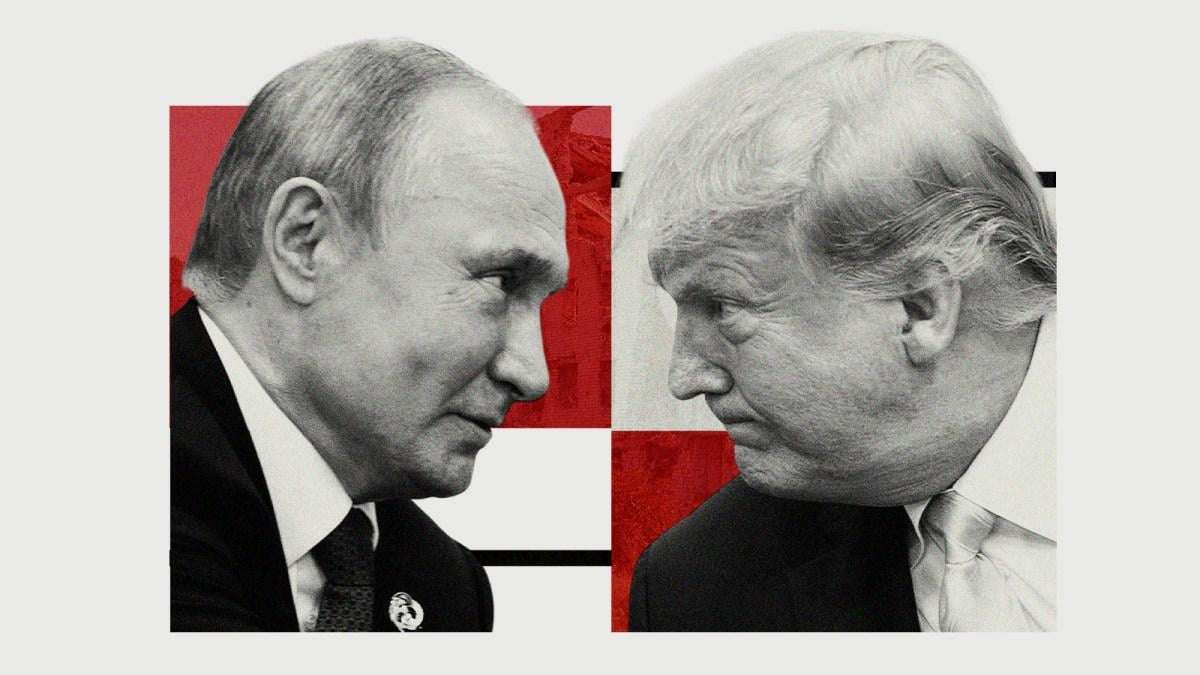
Is peace in Ukraine finally within reach? After so much blood, grudge and disappointment, it seems hard to hold much optimism, but as with anything involving President Trump, prediction is difficult.
What is clear is that even if a deal can be agreed it would really only be the starting point, not the end, of a long-term effort to persuade him to buy into a lasting peace process.
The first meeting between Russian and US presidents since 2021 will take place on Friday in Alaska. Putin might have preferred to see Trump on Russian soil, but the choice of Alaska is a minor concession to his American counterpart.
What do the two men have to discuss, though?
• Why Alaska is hosting Trump and Putin: no arrest, no Europeans
The veteran diplomat Yuri Ushakov, now Putin’s main foreign affairs adviser, was characteristically taciturn after last week’s visit to Moscow by Trump’s real estate baron negotiator, Steve Witkoff.
Putin and Steve Witkoff in Moscow on Wednesday GAVRIIL GRIGOROV/REUTERS
Nonetheless, he did state that “there was an offer made by the Americans that we consider quite acceptable”. The implication is that there is a proposed peace plan. What might this be?
According to the Polish media outlet Onet, it includes a ceasefire, de facto recognition of Russia’s territorial gains, and the lifting of most US sanctions on Russia, perhaps linked to some kind of privileged access to Russian oil and gas for American companies. This aligns with the main direction of travel among the Washington peacemaking community.
It would mean an end to the killing, which seems to be Trump’s own personal priority. It would not entail any kind of formal peace treaty, so the territories Moscow has taken from Ukraine would not be recognised as rightfully Russian. Indeed, the issue of ownership might be deferred for 49 or 99 years.
It would also provide not just much-needed relief for the Russian economy, but also the kind of apparent special access to the country’s natural resources that Trump seems to crave, as witnessed by his minerals deal with Ukraine.
Since then, a welter of leaks and off-the-record briefings have suggested that Kyiv might instead be expected to pull its forces back and surrender more territory. Trump has mentioned “some swapping of territory” but the implication is that Ukraine would have to abandon those portions of the eastern Donetsk and Luhansk regions still not occupied by Russia, in return for nothing more than a ceasefire and the promise of a future comprehensive deal.
If these latest suggestions are true, then the terms are a gift to Putin. Even if they are not accurate there is no doubt that any deal would be trumpeted by Putin’s tame media as a triumph, a victory over not just Kyiv but the serried ranks of a hostile Nato, for whom Ukraine was just a proxy weapon. It would also be greeted with genuine relief by the Kremlin technocrats running the system, who have been increasingly vocal in their efforts to warn Putin of tough economic pressures ahead.
• Trump’s new plan to hit Russia where it hurts
The state budget’s crucial oil and gas revenues fell by 18.5 per cent between January and July, while on Friday, the Finance Ministry admitted that the deficit reached 4.88 trillion rubles (£45.3 billion) in the same period. This is above the 3.8 trillion rubles planned for all of 2025.
Meanwhile, the Centre for Macroeconomic Analysis and Short-Term Forecasting think tank has warned that although a recession is not yet inevitable, the likelihood is that by October, the warning signals will be clear. Yet until now, Putin has given no indication of any willingness to compromise. He wants Ukraine to surrender the unconquered parts of the regions he illegally annexed, a formal repudiation of future Nato membership, and limits on the size of Kyiv’s army.
He also seems to feel he is still winning. In the past month, Russian troops took another 226 square miles. Not only is this more than in the previous month, but a tactic of encircling towns rather than frontally assaulting them is paying dividends.
Zelensky, centre, and General Oleksandr Syrsky, right UKRAINIAN PRESIDENTIAL PRESS SERVICE/AFP VIA GETTY IMAGES
The contested city of Chasiv Yar already seems to be being abandoned, while a withdrawal from the strategic hub Pokrovsk is under consideration. The human cost of these victories remains high (the Centre for Strategic and International Studies last month estimated that up to 250,000 Russian troops had been killed so far) but according to the Ukrainian commander-in-chief, General Oleksandr Syrsky, Moscow is still recruiting 9,000 more men each month than it loses, while Kyiv is struggling to replenish its ranks despite lowering the conscription age to 25 last year. Putin does not, after all, have to fight for ever: he just needs to be able to sustain the effort longer than the Ukrainians.
Trump cannot simply give away Ukrainian territory. His suggestion of a follow-on trilateral summit also including President Zelensky did not go down well with Putin, but the Russian leader was unusually diplomatic.
In the past he has simply denied that Zelensky is Ukraine’s legitimate president because his official term has expired, ignoring the fact that so long as the country is under martial law, no elections can legally be held. This time, Putin retreated into vagueness, saying that a meeting with Zelensky “is possible. But certain conditions must be met, and unfortunately, we are still far from creating such conditions.”
President Zelensky has not yet been invited to the summit
Trump would be wrong to assume that whatever he and Putin agree, Ukraine — and Europe — will be forced to accept. Europe, however, faces the prospect of either denouncing Trump’s deal, reminding him of his old conviction that “the European Union was formed in order to screw the United States”, or meekly accepting his terms, undermining efforts to make the bloc look like a credible, independent geopolitical force.
• Zelensky: I’m ready to work with Trump but we won’t reward Russia
For Ukraine, abandoning the 20 per cent of its territory and 7 per cent of its population now under Russian control would be agonising, let alone conceding the pockets of east Ukraine that it still holds. Zelensky has already warned that “Ukrainians will not give their land to occupiers” and the constitution precludes any legal surrender of territory. While the rumoured land-for-peace swap sidesteps this by focusing on practical control rather than a formal change of borders, it is still hard to see how Zelensky could accept it, or politically survive such a climbdown.
For Kyiv even to consider endorsing such a patently unfair deal (one that also drops claims for reparations), Zelensky would need to be convinced that the West will not leave Ukraine defenceless and in ruins. However, public sentiment has begun to shift. Recent Gallup polling has charted Ukrainians’ increasing fatigue: 69 per cent now favour negotiating peace as soon as possible, with only 24 per cent favouring keeping fighting until the war is won.
One veteran Ukrainian diplomat admitted that “some Ukrainians will fear that refusing to go along with any deal Trump proposes will mean we again face the danger of the United States turning its back on us, but others will use this as an excuse to accept a deal they know is shameful, because they are tired of war”.
The funeral of Mykyta and Sofia Lamekhov and their son Lev at a cemetery in Sloviansk on August 5. They were among 32 people killed in an attack on Kyiv on July 31 GENYA SAVILOV/AFP VIA GETTY IMAGES=
Nonetheless, the immediate response to the news in Ukraine has been anger and outrage, not optimism.
The prospects of any deal holding will depend on the mechanisms adopted to enforce it and to support a post-war Ukraine. To put it bluntly, by invading Georgia in 2008, annexing Crimea in 2014, fighting an undeclared war in southeastern Ukraine until 2022, covering up the shooting-down of Malaysia Airlines MH17 and carrying out a campaign of assassination and sabotage in the West, Putin has not earned anyone’s trust.
The ceasefire will require monitors deployed inside Ukraine. There will then need to be measures in place to punish any ceasefire breach, including “snap-back” restoration of full sanctions. Some European Commission insiders are also suggesting the €183 billion (£158 billion) frozen in the Euroclear financial system could be held as a “good faith bond”, to be released to Ukraine if Moscow breaks its word.
Additionally, Kyiv will want international monitors on the ground to discourage any ceasefire breach in the first place. It is unlikely that the answer here will be the “coalition of the willing” that Sir Keir Starmer and France’s President Macron announced in March. Thirty-one countries have now pledged support to this proposed armed multinational peacekeeping force, which would support the replenishment of Kyiv’s land forces, defend Ukraine’s airspace and protect vital shipping in the Black Sea.
But Putin is not going to accept European troops in this role, and the US is unlikely to offer the kind of “backstop” such a deployment would require — in essence, a willingness to go to war in the event that the Russians targeted these contingents. Instead, that role might have to go to a UN force or one drawn from ostensibly neutral powers, such as India and Brazil (which, incidentally, have been especially hard-hit by Trump’s tariffs).
What would be absolutely crucial, though, would then be rapid investment into not just reconstituting Ukraine’s exhausted armed forces but also developing domestic defence industries so that the country would be able to protect itself against any future Russian attack. Membership of Nato or the European Union brings guarantees of mutual support, but they are still very much over the horizon, and there is understandable scepticism in Kyiv that bilateral promises of support could deter Putin.
“Given that no one wants to send their troops to die in Ukraine,” a senior Ministry of Defence official told me, “it’s really about making sure Putin knows the Ukrainians can give him more than a bloody nose if he invades again.”
This doesn’t just mean drones and air defence systems, however vital they are, but also indigenously built long-range missiles able to hit Russian cities and infrastructure without needing anyone else’s approval.
Sir Keir Starmer and President Macron in July LEON NEAL/GETTY IMAGES
The odds against any such peace remain high. Putin does not appear to feel under pressure, even as Trump has become increasingly exasperated with him. Meanwhile, Russia hawks in Trump’s entourage, especially Marco Rubio, the secretary of state, seem to be trying to minimise concessions to Putin, feeling that Witkoff gave away too much in the name of reaching a deal.
Finally, regardless of what the two presidents agree, any peace deal will need to be accepted by Kyiv. It may be that some much more limited measure will instead be adopted, such as a temporary moratorium on mutual long-range airstrikes. That may be enough for Trump to feel honour is satisfied, while giving Russia respite from highly effective Ukrainian attacks on its infrastructure.
For Putin, after all, further delaying any more serious US action and the optics of a meeting with the US president will already be wins. If he can convince Trump that it is Ukraine, not Russia, that is denying him the political triumph he craves, then there is a chance of reversing the US’s recent tilt back towards Kyiv.
Yet for all the inevitable concerns about this hurried summit and a potential stitch-up of Ukraine, there is value in diplomacy. Western countries have treated dialogue with Russia as a reward for good behaviour, not a necessity in dangerous times. There are fewer open channels for communication now than in the worst days of the Cold War.
Even a temporary ceasefire would give the hard-pressed Ukrainians some respite, while it is worth truly stress-testing Putin’s claimed commitment to a deal, even if only to undermine his propaganda.
This summit may not bring peace in our time. But it could be a step forward if it opens a path to terms that Kyiv can accept, backed by a long-term commitment to securing Ukraine from any future Russian aggression.
Professor Mark Galeotti’s book, Forged in War: A Military History of Russia from its Beginnings to Today, is published by Osprey/Bloomsbury
CharlesIngalls_Pubes on August 10th, 2025 at 13:11 UTC »
Trump can't outsmart a 3 year old. Get ready for there to be talks of Russia taking Alaska as a nice parting gift.
PressPausePlay on August 10th, 2025 at 13:00 UTC »
Trump and his team are vastly outmatched by Putin. Here's what will happen. Putin will make a ridiculous demand, as he's done the entire conflict. There will be no compromise, no offer from Russia. Zero. Nothing. Trump will agree becsuse he has no choice. Then, when Ukraine and EU are like "no.... Ukraine can have a military" trunp and Putin will say "see?? Ukraine doesn't want peace!!". Trump washes his hands and will basically say "I did my best but Zelensky doesn't want to play ball" and Putin will continue the genocide, because the Russian economy is dependent upon it.
Yankee9Niner on August 10th, 2025 at 12:55 UTC »
Can Trump outsmart Putin? I haven't laughed like that in quite a while. Thanks.