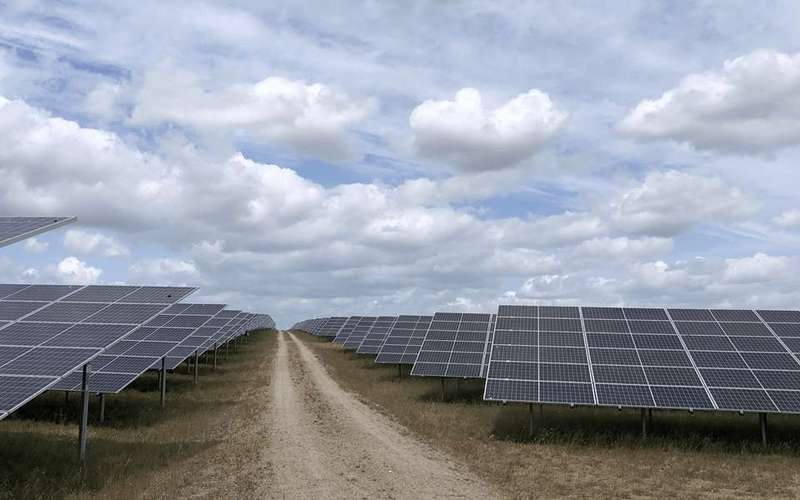
Weesow-Willmersdorf solar park in Brandenburg, Germany, may appear unremarkable, but its 164 hectares support many rare birds – especially larks, which breed frequently here.
Biologist Matthias Stoefer said the high density of breeding larks in one of Germany’s largest solar parks in Brandenburg, north of Berlin, is astonishing.
In his breeding territory mapping, he counted 178 spots within the solar park and surrounding areas.
Whether they can breed successfully there when the farmer sprays, fertilizes, and harvests throughout the summer is questionable, however.
The latest study by Bundesverbands Neue Energiewirtschaft (BNE) also shows that solar parks provide habitats for endangered animals, and better ones than the surrounding agricultural land.
The ground-mounted PV system, with its dense row spacing, also does not meet the recommendations for biodiverse solar parks.
“In the case of Weesow [solar park], sheep grazing has proven very successful, as it has transformed the solar park into a paradise for skylarks,” said Hauck. »




![image for This might genuinely be the most proud I’ve ever been with how a painting has turned out. [OC]](81854480-faeb-56b3-9864-e9a769ac4040_thumb.jpg)

![image for [OC] The Steak 'n Shake in my town was shut down by the health department. I did not take it well.](4d7125f2-19dc-511b-b4f6-ee7621597f61_thumb.jpg)