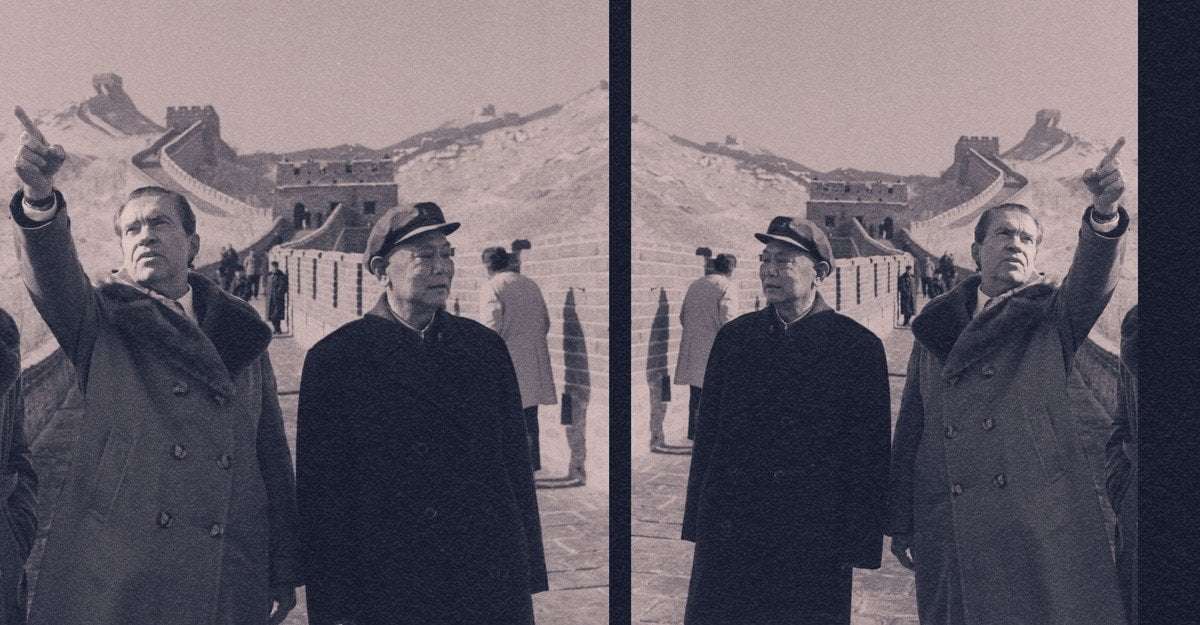
In the early 1970s, President Richard Nixon made history by drawing Communist China closer to the United States, giving Washington an advantage in its Cold War contest with the Soviet Union. Half a century later, President Donald Trump seems to be eyeing a similar diplomatic maneuver, but in reverse: drawing Russia closer to the United States in order to give Washington an advantage in its geopolitical competition with Communist China.
If Trump were to pull this off, he, too, would change the course of history—isolating China, guaranteeing European security, and solidifying American global primacy. But the plan—known as a “reverse Nixon” in foreign-policy circles—could easily backfire.
On the face of it, trying to peel Russia off from China has a certain logic. The two countries have forged a partnership in recent years that could pose a serious threat to U.S. interests—Beijing’s support for Moscow’s invasion of Ukraine exemplifies this. “The one thing you never want to happen is you never want Russia and China uniting,” Trump said in an October interview, citing one of his college professors. “I’m going to have to un-unite them, and I think I can do that.”
This imperative could help explain why the Trump administration has sought rapprochement with Russia. Secretary of State Marco Rubio has suggested that Russia may otherwise become subservient to China. “If Russia becomes a permanent junior partner to China in the long term, well, now you’re talking about two nuclear powers aligned against the United States,” he said in a February interview. Russian leaders could be forced “to do whatever China says they need to do because of their dependence on them,” he continued. “I don’t think that’s a good outcome for Russia, and it’s not a good outcome for America or for Europe or for the world.”
Michael Schuman: Trump hands the world to China
Publicly, Chinese officials have dismissed the possibility of losing Russia to Trump. Chinese Foreign Minister Wang Yi called the reverse-Nixon idea “the obsolete Cold War mindset” and insisted that ties between Beijing and Moscow were “as solid and unshakable as mountains.” Yet the fact that he felt the need to address the possibility may betray a degree of insecurity. Less than two weeks after Trump and Vladimir Putin spoke by phone in February, China’s leader, Xi Jinping, had his own conversation with the Russian president and made sure to stress that “our two countries are true friends” whose partnership had “unique strategic value,” according to the summary of his comments issued by the Chinese foreign ministry.
Nixon’s task in the ’70s was in some ways easier than the reverse Nixon promises to be today. The Chinese leaders Nixon wooed had already split with the Soviets and perceived them as a threat. Now China and Russia are closer than they have been in decades, and Putin has not evinced much inclination to change that. In early May, Putin hosted Xi at a World War II Victory Day celebration in Moscow and called the Chinese leader his “dear friend.” Nor has Putin shown much enthusiasm for a deal with Trump to end the war in Ukraine (Vice President J. D. Vance complained earlier this month that the Russians were “asking for too much”).
The Trump administration may not fully appreciate the depth of the bond between America’s adversaries. In his October interview, Trump expressed the belief that Russia and China have drawn close mainly as a result of faulty U.S. policies, especially those of President Joe Biden. Trump was most likely referring to Washington’s tough stance on Ukraine, including sanctions on Russia, which arguably led Moscow to seek support and reprieve from China. “We united them. Biden united them,” Trump said. “The stupidity of what they’ve done.”
But focusing on Ukraine gives short shrift to the many political, economic, and strategic interests that Putin and Xi share—chief among them a mutual antipathy toward the United States. “Their common mistrust of Washington and their hopes of becoming more powerful in an emerging multipolar order—at the United States’ expense—are likely to provide a strong enough foundation to keep the Chinese-Russian partnership stable and growing,” Alexander Gabuev, the director of the Carnegie Russia Eurasia Center, argued in a December analysis.
Then there are the economic links. At this point, Putin may not be able to break free from China even if he wanted to. According to Gabuev, China now buys 30 percent of Russian exports; 40 percent of Russian imports come from China. China now buys more oil from Russia than from any other country. Even if the U.S. removes sanctions as part of a settlement of the Ukraine war, these arrangements might not change. “Putin has no reason to give up China’s extensive, concrete, and reliable support to Russia’s civilian economy and defense industry in exchange for ties to Washington that may not last past the end of Trump’s term,” the scholars Michael McFaul and Evan Medeiros argued in an essay in April.
Paul Mason: Trump brings Britain’s ‘moron premium’ to the U.S. economy
If Trump and Xi wind up competing for Putin’s attention, the Russian leader could play the U.S. and China off each other, to his own benefit. “Russia could assume the pivot position in the triangular relation among the United States, China, and Russia,” Bonnie Glaser, the managing director of the German Marshall Fund’s Indo-Pacific program, told me, meaning that Moscow would have better ties with Beijing and Washington than either would with the other.
A successful reverse Nixon could work to the advantage of the United States. But it’s a long shot, and failing means fracturing the American alliance with Europe without splitting Russia from China. With its large nuclear arsenal, Russia would remain a threat to global security, and by placing Putin in the pivot position, Trump would strengthen and embolden both him and Xi to increase their pressure on the United States.
MetalRetsam on May 31st, 2025 at 14:43 UTC »
No, no, no. This article fundamentally misunderstands why the rapprochement with China was such a success.
In the 1960s and 1970s, China-Russia relations were at an all-time low. Border disputes nearly caused a hot war between the two powers in the early '60s. This gave China and the US a common enemy. China was then the junior partner, but a strategically important one. The US helped to advance the PRC's goals by giving it international recognition as the 'real' China, but they did not recognize their geopolitical claims, such as on Taiwan. American-Chinese relations focused on trade and other peacetime activities.
Today, China and Russia's common enemy IS the USA. Border disputes persist, but China is playing it safe by focusing on their Southern and Pacific claims over those in Siberia. Russia is not a strategically important power, because it has no unrealized gains that it could realize by exchanging trade and technology with the US. And unlike the USSR, today's China is a not some isolated economic bloc - far from it. The USSR was an autarkic system, it produced only what it needed to consume (and less). China, on the other hand, mostly produces for foreign markets (and more). In conclusion, there's nothing the US could offer Russia that wouldn't immediately backfire, and even if it did commit to warming relations with Russia, this wouldn't do much to hurt the Chinese.
Russia and China are autocracies. Their primary goal is to secure the stability of their regimes, no matter the cost. Mao saw the Soviets as the more immediate threat. Putin sees the Central and Eastern European states as his most immediate threat.
Yes Virginia, there is an important third player in the battle for hegemony. But it's not Russia. It's the European states, whose relationships with the USA have reached historic lows. If the NATO members can be convinced that the alliance isn't worth it, suddenly the math is looking very different. Many Europeans feel apathetic, resentful, or even sorry for their geopolitical ambitions. If those feelings prevail, Europe is easy pickings. If not, they might make a difference.
datapicardgeordi on May 31st, 2025 at 13:08 UTC »
This is ridiculous mental gymnastics that attempt to justify Trump’s pro Russia stances and the likelihood that Trump himself is a Russian Asset.
Calling Trumps loyalty to Putin a ‘reverse Nixon’ implies there is an overarching principle behind his actions relating to American interests. No such principle exists as Trump works against American interests in Ukraine.
cheesaremorgia on May 31st, 2025 at 12:49 UTC »
Putting aside that this doesn’t serve Putin’s goals, Trump is in no way capable of pulling off such manoeuvrings.