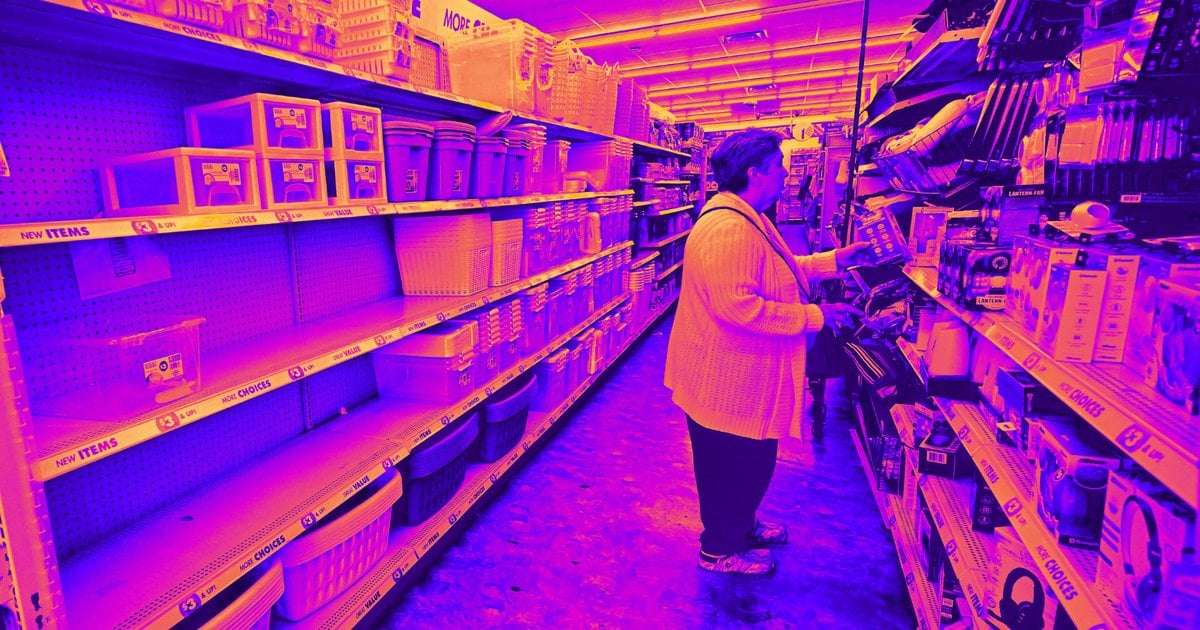
Frederic J. Brown / Getty Images Above, empty shelves are seen as a woman shops for items at a Dollar Tree store on April 28, 2025, in Alhambra, California. Could this become the new norm?
Because of President Donald Trump’s trade war against the world, American consumers may soon start start seeing shortages on their everyday household goods and accessories.
In the past few weeks, Trump has imposed massive import taxes on many U.S. trading partners ― including an astonishing 145% tariff on Chinese goods ― only to abruptly change or suspend some of these tariffs. But Trump’s chaos is already starting to freeze supply chains. U.S. businesses are cancelling or postponing shipment orders from China.
Just last week, the executives for major retailers Walmart, Home Depot and Target reportedly told Trump in a meeting that shoppers are likely to see empty shelves and higher prices in the next few weeks if he doesn’t roll back his tariff plans.
Don’t expect a toilet paper shortage like what we experienced during COVID lockdown. Because many essential goods like food, beverages and paper goods are more likely to be made domestically, they are more immune from these shortages, said Casey Armstrong, chief marketing officer of ShipBob, a global fulfillment and supply chain platform.
“You’re not going to run out of food or toilet paper, but don’t be surprised if your $3 spray bottle or favorite pair of $5 socks vanishes from shelves or doubles in price,” Armstrong said.
HuffPost talked to supply chain experts about which categories of common goods are most vulnerable to disappearing from shelves soon.
Direct-to-consumer brands like Shein and Temu used to rely upon a “de minimis” shipment exemption to sell cheap goods to U.S. consumers.
Under the “de minimis” tariff exemption, a U.S. shopper could buy $800 worth of goods per day directly from a foreign seller free of tariffs and administrative fees, but soon no more.
Trump signed an executive order to close that loophole, which will go into effect on May 2. Ending this exemption is expected to disproportionately hurt lower-income and minority consumers, according to a National Bureau of Economic Research paper published last year.
As a result of the “de minimis” loophole ending, consumers may see both fewer quantities and fewer options from their favorite fast-fashion brand, said Nathan Strang, director of ocean freight at Flexport, a company that brokers customs clearance and logistics for importers and exporters. “You’re going to start to see less quantities,” he said.
Fourth of July is one of the nearest major holidays, and it’s when you might first notice a major shortage, be it your desired grill or fireworks. That’s because seasonal items like American flags and fireworks are largely made in China, said Chris Tang, a University of California, Los Angeles professor who studies global supply chain management.
For some of these products, “they have no alternative” supply maker, he said.
A lot of back-to-school shopping happens over the summer, and if Trump’s tariff plans don’t change, expect to see fewer options.
Strang explained that it can take 30-plus days for goods to get manufactured and shipped from China to the U.S., and the timeline for producing back-to-school supplies like pencils, notebooks and computer bags can all vary. As a result, there won’t be a uniform disappearance of these items in retail aisles.
Instead, what Strang expects to see is fewer options in the back-to-school supplies that many parents want to buy this summer. He noted that many manufacturers don’t make all of the different styles at the same time. Typically, “they do one style, they retool, they reset, and they do the next style, and they continue to do that throughout the year,” Strang said.
He gave the example a child wanting a blue backpack, “and there are no blue backpacks. Like, that’s the kind of thing I think a lot of people will notice,” he said.
The patio furniture you want to buy this summer may also be in short supply, Strang said, because a lot of the parts are manufactured in China.
Armstrong also said a lot of less-expensive home decorations are produced in China and shipped in bulk. These items are “pretty margin sensitive, and so I think that’s going to be pretty impacted as well,” he said.
Factories in China make nearly 80% of all toys sold in America, according to industry group The Toy Association. Even Trump has acknowledged there will be shortages of toys as a result of his tariffs.
On Wednesday, he told reporters, “Maybe the children will have two dolls instead of 30, and maybe the two dolls will cost a couple of bucks more than they would normally.”
Seasonal Christmas toys in particular could be at risk of disappearing in the fall and winter. Almost half of the small and mid-sized U.S. toy companies said in a recent survey that they are likely to go out of business within weeks if 145% tariffs on Chinese goods remain in place.
If you go to your local corner store for plastic cups or other disposable essentials, expect to see shortages there, too.
Armstrong said that retailers for “Dollar Store essentials” like soaps, batteries, toothpaste and disposable plates “will be impacted first” because these type of goods experience extreme cost pressures and tight profit margins.
“Consumer electronics could probably see the biggest hit,” Strang said, because many of the parts are made in China.
Tang said high-end electronics, like an Apple phone, that are still on shelves could also become “very expensive.”
If your dishwasher breaks and you need to fix it this summer, expect to have a harder time finding a proper replacement part. Armstrong said appliance replacement accessories like light bulbs, filters, cords and grill parts can be an overlooked category of goods because they are less flashy, but they are vital to the economy and are often sourced from overseas.
“Supply chains don’t often prioritize reordering those until they’re running low. And a lot of these are sourced from China,” Armstrong said.
Overall, you may not yet notice big changes to your shopping habits, but they will become inevitable under Trump’s tariffs. Major retailers have some inventory they got before Trump’s policy was announced, but that’s running out. Tang predicts that consumers will experience price increases to many of their goods “in three to four weeks’ time.”
We Won't Back Down Your Support Fuels Our Mission Your Support Fuels Our Mission Donald Trump has been in office for 100 days. Our newsroom has stood strong — fearless, unflinching, and relentless in pursuit of the truth. And we're not stopping now. Would you support our mission during this critical time in our nation's history? We remain committed to providing you with the unflinching, fact-based journalism everyone deserves. Thank you again for your support along the way. We’re truly grateful for readers like you! Your initial support helped get us here and bolstered our newsroom, which kept us strong during uncertain times. Now as we continue, we need your help more than ever. We hope you will join us once again. We remain committed to providing you with the unflinching, fact-based journalism everyone deserves. Thank you again for your support along the way. We’re truly grateful for readers like you! Your initial support helped get us here and bolstered our newsroom, which kept us strong during uncertain times. Now as we continue, we need your help more than ever. We hope you will join us once again. Support HuffPost Already contributed? Log in to hide these messages.
We Won't Back Down Donald Trump has been in office for 100 days. Our newsroom has stood strong — fearless, unflinching, and relentless in pursuit of the truth. And we're not stopping now. Would you support our mission during this critical time in our nation's history? Support HuffPost Already contributed? Log in to hide these messages.
In other words, you might not see empty shelves right away. Armstrong said it will not happen all at once, but supply shortages in certain aisles will be a “slow bleed” over time.
“If nothing changes, I think the summer months is when we’ll really start to see it,” Armstrong said. “First, things like toys will vanish. And then maybe, your favorite apparel items. And then, maybe some of the weird replacement parts that you didn’t know came from China.”
Gunningham on May 4th, 2025 at 15:56 UTC »
This happens during hurricanes and pandemics.
Trump getting elected is like a natural disaster. No wonder he’s gutting FEMA and USAID.
gerryf19 on May 4th, 2025 at 15:16 UTC »
Unintended benefit: maga will not be able to buy Trump merchandise because it is all made in China
Desperate_Story7561 on May 4th, 2025 at 13:16 UTC »
I swear to god if you mothercluckers all go for the toilet paper again I’m gonna lose my mind.
No but in all seriousness, it’s going to be awful. Things you don’t even expect will begin to be in short supply. Shit like ziplock bags, doggie poop bags, cardboard boxes, spray bottles, air fresheners, anything made in China. And if you’ve lived in the US for the last 30 years you know that’s pretty much everything on the shelves.