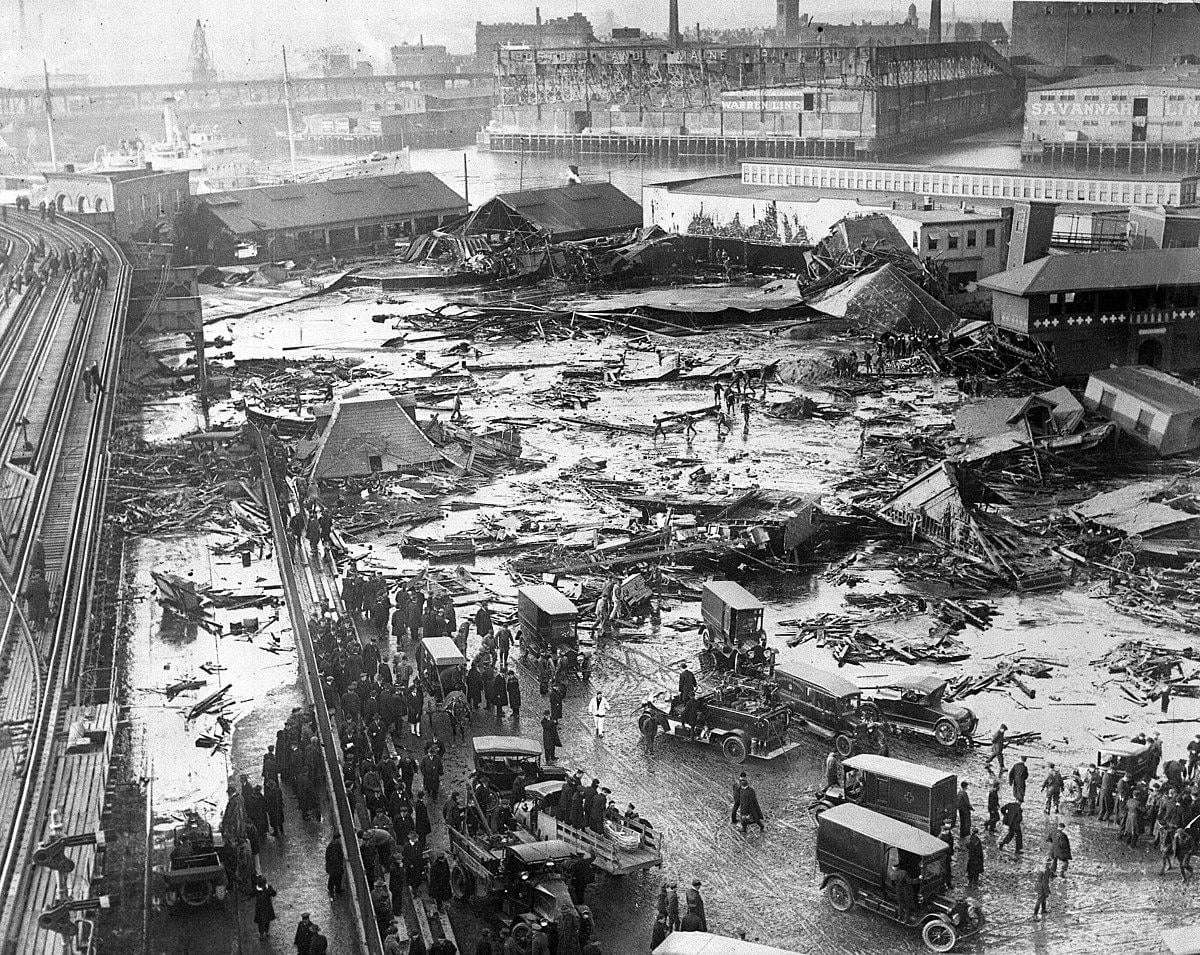
At about 12:30 p.m. on January 15, the molasses tank broke. 2.3 million gallons (8.7 million liters) of molasses spilled out onto Commercial Street.
The wave of molasses was 30 feet (9 meters) high and moved at 35 miles per hour (55 kph). Pieces of the tank flew into houses and broke holes in walls.
One piece flew into one of the pillars holding up an elevated train track and broke it. A train stopped just in time.
Because the molasses was sticky, people in it could not get out. When the tank first broke, some of the molasses was still hot, so it moved fast at first.
But it cooled down quickly in the cold winter air. So people and other animals fell into warm, soft molasses that got hard around them, and they could not get out.
When it covered people's noses and mouths, they could not breathe.
The molasses spread out to other streets. Soon, there was 2-3 feet (up to 1 meter) of molasses on the ground.
A police officer was in a signal box talking to his police group when the tank broke.
Because he was already sending a message to other police officers, he called for help right away.
Rescue workers came to the North End, but they could not walk or drive carts through the molasses.
Some rescuers tried to get a man out of the molasses by pulling on his arm. The molasses was so hard that they pulled his arm off by accident.

Doodlebug510 on April 29th, 2025 at 16:26 UTC »
15 January 1919, Boston, MA
What happened:
Source
Mittendeathfinger on April 29th, 2025 at 16:41 UTC »
List of Casualties.
Potential-Ad-2593 on April 29th, 2025 at 17:04 UTC »
First mustard, then ketchup, now molasses. A terrible day for the industry