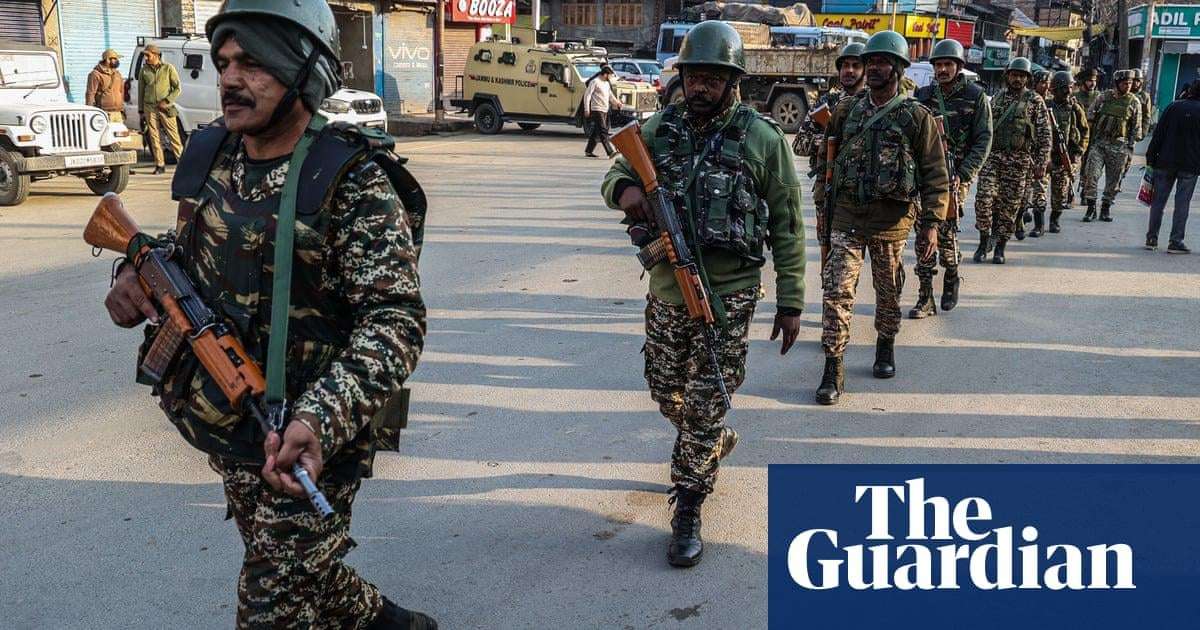
Troops from Pakistan and India exchanged fire overnight across the line of control in disputed Kashmir, officials have said, after the UN urged the nuclear-armed rivals to show “maximum restraint” after Tuesday’s massacre of Indian tourists by Islamic militants.
Relations have plunged to their lowest level in years, with India accusing Pakistan of supporting “cross-border terrorism” after gunmen carried out the worst attack on civilians in contested Muslim-majority Kashmir for a quarter of a century.
The brief exchange of small-arms fire came as police in Kashmir said they had identified three suspected attackers affiliated with the militant group Lashkar-e-Taiba they say were involved in Tuesday’s massacre of Indian tourists and released their sketches, announcing a bounty of 2m rupees (about £17,500) on the three.
A manhunt is under way in the densely forested mountains surrounding the attack site in southern Kashmir.
Syed Ashfaq Gilani, a government official in Pakistan-administered Kashmir, told Agence France-Presse on Friday that troops exchanged fire along the line of control that separates the two countries.
“There is post-to-post firing in Leepa valley overnight. There is no firing on the civilian population. Life is normal. Schools are open,” said Gilani, a senior government official in Jhelum valley district.
India’s army confirmed there had been limited firing of small arms that it said had been initiated by Pakistan, adding it had been “effectively responded to”.
Three Indian army officials told Reuters that Pakistani soldiers used small-arms to fire at an Indian position. The officials, who spoke on condition of anonymity in keeping with departmental policy, said Indian soldiers retaliated and no casualties were reported.
There was no immediate comment from Pakistan, and the incident could not be independently verified. In the past, each side has accused the other of starting border skirmishes in Kashmir, which both claim in its entirety.
India’s army chief, Gen Upendra Dwivedi, is to lead a high-level security review in Srinagar in Indian-held Kashmir on Friday, days after militants killed 26 civilians in the disputed region in one of the worst such attacks in years.
The brazen assault, carried out in a mountain meadow near Pahalgam, has derailed prime minister Narendra Modi’s claims of restored calm in the restive Himalayan territory and sent tensions soaring between nuclear-armed India and Pakistan.
The Indian army has launched sweeping “search-and-destroy” operations, deployed surveillance drones, and ramped up troop numbers across the Kashmir valley. The manhunt is searching for three suspects – one Indian national and two Pakistanis.
Early on Friday, authorities in Indian Kashmir demolished the houses of two suspected militants, one of whom is an accused in Tuesday’s attack, according to an official.
As tensions rise between the two countries, the UN has urged India and Pakistan to show restraint. The countries have imposed tit-for-tat diplomatic measures over a deadly shooting in Kashmir.
Relations have plunged to their lowest level in years, with India accusing Pakistan of supporting cross-border terrorism, after gunmen carried out the worst attack on civilians in contested Muslim-majority Kashmir in a quarter of a century.
“We very much appeal to both the governments … to exercise maximum restraint, and to ensure that the situation and the developments we’ve seen do not deteriorate any further,” the UN spokesperson, Stéphane Dujarric, told reporters in New York on Thursday.
“Any issues between Pakistan and India, we believe, can be and should be resolved peacefully through meaningful mutual engagement.”
1:10 Tensions escalate between India and Pakistan after Kashmir attack – video
Dwivedi’s visit to the regional capital underscores a sharp increase in military and diplomatic activity. India began large-scale air and naval drills on Thursday, which analysts say could pave the way for military action.
The Indian air force’s Gagan Shakti exercises, showcasing its Rafale jets and elite strike squadrons, have assumed added urgency, while the navy has intensified manoeuvres and test-fired a surface-to-air missile.
“There are many imponderables Modi must deal with, including the significant capabilities of the Pakistan army,” the veteran analyst C Raja Mohan wrote in the Indian Express. “But given the horrific nature of the attack and the outrage that has convulsed the nation – the victims came from 15 states across India – the PM may have no option but to explore some major risks.”
On the diplomatic front, India’s foreign secretary, Vikram Misri, briefed envoys from 25 countries, including key G20 partners, Gulf states and, notably, China. Beijing’s inclusion, despite strained ties, was seen as an attempt to build broader global consensus.
View image in fullscreen Supporters of the Indian Secular Front, along with others, stage a protest over the killing of more than 25 tourists at Pahalgam. Photograph: Rupak De Chowdhuri/NurPhoto/Rex/Shutterstock
India presented what it called “clear evidence of cross-border complicity”. An obscure group calling itself the Resistance Front has claimed responsibility for the attack. Indian officials say it is a proxy for the Pakistan-based Lashkar-e-Taiba or a similar outfit. Islamabad denied involvement, accusing India of failing to provide proof.
On Thursday, Modi promised to capture the gunmen responsible for killing 26 civilians, after Indian police identified two of the three fugitive assailants as Pakistani.
“I say to the whole world: India will identify, track and punish every terrorist and their backer,” the prime minister said, in his first speech since Tuesday’s attack in the Himalayan region. “We will pursue them to the ends of the Earth.”
Denying any involvement, Islamabad called attempts to link Pakistan to the Pahalgam attack “frivolous” and vowed to respond to any Indian action.
“Any threat to Pakistan’s sovereignty and to the security of its people will be met with firm reciprocal measures in all domains,” a Pakistani statement said, after the prime minister, Shehbaz Sharif, held a rare national security committee meeting with top military chiefs.
Kashmir has been divided between India and Pakistan since its independence in 1947, with both claiming the territory in full but governing separate portions of it.
Rebel groups have waged an insurgency in Indian-controlled Kashmir since 1989, demanding independence or a merger with Pakistan.
1:17 Manhunt launched after 26 tourists killed by suspected militants in Kashmir – video
A day after the attack, New Delhi suspended a water-sharing treaty, announced the closure of the main land border crossing with Pakistan, downgraded diplomatic ties, and withdrew visas for Pakistanis.
In response, Islamabad ordered the expulsion of Indian diplomats and military advisers on Thursday, cancelling visas for Indian nationals – with the exception of Sikh pilgrims – and closing the main border crossing from its side.
Pakistan also warned any attempt by India to stop the supply of water from the Indus River would be an “act of war”.
Agence France-Presse and Reuters contributed to this report
notorious_eagle1 on April 25th, 2025 at 11:35 UTC »
This pretty much sums it up. Over the last few days, there’s been a disturbing level of enthusiasm from some Indian voices. openly fantasizing about turning Pakistan into Gaza, cutting off our water supply, starving millions, and blockading Karachi and Gwadar as if this were some video game scenario. The idea of boarding or sinking foreign-flagged vessels doing lawful trade with Pakistan has been tossed around like it’s a casual flex, not an act of war with global consequences.
But here’s the reality check: any military action taken by India will not go unanswered. Pakistan will respond. Escalation cuts both ways, and no side holds a monopoly on pain or retaliation. If you’re willing to start something, be prepared for the consequences, because this region doesn't run on fantasies, it runs on balance, deterrence, and hard truths.
Sumeru88 on April 25th, 2025 at 09:57 UTC »
After the 1971 war, India and Pakistan signed a peace treaty. This is known as Shimla Agreement. Yesterday, Pakistan, decided to suspend it. But does that mean that we are now technically at war with Pakistan (the continuation of 1971 war)? It would be pretty neat if that's the case since we wouldn't even be violating the UN Charter now by attacking Pakistan if we are already at war. (Pakistan was the one who had initiated hostilities in 1971 war)
Mundane-Laugh8562 on April 25th, 2025 at 09:32 UTC »
SS: Troops from Pakistan and India exchanged fire overnight across the line of control in disputed Kashmir, officials have said, after the UN urged the nuclear-armed rivals to show “maximum restraint” after Tuesday’s massacre of Indian tourists by Islamic militants.
Relations have plunged to their lowest level in years, with India accusing Pakistan of supporting “cross-border terrorism” after gunmen carried out the worst attack on civilians in contested Muslim-majority Kashmir for a quarter of a century.
Syed Ashfaq Gilani, a government official in Pakistan-administered Kashmir, told Agence France-Presse on Friday that troops exchanged fire along the line of control that separates the two countries.
“There is post-to-post firing in Leepa valley overnight. There is no firing on the civilian population. Life is normal. Schools are open,” said Gilani, a senior government official in Jhelum valley district.
India’s army confirmed there had been limited firing of small arms that it said had been initiated by Pakistan, adding it had been “effectively responded to”.
India began large-scale air and naval drills on Thursday, which analysts say could pave the way for military action.