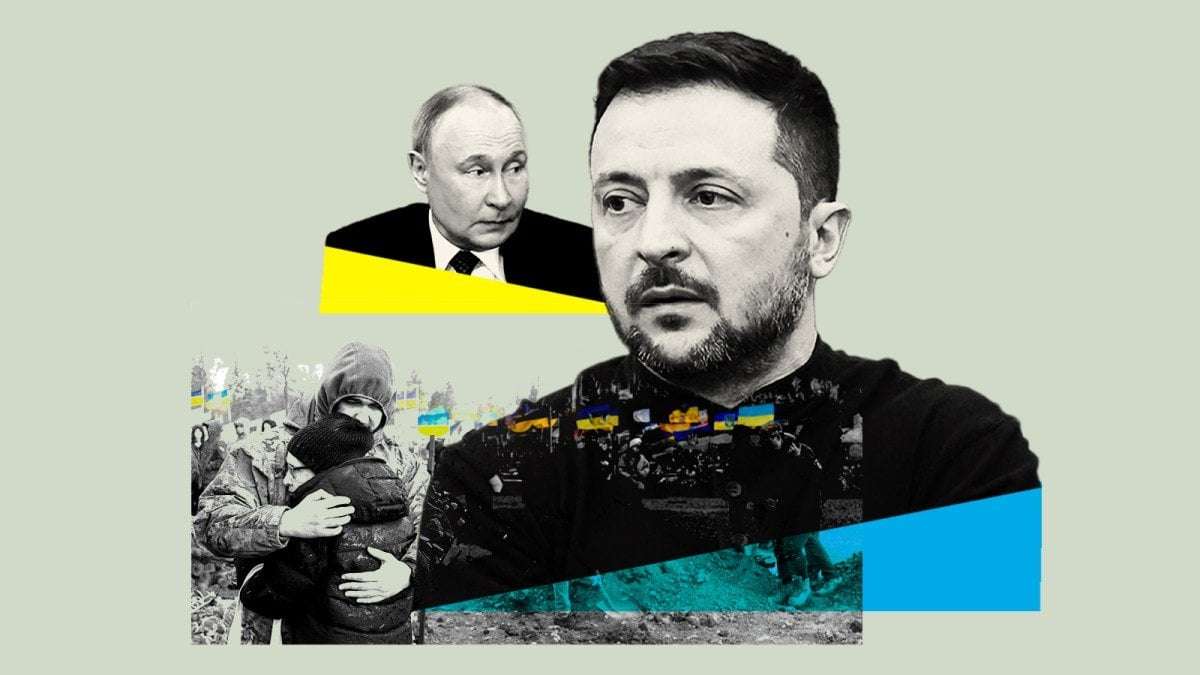
Unusually, this year the Western and Orthodox religious calendars coincide and Easter is celebrated at the same time. The White House was said to be aiming, perhaps symbolically, for a truce in Ukraine by the festival. But as it is marked on Sunday across the globe, the war rages on.
Despite Moscow’s surprise proposal on Saturday — to halt all hostilities in the east for 30 hours, from 6pm local time until midnight on Monday, a gesture he also made in Christmas 2023 — the Kremlin simultaneously admitted Russian forces were moving forwards.
This statement is unlikely to be aimed principally at President Trump but rather a domestic audience. If Ukraine refuses to join the ceasefire, President Putin will use it to demonise Kyiv. If it does, he can present himself as the man of peace and a Christian leader. Either way, guns will be firing come Monday.
• Russia declares 30-hour ‘Easter ceasefire’ with Ukraine
Both Russia and the United States suggest that the window of opportunity for negotiations may be closing. On Friday night President Trump said he would “take a pass” on attempting to broker peace in a matter of days if progress was not made soon.
The consensus is that April 30, the end of Trump’s first hundred days in office, is when the current peace process runs out of road. As is, this looks like a four-way game of chicken, with Moscow, Kyiv, Washington and Brussels all hardening their positions rather than making real compromises.
President Putin met Steve Witkoff, Donald Trump’s special envoy, in Saint Petersburg on April 11 GAVRIIL GRIGOROV/SPUTNIK/REUTERS
Although there is a sense that Trump cannot be kept waiting for ever, Moscow is so far unwilling to make any concessions. Yet because of Putin’s apparent conviction that he is winning the war, even to be talking of peace is a concession — but the Kremlin is dreaming of a deal much larger than just over Ukraine.
Steve Witkoff, Trump’s envoy to Russia, hinted at this when he admitted that his talks with Putin included not just Ukrainian territory but even Nato and its article 5 mutual security guarantee. For the Russian president, it seems a once-in-a-lifetime opportunity to reshape Europe’s security architecture and restore Russia as a great power. This may well prove to be a delusion, but one powerful enough that Putin seems willing to test the apparent April 30 deadline in the hope of attaining it.
Not everyone in Moscow agrees. To many, Putin risks squandering a chance to end the war on favourable terms before conditions become much more difficult next year, as Soviet-era stocks of old tanks that can be reconditioned run out, and the economy begins to strain.
Sergey Lavrov, Russia’s foreign minister, believes peacemakers are quietly sabotaging Putin GAVRIIL GRIGOROV/SPUTNIK/REUTERS
There is now a behind-the-scenes struggle as hawks and peacemakers compete to try to win Putin’s ear. In a sign of the times, Sergey Lavrov, the foreign minister, openly rounded on the latter as “fifth columnists” who pretend to be “loyal to Putin, nodding at everything he says”, but who are actually “quietly sabotaging” everything he has achieved.
There is a similar split in the US administration. While Witkoff gushes that “we might be on the verge of something that would be very, very important for the world at large”, Marco Rubio, the secretary of state, warned on Friday that “if it is not possible to end the war in Ukraine, we need to move on”, and that this needs to be determined in “a matter of days”. Trump himself later said he was ready to “take a pass” on the peace process unless a deal is reached “very shortly”.
More than just the existing struggle between the isolationists and interventionists, this betrays a growing sense that the prospective “return on investment” of the whole process may not be worth the effort. As one British diplomat observed, “Trump wanted a quick deal. A month ago, Witkoff was driving the process, but he is not as dominant these days” as sceptics like Rubio and Keith Kellogg, Trump’s envoy to Ukraine, come to the fore.
Marco Rubio’s comments, after his meeting with foreign ministers in Paris this week, suggested the US would walk away from peace talks if no progress was made FREDDIE EVERETT/US STATE DEPARTMENT PHOTO/ALAMY LIVE NEWS
Moscow may be able to keep Trump engaged with nebulous promises and empty gestures like an Easter truce. Already, there has been talk of joint exploitation of Arctic oil and gas and Russian rare earths, of big orders for civilian airliners from the troubled US aerospace giant Boeing, and even allowing US companies forced out of the Russian market to recoup their losses.
Trump’s head could be turned by what Russia has to offer him, dwarfing Ukraine’s mineral assets THE MEGA AGENCY
The real prizes might be geopolitical, if Moscow is willing to offer up its close relationships with Iran or North Korea. As one US national security official admitted, “If Russia was ready to distance itself from Tehran, especially if quietly to let us know what it knows about its nuclear programme, that would be huge… Even huger,” he added wryly, “than Ukrainian minerals”.
The Ukrainian government is becoming more sure-footed in handling the new White House. It initially furiously rejected Trump’s deal for joint exploitation of Ukraine’s natural resources. “I’m not signing something that ten generations of Ukrainians are going to pay later,” President Zelensky said, but this week the government bowed to the inevitable and signed a preliminary memorandum of understanding. Denys Shmyhal the prime minister of Ukraine, will visit Washington next week to meet with Scott Bessent, the US Treasury secretary, to finalise the agreement.
Ukraine and the US have made progress on a deal which at one point looked unlikely THE TIMES PHOTOGRAPHER JACK HILL
This includes none of the security guarantees Zelensky wanted. Trump claimed they were unnecessary because Putin would not risk further attacks once American firms were active on the ground. The presence of American firms did not deter Putin in 2022. In an age when US assistance cannot be relied on, only rented, Kyiv is gambling that its new tone and the mineral deal will be enough to keep America on side.
One uncertainty is whether the deal would jeopardise Ukraine’s prospects of joining the European Union, which it sees as offering both economic advantage and a second-best kind of security guarantee. The memorandum says that the US will not hinder this process, but it is still possible that the specific terms may cause problems by giving US companies privileged access to resources and contracts.
Rubio urged European countries to remain engaged with the US-led peace efforts JULIEN DE ROSA/REUTERS
If that does happen, Brussels is unlikely to give ground. Ever since Trump’s accession, its position and rhetoric have hardened. Ursula von der Leyen, the European Commission president, raised eyebrows on Wednesday with her bold claim that “the West as we knew it no longer exists”.
Despite the misgivings of many member states, Brussels is maintaining a tough line in support of Ukraine but also often in opposition to the US position. This is not simply out of conviction, but also a sense that, in an age of tariff wars and potential American disengagement from Europe, it needs to fight its corner.
What happens if Washington decides this is not the time to strike a deal? The implication is that the US will walk away not just from the process, but the whole war. Rubio said that if a peace deal doesn’t seem “doable” then “I think the president is probably at a point where he’s going to say ‘we’re done’”, adding: “It’s not our war.”
Other officials have been trying to downplay this, saying that there was no threat to leave Kyiv high and dry. This is another indication of a lack of any clear consensus within the administration. One White House official admitted that there were those trying to persuade the president that he would look weak if he did not maintain or increase support for Kyiv, and “those of us who think we’ve done our bit frankly look forward to seeing the Europeans having to make good on their bold words. This is a European problem”.
On Saturday morning, former British defence secretary Ben Wallace, suggested Trump is “prepared to walk away because he is not actually very good at doing deals” but agreed that Europe can indeed “step up further” in its support for Ukraine.
The war has continued, largely unabated, despite renewed efforts for peace talks and ceasefires EPA
Russia is not compromising because it hopes to force a wider deal. The US is not compromising because it is losing interest. Kyiv feels it cannot offer what Moscow demands, and Brussels is trying to assert itself as a serious geopolitical player. With no one seemingly willing to give ground, the next fortnight may prove to be another turning point in the war.
Yet, away from the apparent impasse a shift may have already occurred. Despite talk of grand bargains and “permanent peace”, the proposals for even a temporary ceasefire that emerged from talks in Paris with Rubio, Witkoff and European leaders are similar to those raised as far back as 2022.
In this version of events Russia remains in control of the occupied territories but with no legal title to them. Ukraine is excluded from Nato but retains its sovereignty. Some sanctions relief is offered to Russia while Ukraine is given access to $300 billion (£225 billion) of frozen Russian sovereign assets to help rebuild. A deal, in short, that leaves no one truly happy.
Mutual dissatisfaction is often the price of peace.
Professor Mark Galeotti’s latest book, Forged in War: A Military History of Russia from its Beginnings to Today, is published by Osprey/Bloomsbury
diggitythedoge on April 19th, 2025 at 21:19 UTC »
Either Europe confronts Russia now while it is still strong, or it prevaricates and allows the hybrid war to continue, and Putin will know when the moment of weakness arrives.
Tammer_Stern on April 19th, 2025 at 18:28 UTC »
I think this is looking like the earlier chats on geopolitics where we note that the Trump Administration is made up of low calibre politicians. Unfortunately for the US, Russia and China are not led by donkeys and are one step ahead, at all times.
When Kellog and Rubio come back from negotiations I’m reminded of the Jedi mind trick from Star Wars as they say how it’s Ukraine’s fault, no NATO for Ukraine etc.
It would not be easy to solve the war. Only skilful negotiations or an absolute show of might would cause Russia to pause. Unfortunately, the US is looking like the schoolyard bully who has no real fighting skills other than brute strength and quickly gets bored when things get difficult.
TimesandSundayTimes on April 19th, 2025 at 18:13 UTC »
Unusually, this year the Western and Orthodox religious calendars coincide and Easter is celebrated at the same time. The White House was said to be aiming, perhaps symbolically, for a truce in Ukraine by the festival. But as it is marked on Sunday across the globe, the war rages on.
Despite the Kremlin’s surprise proposal on Saturday — to halt all hostilities in the east for 30 hours, from 6pm local time until midnight on Monday, a gesture he also made in Christmas 2023 — the Kremlin simultaneously admitted Russian forces were moving forwards.
Both Russia and the United States suggest that the window of opportunity for negotiations may be closing. On Friday night President Trump said he would “take a pass” on attempting to broker peace in a matter of days if progress was not made soon.
The consensus is that April 30, the end of Trump’s first hundred days in office, is when the current peace process runs out of road. As is, this looks like a four-way game of chicken, with Moscow, Kyiv, Washington and Brussels all hardening their positions rather than making real compromises