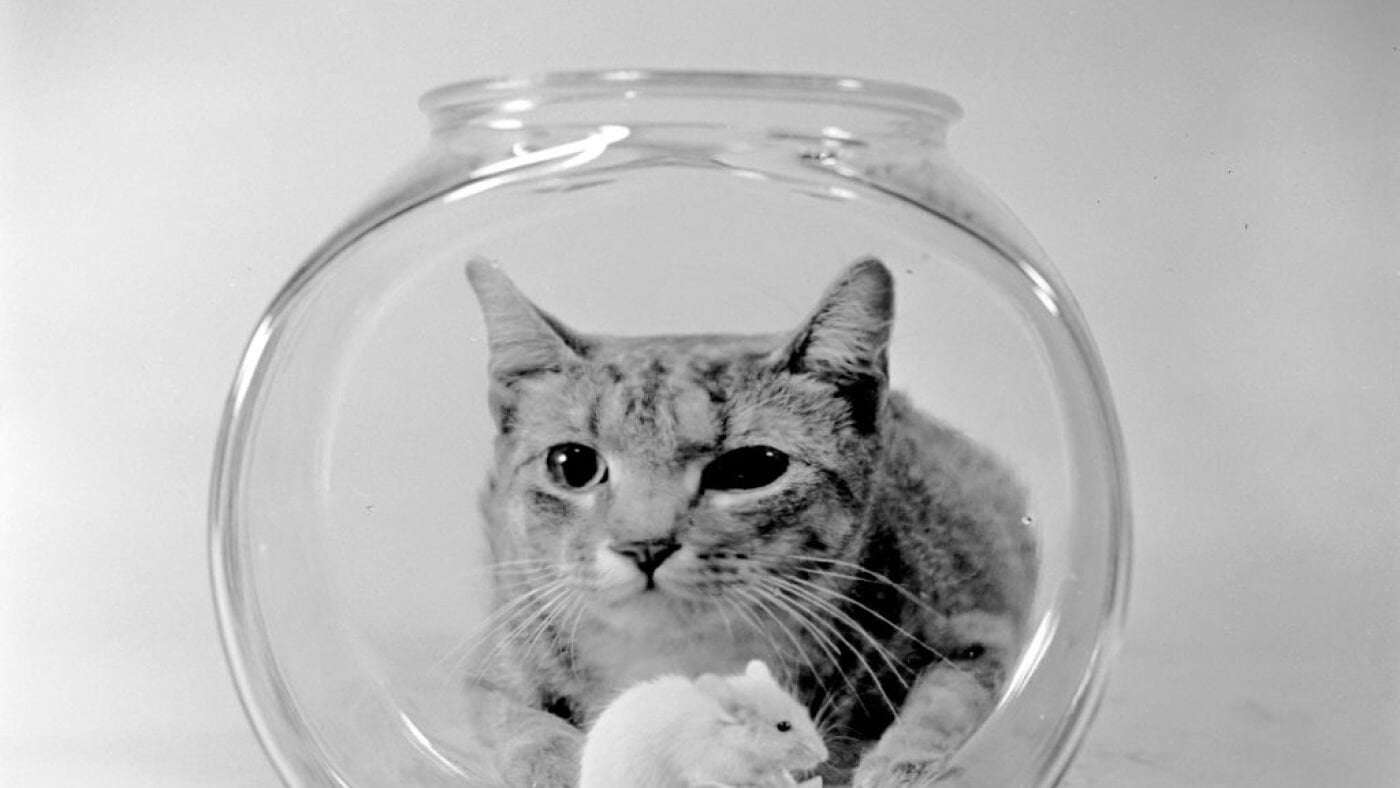
These scientists are building a cat database to understand why they act like that
toggle caption Three Lions/Getty Images/Hulton Archive
Notice that quirky thing your cat always does?
Maybe it loses its mind when you try to eat a piece of whole wheat bread without sharing; races around the house at full speed after using the litterbox or perhaps insists on sitting in that one spot filled with delicate papers you'd rather they didn't touch.
Over time, you've come to accept these unique characteristics of the various cats that share your life here on Earth. But scientists at the Broad Institute of MIT and Harvard, along with UMass Chan Medical School are working on the Darwin's Cats project. Their goal is to build a comprehensive database that answers many questions about the behavioral and genetic traits of our friendly felines.
Listen to NPR's Short Wave podcast for more discoveries, everyday mysteries and the science behind the headlines.
If this concept sounds familiar, it's probably because the same company, Darwin's Ark, previously conducted a similar project focused on dogs. For this iteration, volunteer cat owners will collect fur samples and mail them in, along with completing a series of surveys about their little fur babies' behavior.
The project aims to recruit 100,000 participating cats by June of 2026. Once the sample collection period is over, the researchers behind the Darwin's Cats project will sequence the DNA of their sample population to investigate the genetic influences on various cat traits, behaviors and health issues.
The goal, according to their website, is to build the largest database of feline behaviors and genetics to help answer many of our unanswered questions about cats. This includes insights into their physical traits, behavioral evolution, the health challenges our kitties faces and the factors contributing to those issues.
According to Darwin's Ark, nearly 5,000 cats have been registered for the project since 2024.
Curious cat owners can sign up here, but it's important to know that the organization requests a $150 donation per cat to help fund research and cover for the sequencing costs.
There's still so much we don't know about cats and their behaviors. For instance, why does my cat only care for whole wheat bread while ignoring white bread?
Hopefully, the pursuit of science will give us some real answers to real questions. Like why an internet-famous cat named Monkey has such a mischievous little smile.
I wake up to this sinister smile every morning pic.twitter.com/I5mnKVErbS — oreo & monkey (@oreoeocat) February 1, 2025
SpottyNoonerism on March 21st, 2025 at 02:55 UTC »
You think we slipped into bizarro universe when they turned on the LHC? Understanding cats is one of those, "You can't know the ultimate answer AND the ultimate question in the same universe" sort of things.
If these troublemakers actually unlock the answer to why cats do cat stuff, things are going to get even weirder.
jlaine on March 21st, 2025 at 02:53 UTC »
When you can sequence out the space where the little demons get in my way at the most awkward times, I may consider a purebred lol
214txdude on March 21st, 2025 at 02:31 UTC »
This is awesome