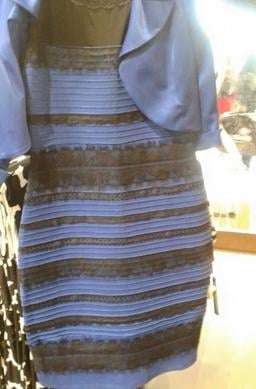
If anyone is curious, a researcher looked into this and found that due to the poor image quality, with uncertain lighting and lacking context on the dress and the surroundings, it makes peoples brains interpret what they see differently.
The usually deciding factor between whether your brain goes blue and black or white and gold is the light conditions you are most habituated to, or have recently been exposed a lot to.
Whether you are most used to indoor lighting and artificial light, or outdoor and natural light. If I remember correctly indoor lighting makes people more likely to interpret the colours as blue and black.
Basically, when your brain isn't quite sure what colour it's supposed to see, it will lean on past experience to decide what it's looking at. It guesses and then sees it as that colour without bothering to inform the conscious you about the fact that there was ever a question about what colour it was to begin with.
If the photo had been better quality and/or you had seen more of the surroundings so you could see whether it was indoor or outdoors and what other familiar objects and materials looked like in these light conditions, then this wouldn't have happened because there would be enough visual clues so peoples brain didn't have to do a guesstimate game.
It was very interesting to the researcher because up until that time they didn't know that was something our brains could do with colours. That people, without colour blindness, can look at the same exact image and see such drastically and completely different colours. He said in his field it was a bit like being told they had found a new human organ that nobody had spotted before.

Cloverleafs85 on March 21st, 2025 at 09:49 UTC »
If anyone is curious, a researcher looked into this and found that due to the poor image quality, with uncertain lighting and lacking context on the dress and the surroundings, it makes peoples brains interpret what they see differently.
The usually deciding factor between whether your brain goes blue and black or white and gold is the light conditions you are most habituated to, or have recently been exposed a lot to.
Whether you are most used to indoor lighting and artificial light, or outdoor and natural light. If I remember correctly indoor lighting makes people more likely to interpret the colours as blue and black.
Basically, when your brain isn't quite sure what colour it's supposed to see, it will lean on past experience to decide what it's looking at. It guesses and then sees it as that colour without bothering to inform the conscious you about the fact that there was ever a question about what colour it was to begin with.
If the photo had been better quality and/or you had seen more of the surroundings so you could see whether it was indoor or outdoors and what other familiar objects and materials looked like in these light conditions, then this wouldn't have happened because there would be enough visual clues so peoples brain didn't have to do a guesstimate game.
It was very interesting to the researcher because up until that time they didn't know that was something our brains could do with colours. That people, without colour blindness, can look at the same exact image and see such drastically and completely different colours. He said in his field it was a bit like being told they had found a new human organ that nobody had spotted before.
Wotmate01 on March 21st, 2025 at 09:51 UTC »
It's clearly laurel.
ktr83 on March 21st, 2025 at 10:01 UTC »
I love how the Wikipedia page for this is titled nothing more than "The Dress". And everyone knows exactly which dress it's referring to and why.