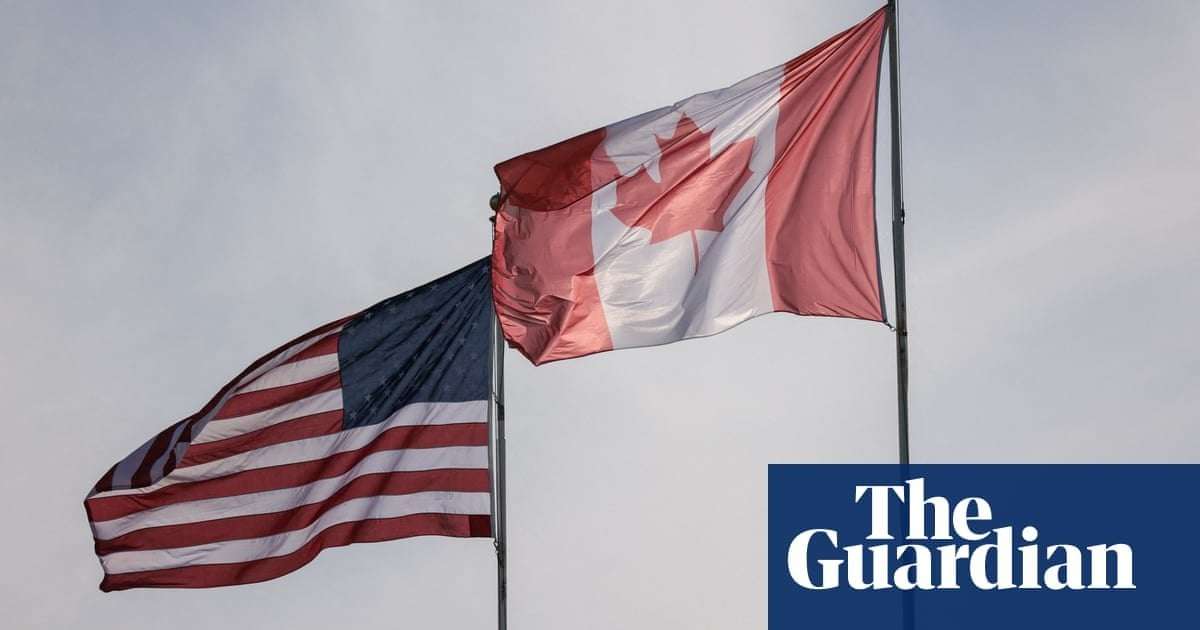
Canadians who visit the US for more than 30 days will be required to register with authorities and have their fingerprints taken, as the Trump administration tightens migration rules amid soaring tensions between the North American neighbors.
The new requirement, effective from 11 April, will harden enforcement of an existing law, which states that all foreign nationals 14 years old or older who plan to stay in the US for 30 days or more must register with the authorities.
In practice, that rule has not been applied consistently to Canadians entering the United States across the 5,525-mile land border between the two countries.
On his first day in office in January, Donald Trump signed an executive order directing US authorities to enforce the rule. “Failure to comply may result in criminal and civil penalties, up to and including misdemeanor prosecution, the imposition of fines, and incarceration,” the order said.
The move marks a further deterioration in ties between the historical allies since Trump returned to power. Trump has meanwhile repeatedly called for Canada to become the 51st US state – a taunt seen by some north of the border as an annexation threat.
The new rule was published on the Federal Registrar on Wednesday as fresh US tariffs of 25% came into effect on steel and aluminum – widely seen as a blow to Canada, which already faces a separate 25% levy on other goods. Canada, in turn, announced retaliatory tariffs on nearly C$30bn worth of American imports.
It will probably affect the estimated 900,000 Canadians – known colloquially as “snowbirds” – who spend winters in warmer southern US states such as Florida, Texas and South Carolina.
The Department of Homeland Security estimates that between 2.2 million and 3.2 million people will be affected by the new visitor registration rules.
The immigration attorney Rosanna Berardi said: “It’s important to clarify that this measure specifically impacts Canadian citizens crossing land borders who intend to remain in the United States for periods exceeding 30 days.
skip past newsletter promotion Sign up to This Week in Trumpland Free newsletter A deep dive into the policies, controversies and oddities surrounding the Trump administration Enter your email address Sign up Privacy Notice: Newsletters may contain info about charities, online ads, and content funded by outside parties. For more information see our Newsletters may contain info about charities, online ads, and content funded by outside parties. For more information see our Privacy Policy . We use Google reCaptcha to protect our website and the Google Privacy Policy and Terms of Service apply. after newsletter promotion
“Casual travelers visiting for tourism or shopping will not be affected. However, Canadian business professionals who regularly enter the US for extended assignments will now face these new registration requirements,” she told ABC, which first reported the new requirement.
graphomaniacal on March 13rd, 2025 at 17:03 UTC »
The USA had Clinton, Canada had Chretien. The US economy was roaring, and the dot com boom was just taking off. And I learned in geography class that our nations had the largest friendly border in the world.
Five years later the worst terrorist attack on US soil occurred. 15 of the hijackers were Saudi nationals. None of the terrorists entered through the Canadian border. For the first and only time, the USA invoked Article 5 of NATO, and Canada fought alongside the US for damn near two decades in Afghanistan. 165 of our boys died fighting for the US.
Today the Trump administration - after bungling the Afghan pullout and cutting a deal with the enemy Taliban, one of the world's most repressive regimes - now takes a friendlier attitude to Saudi Arabia than it does Canada. A sickening betrayal and a reversal on more than a century of friendship that will harm Canada, but it will also do the USA more harm than good.
shadrap on March 13rd, 2025 at 16:31 UTC »
Canadians who come and stay for more than 30 days are likely to be wealthy snowbirds.
Discouraging them from visiting and treating them like criminals is a weird strategy.
Do Canadians suddenly become criminal troublemakers after 30 days?
A lot of European, Pacific, and Central and South American beach towns thank the USA for the boost in polite, wealthy tourists.
gbroon on March 13rd, 2025 at 16:11 UTC »
Canada to employ large handed border agents to cavity search US visitors.