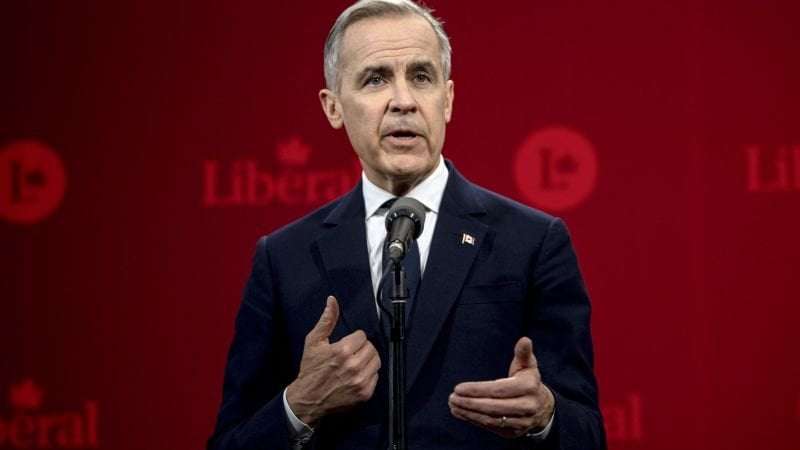
Mark Carney has been elected leader of Canada’s Liberal Party in a months-long, high stakes race to replace Justin Trudeau.
He will now be expected to lead the party into the next federal elections – which must be held before October, but could be called much earlier – where he is likely to face stiff competition from the Conservative party, which is currently leading in the polls.
While Carney will take over immediately as Liberal Party leader, Trudeau will remain as Canada’s prime minister for an as-yet undisclosed transitional period while his successor settles in.
One of the biggest issues in Carney’s immediate inbox will be the country’s souring relations with the United States.
US President Donald Trump has repeatedly blamed Canada for illegal immigration into the US, threatened to turn Canada into a 51st state, and impose steep tariffs on Canadian imports, which the White House says is necessary to stem the flow of fentanyl over its borders.
In his first remarks following the result of the vote, Carney referenced the tensions with the US, saying his government would “create new trading relationships with reliable trading partners.” He also vowed to keep retaliatory tariffs on the US “until the Americans show us respect.”
“New threats demand new ideas and a new plan,” he told the Liberal Party convention on Sunday.
Slamming the Trump administration’s tariff plans, Carney said of the US president, “He’s attacking Canadian families, workers, and businesses and we cannot let him succeed and we won’t.”
“In trade as in hockey, Canada will win,” he added.
The ripple effects of the tense relations with the US have spread through Canadian society, with fans at NHL and NBA games in Canada even booing the US national anthem.
Carney will now face off with Conservative leader Pierre Poilievre, who has previously been compared to Trump but now seeks to distance himself from the US leader, reiterating at a press conference earlier this week that he is “not MAGA.”
At a rally on Sunday ahead of the Liberal vote, Poilievre delivered scathing remarks about Carney, a former governor of both the Bank of England and Bank of Canada, portraying him as a leader ill-equipped to deal with Trump.
“Working for Trudeau, Carney made Canada weaker and poorer; working for himself Carney made the United States richer and stronger,” Poilievre said.
In his remarks following the results of the vote, Carney shot back at his conservative opponent.
“Donald Trump thinks he can weaken us with his plan to divide and conquer. Pierre Poilievre’s plan will leave us divided and ready to be conquered,” Carney said.
In recent weeks, the lead enjoyed by the Conservatives has narrowed as Trudeau, Carney and other Liberal Party figures have taken strong positions on the trade dispute with the US.
Trudeau has led the party for over a decade. He took the Liberals to power in 2015, promising “sunny ways” for Canada and was elected two more times, most recently in 2021, when he remained in power but lost his governing majority.
Trudeau’s impending departure follows a series of political crises, rising economic discontent and the surprise resignation of his deputy prime minister and finance minister Chrystia Freeland – who was also in the race to succeed him.
In some of his last remarks as Liberal Party leader, Trudeau warned Sunday that Canadians face an “existential challenge” from the US.
“This is a nation-defining moment,” he told the Liberal leadership convention in Ottawa, ahead of Carney being announced as his successor.
“And now, as Canadians face from our neighbor an existential challenge, an economic crisis, Canadians are showing exactly what we are made of,” Trudeau said.
Carney started his career in finance and in 2019 he was appointed UN Special Envoy for Climate Action and Finance. Drawing on his background, Carney has made clean energy, climate policies and economic prosperity for Canada some of the central facets of his campaign
Raised in Edmonton, Alberta, when launching his campaign, Carney highlighted his role in helping the government address its debt during the 2008 financial crisis – and his role in navigating Britain’s economy through Brexit.
Carney has zeroed in on bringing economic prosperity to Canada with the help of its natural resources like critical minerals and making Canada a leader in clean energy, stressing that being low-carbon will help Canada be more competitive. He has proposed shifting the financial burden of the carbon tax from consumers to big corporations and has said that under his leadership, the tax Canadian consumers and small businesses pay on fuel would be replaced with incentives to reduce carbon emissions.
Carney has not shied away from questions on how to tackle the Trump administration.
Since the US tariffs were announced last month, Carney has been an outspoken proponent of dollar-for-dollar retaliatory tariffs that would hit the US hard but have minimal impact on Canada.
After Trump’s tariff announcement and accusations of fentanyl trafficking from Canada into the US, Carney told CNN last month he was “offended” given Canada’s long friendship with the US.
“We are a proud, independent nation. We view ourselves as the greatest country on Earth. We have been insulted on multiple occasions by senior members of the administration. We are not going to reciprocate in those insults.”
This is a developing story and will be updated.
DrNick1221 on March 9th, 2025 at 23:59 UTC »
Dude won with 86% on the first ballot.
And that's against 3 other contenders. A complete and utter blowout.
Final tally was:
Mark Carney - 85.88% Chrystia Freeland - 7.96% Karina Gould - 3.21% Frank Baylis - 2.96%TheSleepingPoet on March 9th, 2025 at 23:41 UTC »
PRÉCIS:
Mark Carney Takes Helm of Canada's Liberals as US Tensions RiseMark Carney has been elected leader of Canada’s Liberal Party, succeeding Justin Trudeau in a closely contested race. The former Bank of Canada and Bank of England governor now faces the challenge of leading his party into a federal election that must be held before October but could come much sooner. With the opposition Conservatives currently leading in the polls, Carney will need to quickly assert himself as a capable leader.
One of his most pressing issues will be Canada’s strained relationship with the United States. President Donald Trump has blamed Canada for illegal immigration, threatened severe tariffs on Canadian imports, and even suggested incorporating Canada as the fifty-first US state. Carney has responded forcefully, pledging to maintain retaliatory tariffs against the US until the White House treats Canada with respect. He has framed his leadership as a fresh approach to modern challenges, declaring that Canada will not back down.
The political landscape remains volatile. Conservative leader Pierre Poilievre, often compared to Trump in the past, is now keen to distance himself from the US president. He has launched blistering attacks on Carney, accusing him of enriching the US while weakening Canada during his time in global finance. However, the Liberals have gained ground in recent weeks, with Trudeau and Carney rallying public support through strong rhetoric against Trump’s trade policies.
Carney, raised in Edmonton, has built his campaign around economic strength, clean energy, and national prosperity. He plans to shift the financial burden of the carbon tax from consumers to large corporations and use Canada’s wealth of natural resources to its advantage. His experience in navigating the 2008 financial crisis and Brexit has been a cornerstone of his appeal.
Tensions between Canada and the US have spilt into public sentiment, with American national anthems being booed at Canadian sporting events. Carney remains defiant, insisting that Canada is a proud and independent nation that will not be bullied. With the political stakes high and an election looming, his ability to navigate both domestic and international turbulence will be put to the test.
Soronya on March 9th, 2025 at 23:33 UTC »
Trump will somehow claim he got Trudeau to step down...I'm waiting for it.